For nearly two centuries, the theory of evolution has stood as one of science’s most powerful explanatory frameworks — and one of religion’s most persistent challenges. Since Charles Darwin published On the Origin of Species in 1859, believers across faith traditions have grappled with how to reconcile their sacred texts with a theory that suggests humans share common ancestors with apes.
But a paper offers hope for Muslims navigating this contentious terrain. Published in the journal Religions, the study presents a “theology-centric approach” that could transform how Islamic educators and students engage with evolutionary science.
The stakes could hardly be higher. Research across Muslim-majority nations from Indonesia to Turkey, and Muslim-minority communities from Britain to the United States, consistently shows that Muslims tend to reject evolution more than adherents of other faiths. In many contexts, evolution is viewed not as science but as a threat to faith itself.
Yet Malik’s analysis suggests this need not be the case. By carefully examining Islamic theology (aqida) alongside the actual claims of evolutionary science, he demonstrates that Muslims have multiple intellectually viable options for relating their faith to evolution — options that preserve theological integrity while engaging honestly with scientific evidence.
The Science: What Evolution Actually Claims
Before any theological discussion can begin, Malik emphasizes the importance of understanding what evolution actually says — and what it doesn’t.
“Evolution carries a lot of colloquial connotations that do not accurately correlate to the scientific understanding,” he writes.
The theory of evolution, as understood in contemporary biology, rests on three core propositions:
- Deep time: Earth is approximately 4.6 billion years old
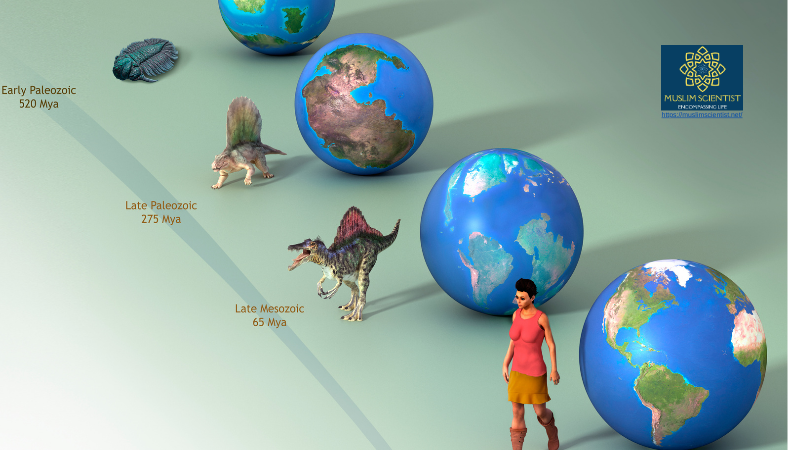
- Common ancestry: All biological life is interconnected through a long historical lineage, like a vast family tree
- Mechanisms: Evolution occurs through random genetic mutations filtered by natural selection
Notably, evolution does NOT claim that “humans come from monkeys” — a common misconception. Rather, humans and chimpanzees share a common ancestor that lived millions of years ago. Evolution also does not address how life began (that’s abiogenesis), only how life diversified once it existed.
The Challenge: Why Muslims Struggle with Evolution
Malik’s paper synthesizes decades of research to identify why evolution proves particularly challenging in Muslim contexts. The obstacles are multiple and interconnected.
Table 1: Key Challenges Muslims Face with Evolution
| Challenge Type | Specific Issue | Impact |
|---|---|---|
| Scientific misunderstanding | Evolution seen as linear (“humans from monkeys”) | Rejection based on incorrect understanding |
| Nature of science confusion | Evolution dismissed as “just a theory” | Failure to recognize scientific consensus |
| Cultural factors | Evolution associated with Western/secular values | Resistance as identity preservation |
| Theological concerns | Apparent conflict with Adam and Eve narrative | Fear of losing faith |
| Atheist appropriation | New Atheists use evolution to attack religion | Evolution seen as inherently atheistic |
The last point carries particular weight. Figures like Richard Dawkins have explicitly argued that one cannot be both an evolutionist and a religious person. For Muslims already concerned about preserving their faith, such polemics make evolution seem like a direct assault on Islam itself.
“Evolution is seen as an argument against theism in two ways,” Malik explains. First, if science explains biological origins, “what need do we have for God?” Second, evolution appears to contradict scriptural accounts of Adam and Eve as the first humans, miraculously created.
The Theology-Centric Approach: A Way Forward
Malik’s innovation is to shift the conversation’s center of gravity. Rather than getting mired in scientific debates or philosophical nuances about the nature of science, he argues for placing theology front and center.
“The function of theology is to safeguard one’s beliefs so that one has attained salvation in the eschaton, which is the goal of every Muslim,” he writes. Theology establishes the boundaries of what a Muslim must believe, what they may believe, and what is irrelevant to faith.
Working within the Ash’ari school of Sunni theology (one of the major theological traditions in Islam), Malik develops a two-part filter for evaluating any scientific claim:
- Metaphysical possibility: Can God, as understood in Islamic theology, create a world with this characteristic?
- Scriptural compatibility: Does Islamic scripture affirm, negate, or remain silent on this matter?
Applied to evolution’s three core claims, the results are striking.
Table 2: Evaluating Evolution Through an Islamic Theological Lens
| Scientific Claim | Metaphysically Possible? | Scripturally Compatible? |
|---|---|---|
| Deep time (4.6 billion years) | ✓ Yes | ✓ Yes (Qur’anic “days” are elastic) |
| Common ancestry (non-human) | ✓ Yes | ✓ Yes (scripture silent) |
| Natural selection mechanism | ✓ Yes | ✓ Yes (scripture silent) |
| Random mutations | ✓ Yes | ✓ Yes (divine knowledge encompasses all) |
| Human common ancestry | ✓ Yes | ? (Requires careful interpretation) |
The only point of genuine tension is human evolution — specifically, how Adam and Eve fit into the picture. Here, Malik identifies multiple positions that faithful Muslims can hold.
Four Islamic Positions on Evolution
Drawing on classical and contemporary scholarship, Malik outlines a spectrum of Muslim responses to evolution:
1. Creationism: The view that God created each species directly and miraculously, with no evolutionary connection between them. This position rejects evolution entirely.
2. Human Exceptionalism: Evolution applies to all non-human life, but humans (descended from Adam and Eve) were created miraculously and are exempt from common ancestry with other primates.
3. Adamic Exceptionalism: Adam and Eve were created miraculously, but there may have been pre- or co-existing hominids on earth, and some of Adam’s descendants may have interbred with them. Humans are biologically connected to other life, but Adam’s creation remains a special divine act.
4. No Exceptions: Evolution applies to all life, including humans, with no special exemption. Adam and Eve are understood allegorically or as symbols rather than historical figures.
Crucially, Malik argues that the first three positions are all theologically viable within Ash’ari Islam. Only the “no exceptions” position conflicts with scriptural commitments about Adam and Eve as real, miraculously created historical figures.
“The multiplicity of possibilities or determining an exact stance is not an unsatisfactory outcome,” Malik explains. “In science, something is either the case or not. But science and theology are not the same thing and do not occupy the same goals.”
Why This Matters for Educators and Students
The implications for Islamic education are profound. Rather than presenting evolution as a binary choice — accept it and abandon faith, or reject it and preserve faith — educators can help students understand the range of theologically grounded options.
This approach offers several practical benefits:
It reduces cognitive dissonance. Students no longer feel forced to choose between their intellectual integrity and their religious identity.
It focuses on essentials. Rather than getting lost in scientific minutiae or philosophical debates, students can identify what actually matters for their faith.
It respects both science and theology. Neither discipline is asked to surrender its legitimate authority. Science describes the natural world; theology establishes the boundaries of faith.
It accommodates different levels of scientific confidence. A student who finds evolution unconvincing can hold creationism. A student who finds the evidence compelling can hold human or Adamic exceptionalism. Both remain within the bounds of Islamic faith.
Addressing Common Objections
Malik anticipates and responds to potential criticisms from multiple directions.
To those who worry this approach “bends theology to fit science,” he responds that creationism remains a perfectly acceptable position. “On the contrary, the author is taking theology seriously and seeing what can be accepted based on that framework.”
To those who insist that miracles are “unscientific” and should be abandoned, he notes that belief in miracles is a core theological commitment for Sunni and Shi’i Muslims. Rejecting miracles based on scientific claims would reflect a commitment to philosophical naturalism — the belief that nature is all that exists — which contradicts Islamic theism.
To those who argue that evolution must be rejected entirely because atheists use it to attack religion, he points out that “any atheistic instrumentalization of evolution used against the Islamic faith immediately loses its force” when evolution is understood through a theological lens. Natural selection and random mutations can be understood as laws of nature that God created, no different from gravity or electromagnetism.
A Practical Guide for Teaching Islam and Evolution
Based on his experience developing and teaching courses on Islam and evolution at multiple institutions, Malik offers a simple three-part framework for educators:
1. Keep the science simple and accessible:
- Deep time
- Common ancestry
- Mechanisms
2. Present the various Muslim positions:
- Creationism
- Human exceptionalism
- Adamic exceptionalism
- No exceptions (with explanation of why some positions may be theologically problematic)
3. Evaluate positions through theological lenses:
- Metaphysical possibility (what can God do?)
- Scriptural compatibility (what has God revealed?)
This framework respects both scientific and theological expertise while empowering students to make their own informed decisions.
Beyond Polemics, Toward Understanding
The significance of Malik’s work extends far beyond the classroom. In an era of increasing polarization — between science and religion, between secular and religious worldviews, between “progressive” and “traditional” interpretations of faith — his approach models a different path.
Rather than demanding that Muslims choose between intellectual integrity and religious commitment, it demonstrates how both can be honored. Rather than treating evolution as a monolithic threat, it distinguishes between what science actually claims and what atheists claim on science’s behalf. Rather than imposing a single “correct” Muslim position, it acknowledges a spectrum of legitimate responses.
For the millions of Muslim students worldwide who encounter evolution in their biology classrooms, this matters enormously. Research consistently shows that perceived conflict between science and religion leads to science rejection. By resolving that perceived conflict — or at least demonstrating that multiple resolutions exist — educators can keep students engaged with science without asking them to surrender their faith.
The Road Ahead
Malik acknowledges that his work represents one approach based on one theological tradition (Ash’ari Sunnism). Advocates of other positions — whether from different Sunni schools, Shi’i traditions, or other Islamic perspectives — may develop their own frameworks.
He also notes that the science of evolution continues to develop. Debates among evolutionary biologists about mechanisms (Neo-Darwinism vs. Extended Evolutionary Synthesis) do not undermine the reality of evolution, but they do remind us that scientific understanding is always provisional and subject to refinement.
What matters most, Malik suggests, is that Muslims engage these questions thoughtfully rather than defensively. “This new idea requires reconsidering longstanding beliefs, particularly if they have creedal implications. Thus, there is no bending of theology, but rather testing theological parameters in light of new ideas that were not known before.”
Conclusion: Beyond Fear, Toward Faithful Engagement
For 1.8 billion Muslims worldwide, the question of evolution is not going away. It appears in high school biology textbooks, university lectures, YouTube videos, and dinner table conversations. It shapes how young Muslims understand both their faith and the natural world.
Malik’s research offers a gift to this community: a way forward that neither sacrifices intellectual integrity nor abandons theological commitment. By taking theology seriously — by understanding what faith actually requires and permits — Muslims can engage evolution without fear.
The goal, ultimately, is not to force acceptance of evolution nor to justify its rejection. It is to equip Muslims with the tools to make informed decisions that honor both their intellect and their faith.
As Malik writes, “Whether one believes in these things or not would be a personal or scientific opinion, not a theological one.” That distinction — between what faith requires and what it permits — may be the most liberating insight of all.
Reference: here
Other Articles: