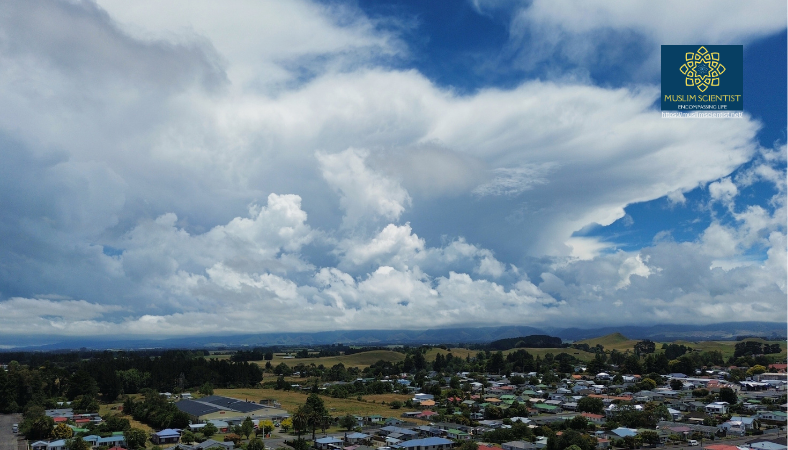
This article explores the fascinating scientific fact that clouds have tremendous weight, despite appearing light and floating effortlessly in the sky. The Qur’an, revealed more than 1,400 years ago, contained references to “heavy clouds” long before modern science could measure their mass. This narrative connects the divine revelation with contemporary meteorological findings, demonstrating the remarkable alignment between Islamic scripture and established scientific knowledge. Through two comprehensive tables, this article presents a detailed comparison of Qur’anic verses and scientific evidence, along with the physical mechanisms that allow these massive structures to remain suspended in the atmosphere.
1. Introduction
When we gaze at the sky on a sunny day, clouds appear as soft, fluffy masses floating effortlessly—seemingly weightless. This perception has persisted throughout human history. However, modern science has revealed a surprising truth: clouds are extraordinarily heavy. A single cumulus cloud can weigh as much as 500 tons, equivalent to approximately 100 adult African elephants .
Remarkably, the Qur’an mentioned the concept of “heavy clouds” (سَحَابًا ثِقَالًا) centuries before the advent of modern meteorology. This article explores the fascinating convergence between Qur’anic revelation and contemporary scientific understanding of cloud weight, formation, and behavior.
2. Qur’anic Verses About Heavy Clouds
The Qur’an contains several verses that describe clouds with remarkable precision, including their weight and formation processes. Two primary verses stand out in this context:
Surah Ar-Ra’d (13):12
هُوَ الَّذِيْ يُرِيْكُمُ الْبَرْقَ خَوْفًا وَّطَمَعًا وَّيُنْشِئُ السَّحَابَ الثِّقَالَۚ
“He is the One Who shows you lightning, inspiring ˹you with˺ hope and fear, 1 and produces heavy clouds..” (QS. Ar-Ra’d: 12)
The term “al-sihaba al-tsiqala” (السَّحَابَ الثِّقَالَ) literally means “heavy clouds” or “weight-bearing clouds.” This description indicates that clouds possess significant mass—a fact that science would only confirm centuries later.
Surah Az-Zariyat (51):2
فَالْحَامِلَاتِ وِقْرًا
“And ( the clouds ) that bear heavy weight of water. ” (QS. Az-Zariyat: 2)
This verse explicitly describes clouds as “carriers of heavy burdens” (al-hamilati wiqran). The word “wiqran” denotes something heavy, weighty, or burdensome. Various translations render this as “those that bear the burden (of rain)” or “heavy-laden clouds” .
Surah An-Nur (24):43
This verse provides additional detail about cloud formation and the processes within them:
أَلَمْ تَرَ أَنَّ اللَّهَ يُزْجِي سَحَابًا ثُمَّ يُؤَلِّفُ بَيْنَهُ ثُمَّ يَجْعَلُهُ رُكَامًا فَتَرَى الْوَدْقَ يَخْرُجُ مِنْ خِلَالِهِ
“Do you not see that Allah drives clouds? Then He brings them together, then He makes them into a mass, and you see the rain emerge from within it (QS. An-Nur: 43)
This verse describes the stages of cloud formation—being driven, then gathered, then stacked—which corresponds perfectly to modern meteorological understanding of cumulonimbus cloud development .
Qur’anic Verses and Scientific Correlations
| Aspect | Qur’anic Reference | Translation & Key Term | Scientific Correlation |
|---|---|---|---|
| Explicit Weight | Surah Ar-Ra’d (13):12 | “…and He creates the heavy clouds (al-sihaba al-tsiqala).” | Mass Measurement: Modern science confirms a single cumulus cloud averages 500 tons (500,000 kg). The term “heavy” (thiqal) accurately describes this immense mass, a fact unknowable to 7th-century observers. |
| Heavy Burden | Surah Az-Zariyat (51):2 | “And the clouds that carry a heavy burden (al-hamilati wiqran).” | Water Content: The “burden” refers to the millions of kilograms of suspended water droplets. Cumulonimbus clouds can carry up to 2,000 tons of water per cubic kilometer, acting as massive reservoirs in the sky. |
| Formation Stages | Surah An-Nur (24):43 | “Do you not see that Allah drives clouds (yuzji), then joins them together (yu’allif), then makes them into a stack (rukaman)…” | Cumulonimbus Lifecycle: This describes the three-stage process of thunderstorm formation: 1) Advection (wind-driven movement), 2) Aggregation (convergence and updraft), and 3) Vertical Stacking (towering cumulonimbus reaching the tropopause). |
| Precipitation | Surah An-Nur (24):43 | “…then you see the rain emerge from within them.” | Coalescence: Rain falls when cloud droplets (approx. 10 micrometers) collide and coalesce into raindrops (approx. 2 millimeters). Once the weight exceeds the updraft force, gravity pulls them down as rain. |
Scientific Facts About Cloud Weight
3.1 How Much Does a Cloud Weigh?
Modern meteorological research has quantified cloud weight with impressive precision. According to studies conducted by researchers such as Margaret LeMone at the National Center for Atmospheric Research:
- A typical cumulus cloud (the fluffy white clouds seen on sunny days) measuring 1 kilometer in diameter and 1 kilometer in thickness has a volume of 1 billion cubic meters .
- With a water density of approximately 0.5 grams per cubic meter, such a cloud contains about 500,000 kilograms (500 tons) of water .
- This is equivalent to the weight of 100 adult African elephants or approximately the weight of a Boeing 747 jumbo jet .
Different cloud types have varying weights. Cumulonimbus clouds—the towering storm clouds described in Surah An-Nur—are significantly heavier due to their higher water density, which can reach 2 grams per cubic meter or more .
Physical Properties and Buoyancy of Clouds
| Cloud Type | Water Content (g/m³) | Total Weight (per km³) | Equivalent Weight | Why It Floats (Buoyancy Mechanics) |
|---|---|---|---|---|
| Cumulus (Fair Weather) | 0.3 – 0.5 | 300 – 500 tons | 60 – 100 African Elephants | Terminal Velocity: Droplets fall at only 0.01 m/s. Updrafts: Thermal currents rise at 0.5–1.5 m/s, which is 50–150x faster than the droplets fall, effectively suspending the mass. |
| Cumulonimbus (Storm) | 1.0 – 2.0 | 1,000 – 2,000 tons | 200 – 400 African Elephants | Dynamic Lift: Strong updrafts (up to 20 m/s) within the cloud counteract the weight of larger droplets and hailstones, holding the massive structure aloft until the weight becomes unsustainable. |
| Stratus (Layered) | 0.1 – 0.3 | 100 – 300 tons | 20 – 60 African Elephants | Stability: These clouds form in stable atmospheric layers with minimal vertical movement, relying on slight density differences and weak updrafts to remain suspended. |
| Cirrus (High-altitude) | 0.01 – 0.1 | 10 – 100 tons | 2 – 20 African Elephants | Ice Composition: Composed of ice crystals rather than water. The crystals are extremely light and fall slowly, while high-altitude jet streams provide the lift needed to keep them spread across the sky. |
3.2 Why Don’t Heavy Clouds Fall?
If clouds weigh hundreds of tons, why do they remain suspended in the sky? The answer lies in two physical principles:
1. Extremely Slow Falling Speed | Kecepatan Jatuh yang Sangat Lambat
Cloud droplets are incredibly small—approximately 10 micrometers in diameter, or about 1/5 the width of a human hair . At this size, the falling speed is only 0.01 meters per second. At such a slow rate, it would take nearly two minutes for a droplet to fall just one meter .
2. Upward Air Currents | Arus Udara ke Atas
The air below clouds is often rising due to thermal convection. When the sun heats the Earth’s surface, warm air rises at speeds of 0.5 to 1.5 meters per second—50 to 150 times faster than cloud droplets fall . These rising currents effectively “hold up” the clouds, preventing them from descending.
Additionally, clouds are less dense than the dry air surrounding them, contributing to their buoyancy .
5. Discussion
The revelation of these Qur’anic verses occurred in the 7th century CE, a time when no scientific instruments existed to measure atmospheric phenomena. The concept of clouds having weight would have been counterintuitive to people observing these seemingly weightless objects floating in the sky .
The Qur’an’s description of cloud formation in Surah An-Nur—using terms like “driven” (yuzji), “gathered” (yu’allif), and “stacked” (rukaman)—reflects an understanding of atmospheric processes that aligns with modern meteorology. Scientists now know that clouds form through specific stages: wind-driven accumulation of water vapor, condensation into droplets, and vertical development into towering structures .
The scientific discovery that clouds weigh hundreds of tons while remaining suspended represents a remarkable confirmation of the Qur’anic description. The mechanism by which they float—through the balance of gravity, buoyancy, and upward air currents—demonstrates the intricate design in nature that the Qur’an invites humanity to contemplate .
6. Conclusion
The Qur’an’s reference to “heavy clouds” more than 1,400 years ago stands as a remarkable example of the harmony between revelation and scientific discovery. What was once a matter of faith—that clouds possess significant weight—has now been empirically verified through modern meteorological research.
The Qur’an does not serve as a scientific textbook, but rather contains signs (ayat) for those who reflect. The accurate descriptions of natural phenomena, including the weight of clouds, invite contemplation of the Creator’s wisdom and power. As scientific understanding advances, it continues to reveal layers of meaning in the Qur’anic text that were previously inaccessible to human knowledge.
References: here
Other Articles: