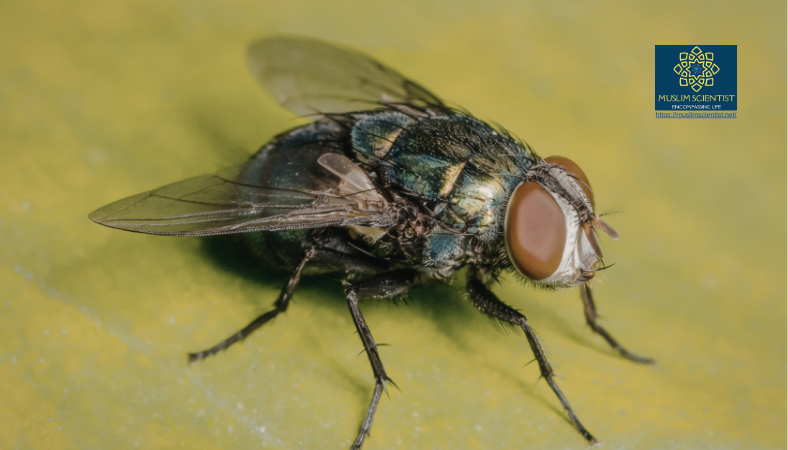
A centuries-old Islamic teaching, often met with skepticism, has become the subject of modern scientific investigation with startling results. The Hadith of Prophet Muhammad (peace be upon him) states: “If a fly falls in the vessel of anyone of you, let him dip all of it (in the vessel) and then throw it away, for in one of its wings has the ailment and the other has the cure.” Researchers a put this to the test against Escherichia coli, a common and harmful bacteria. Their findings challenge conventional wisdom and open a door to a fascinating intersection of faith and microbiology.
For generations, this Hadith has been a point of curiosity and debate. From a public health perspective, flies are notorious vectors of disease, carrying pathogens from filth to food. The idea of intentionally submerging one in a drink seems counterintuitive. Yet, a team of scientists embarked on an experiment not to debate theology, but to seek empirical evidence. Their question was straightforward: Can the right wing of a common housefly (Musca domestica) neutralize water contaminated with harmful bacteria?
The Experiment: Testing Faith with Microbiology
The research team designed a controlled laboratory experiment to isolate and test the effect of the fly’s wing. They used a standard microbiological approach, treating the wing as a potential variable in bacterial growth.
The Setup:
- Positive Control: Sterilized drinking water (known to be clean).
- Negative Control: Sterilized water deliberately contaminated with E. coli (known to grow bacteria).
- Treatments: E. coli-contaminated water with the addition of 1, 2, or 3 right wings of the housefly.
The contaminated samples were inoculated onto special agar plates designed to highlight E. coli growth and incubated for 48 hours. Colony counts were recorded every 12 hours.
The Results: A Clear and Unambiguous Signal
The results were visually and scientifically striking. As expected, the negative control (water with only E. coli) showed robust bacterial growth. The positive control (sterile water) and all samples containing the fly’s right wing showed zero bacterial colony growth.
Table 1: Summary of Experimental Results on Bacterial Growth
| Sample Type | Expected Result (Conventional Wisdom) | Observed Result (48-hour incubation) |
|---|---|---|
| Sterilized Water (Positive Control) | No Growth | ✅ No Growth |
| Water + E. coli (Negative Control) | Significant Growth | ✅ Significant Growth |
| Water + E. coli + 1 Right Wing | Growth (contamination) | ❌ No Growth |
| Water + E. coli + 2 Right Wings | Growth (more contamination) | ❌ No Growth |
| Water + E. coli + 3 Right Wings | Growth (even more contamination) | ❌ No Growth |
The data was so definitive—a result of “0” colonies across all wing treatments—that it couldn’t be analyzed with standard statistical software; there was simply no variation to measure. The right wing didn’t just reduce bacterial growth; it appeared to completely inhibit it under these experimental conditions.
The “How”: Unpacking the Microbial Antidote
The critical question shifts from “Did it work?” to “How did it work?” The Indonesian researchers and studies they cite point to a compelling biological explanation: the fly’s body, particularly its right wing, is not sterile but hosts beneficial microorganisms that act as natural antibiotics.
Table 2: Proposed Antibacterial Agents Found on Flies
| Proposed Agent | Source on Fly | Hypothesized Action |
|---|---|---|
| Antibiotic-producing Bacteria (e.g., Bacillus circulans, Actinomycetes) | Surface of the right wing | Secrete natural antibiotic compounds (like Actinomycin) that kill or inhibit pathogens like E. coli. |
| Bacteriophages | Tiny viruses present on the body | Specifically target and destroy bacterial cells by causing them to lyse (burst open). |
| Enzymes (e.g., Endolysin) | Produced by bacteriophages | Break down the cell walls of the host bacteria, leading to their destruction. |
This creates a profound paradigm shift. The fly is not a sterile syringe of medicine; it is a mobile ecosystem. While its left wing and body may carry pathogens (the “ailment”), its right wing harbors specialized bacteria and viruses that are predators to other bacteria (the “cure”). The act of dipping the whole fly, as mentioned in the Hadith, may allow these beneficial agents to disperse and counteract any harmful ones introduced.
Implications and the Path Forward
This research, while focused on a specific Hadith, resonates with broader themes in science and tradition.
- Bridging Knowledge Systems: It demonstrates how ancient texts can inspire novel scientific hypotheses. The study is a dialogue between empirical observation and revelatory knowledge.
- The Search for Novel Antibiotics: In an era of rising antibiotic resistance, exploring unconventional sources like insects for new antimicrobial compounds is a critical frontier. The fly, an icon of disease, may ironically hold clues to future medicines.
- A Lesson in Humility and Depth: It challenges the superficial reading of both science and scripture. A fly is not merely “dirty”; it hosts a complex microcosm of life and death, harm and healing.
The researchers conclude with a powerful affirmation: their findings provide experimental evidence supporting the truth of the Prophetic narration. They recommend further study to identify the exact antibacterial compounds and the optimal conditions for their activity.
This study from Gontor University is more than a microbiology paper; it’s an invitation to view the natural world—and the wisdom traditions that observe it—with renewed curiosity and respect. It suggests that sometimes, answers to modern questions are waiting in plain sight, carried on the wings of a common housefly.
Reference: here
Other Articles: