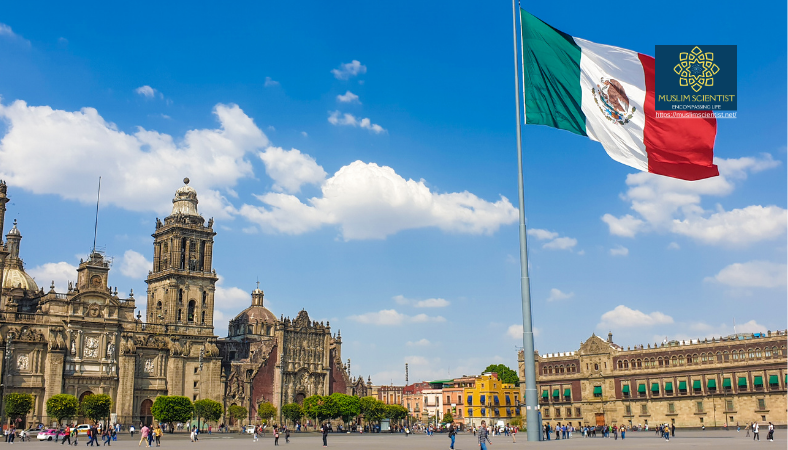
For centuries, Mexico’s religious identity has been painted with a broad Catholic brush. But beneath that well-known surface, a quiet, remarkable transformation is taking place. Islam, once virtually invisible, is now the fastest-growing minority religion in the country, weaving a new thread into Mexico’s rich cultural tapestry.
This isn’t a story of mass migration from the Middle East. Instead, it’s a uniquely Mexican story of spiritual seeking, transnational connections, and the creation of a homegrown Islamic identity that blends Qur’anic teachings with local traditions.
A Community Multiplying
The numbers tell a compelling story of growth. According to Mexico’s national census (INEGI), the Muslim population has seen a dramatic increase in the 21st century.
Table 1: The Growth of Islam in Mexico (National Census Data)
| Year | Registered Muslim Population | Notes |
|---|---|---|
| 2000 | ~500 | A small, largely unnoticed community. |
| 2010 | 3,760 | Growth begins to accelerate. |
| 2020 | 7,982 | A 112% increase in a single decade. |
This surge is even more significant considering Mexico’s overall religiosity is gradually declining. While over 80% of Mexicans still identify as Catholic, the “none” category and minority faiths are rising. Islam’s growth rate among organized religions is particularly striking.
Five Centuries in Five Acts
The history of Islam in Mexico is not a continuous line but a series of distinct chapters, each shaped by global forces and local realities.
1. The Era of Secrets (Colonial Period): The first Muslims arrived not as settlers, but often as enslaved peoples from Africa or “crypto-Muslims” from Spain hiding their faith under the practice of Taqiyya (dissimulation) to escape the Inquisition. They were individuals, not a community, leaving faint traces in historical records.
2. Diplomatic Presence (19th Century): With Mexico’s independence and secular constitution, a few Muslims arrived as diplomats. Prayer was a private, intimate affair, often held in embassies or homes. The term “Mohammedan” in official documents reflected a distant, misunderstood faith.
3. The Arab Diaspora (Late 19th-Mid 20th Century): Geopolitical turmoil in the Ottoman Empire spurred migration from Lebanon, Syria, and Palestine. However, the vast majority of these migrants were Christian. The small Muslim minority among them often concealed their faith to better integrate into Mexican society, which viewed “Arabs” with a mix of curiosity and prejudice.
4. Re-Islamization and First Converts (Late 20th Century): The tide turned in the 1980s and 1990s. Two key dynamics emerged: descendants of Arab migrants reconnected with their Islamic heritage, and the first significant waves of Mexican conversion began. Influences came from the U.S., including the Nation of Islam and Sufi orders, which resonated with themes of identity and spirituality. In 1983, the first mosque was inaugurated in Torreón, Coahuila, a landmark moment.
5. The Digital and Transnational Age (21st Century): This is the current, dynamic stage. Growth is driven by:
- Autonomous Conversions: Individuals discovering Islam online, through social media, Spanish-language dawah (invitation), and popular culture.
- Diverse Migration: New arrivals from Pakistan, Turkey, Africa, and the Middle East, adding to the community’s diversity.
- Organized Outreach: Efforts by groups like the Ahmadiyya movement and Latino Muslim organizations from the U.S.
- Local Institutionalization: Proliferation of musallahs (prayer spaces) and mosques across cities like Mexico City, Guadalajara, and San Cristóbal de las Casas.
Table 2: The Faces of Mexican Islam Today
| Group/Characteristic | Description | Contribution to Diversity |
|---|---|---|
| Mexican Converts | The majority of Muslims in Mexico today. Come from urban, middle-class backgrounds. | Create a uniquely “Mexican” Islamic practice, navigating dual identities. |
| Tzotzil Indigenous Muslims | Based in Chiapas, the first indigenous Muslim community in Latin America. | Symbolize Islam’s reach beyond urban centers and its appeal for social cohesion. |
| Sufi Communities | Such as the Halveti Yerrahi order in Mexico City. | Incorporate elements like conchero dance, showing spiritual flexibility and dialogue with local culture. |
| Migrant Communities | From Lebanon, Pakistan, Syria, Africa, etc. | Maintain links to global Islam, enriching the community with different traditions (Sunni, Shia, Salafi). |
| Latino-Muslim Bridge Builders | Figures like Nahela Morales connecting U.S. and Mexican communities. | Foster transnational solidarity, activism (e.g., pro-Palestine rallies), and support networks. |
Navigating Identity: Hijab, Marriage, and Mexicanidad
For Mexican Muslims, daily life is an act of cultural negotiation. Muslim women speak of finding empowerment and freedom in the hijab, even as it draws stares in public. Converts navigate family reactions, blending Islamic holidays with Mexican traditions. Studies show converts often use Islamic principles to address social issues like alcoholism or domestic violence, framing Islam as a force for positive personal and community change.
The search for marriage partners has also gone transnational, with some using digital platforms to connect with Muslims abroad, while others forge bonds within the small local community.
Challenges and the Path Forward
Despite growth, challenges remain. Muslims are a tiny minority, often invisible or misunderstood in the public sphere. They face stereotypes, especially post-9/11. Academic study of Islam in Mexico is still young, often wrestling with outdated “Orientalist” frameworks rather than capturing the lived reality on the ground.
Yet, the future is one of confident self-definition. Scholars like Arely Medina argue for understanding “Islam in Mexico” on its own terms—not through a Middle Eastern or European lens, but through the specific experiences of Mexicans who find meaning in this faith. It’s an Islam that is lived in the interstices, in the daily blend of Qur’anic recitation and Mexican Spanish, of prayer rhythms and local rhythms.
Conclusion: A Tapestry Woven Anew
The story of Islam in Mexico is no longer one of hiding or assimilation, but of visible, vibrant expression. From the first mosque in Torreón to the digital dawah of a convert in Guadalajara, from the prayers of Tzotzil Muslims in Chiapas to the humanitarian work of Muslim women aiding refugees at the Tijuana border, a new facet of Mexican identity is being sculpted.
This quiet boom is more than a demographic shift. It is a testament to Mexico’s evolving pluralism and the global, interconnected nature of modern faith. It proves that spirituality can take root in unexpected soil, producing a unique and resilient blossom that contributes to the nation’s diverse and growing garden.
Reference: here
Other Articles: