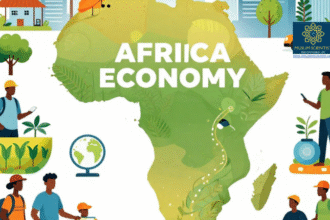
A silent revolution is brewing across Africa, but it’s not happening in towering skyscrapers or on distant trading floors. It’s sprouting from the soil of local communities, in village cooperatives, and in the dreams of small-scale entrepreneurs. This is the revolution of endogenous development—a powerful idea that puts people and their local resources at the very heart of progress.
Yet, a critical question persists: How do we fund this revolution? Traditional banks often see rural farmers or community cooperatives as too risky. Enter Islamic Finance—not just as an alternative banking system, but as a potential soulmate for this people-powered development model. A groundbreaking study reveals that when these two forces combine, they create a formidable toolkit for tackling poverty and unlocking Africa’s most untapped resource: its own communities.
What is Endogenous Development? Think Global, Build Local.
For decades, the dominant development model for Africa has been largely exogenous—driven by external aid, foreign investment, and prescriptions from afar. Endogenous development flips this script. It asks: What if development started from within?
Endogenous development is a philosophy and practice that builds progress on locally available resources: local knowledge, cultural practices, community leadership, and the environment. It’s not about rejecting outside ideas, but about selectively integrating them to strengthen, not replace, local systems. The goal is to build economies that are resilient, self-sustaining, and, most importantly, controlled by the people they are meant to serve.
Table 1: The Building Blocks of Endogenous Development
| Resource Category | What It Includes |
|---|---|
| Natural Resources | Land, water, climate, biodiversity |
| Human Resources | Local knowledge, skills, teaching methods |
| Social Resources | Family ties, community organizations, local leadership |
| Cultural Resources | Beliefs, values, languages, rituals, art |
| Economic Resources | Local markets, community savings, small-scale assets |
This approach directly tackles the core flaws of top-down models. As the research notes, the failure of past structural adjustment programs was partly because “African countries were not involved in drawing up the program.” Endogenous development ensures that the people are not just beneficiaries, but architects of their own future.
The Perfect Partner: Islamic Finance’s Ethical Engine
At first glance, finance and community-driven development might seem worlds apart. But Islamic finance operates on principles that make it a uniquely suited partner:
- Risk-Sharing, Not Risk-Shifting: Unlike conventional loans that burden the borrower with all the risk, Islamic models like Mudaraba and Musharaka promote profit-and-loss sharing between the financier and the entrepreneur.
- Asset-Backed and Ethical: Transactions must be tied to real, tangible assets or ethical ventures, preventing speculative bubbles and ensuring finance serves the real economy.
- Interest-Free: The prohibition of usury (riba) removes the often-crippling debt burden that can sink small-scale projects, focusing instead on the viability of the venture itself.
This alignment is profound. As the study states, “Islamic finance is a holistic approach to both social and development issues.” It doesn’t just provide money; it shares in the journey, aligning its success with the success of the community.
The Toolkit: Islamic Finance Products for Community Growth
So, how does this work in practice? Imagine a farming cooperative, a women’s artisan group, or a community needing a clean water plant. Here’s how Islamic finance instruments can fuel their dreams:
Table 2: Islamic Finance Tools for Grassroots Development
| Instrument | How It Works | Perfect For Community Projects Like… |
|---|---|---|
| Mudaraba | A profit-sharing partnership. Bank provides capital, community provides labor/management. | Launching a community-owned shea butter processing unit. |
| Murabaha | Cost-plus financing. Bank buys an asset (e.g., irrigation pump) and sells it to the community at a transparent markup. | Acquiring farming equipment or solar panels for a village. |
| Musharaka | A joint venture. Both bank and community invest capital and share profits/losses proportionally. | Building a local clinic or a small-scale agro-processing plant. |
| Istisna | A manufacturing contract. Bank funds the construction of an asset, delivered in stages. | Constructing a school building or a community grain storage silo. |
| Islamic Microfinance | Shariah-compliant small-scale financing, often using the above tools. | Providing seed capital for individual tailors, farmers, or shopkeepers within a cooperative. |
The study highlights Islamic microfinance as a critical bridge. It brings “the underprivileged into the sanctuary of the world of Islamic finance,” offering a gateway to larger, community-wide projects.
A Symbiosis for Success: Why This Partnership Works
- Focus on Project Viability, Not Just Credit Scores: Conventional banks often reject viable community projects due to a lack of collateral. Islamic finance, with its profit-sharing model, prioritizes the economic potential of the idea itself. The research confirms it “is more concerned with the profitability of the project financed than with the solvency of the beneficiary.”
- Retains Wealth Locally: The core credo of endogenous development is to retain benefits within the community. Islamic finance structures ensure returns are shared locally, circulating wealth and strengthening the local economy, rather than being extracted as interest payments to distant headquarters.
- Builds Resilience and Inclusion: By providing ethical, accessible tools, this combination empowers the most vulnerable. It turns communities from aid recipients into active economic players, building resilience against economic shocks.
The Road Ahead: Challenges and the Call to Action
The path isn’t without hurdles. The study acknowledges that social cohesion is essential; fragmented communities struggle to organize for common goals. Furthermore, Islamic financial institutions need to innovate and deconstruct products to be more accessible at the grassroots level.
The call to action is clear:
- For Governments: Create enabling regulatory environments that recognize and support Islamic microfinance and community-investment partnerships.
- For Islamic Banks: Move beyond urban centers. Design products specifically for agricultural and community cooperative models.
- For Communities: Organize, formalize, and articulate viable project proposals.
- For Development Agencies: Look beyond conventional grant/aid models. Partner with Islamic finance institutions to create blended finance vehicles for endogenous projects.
Conclusion: Unleashing Africa’s Inner Strength
Africa’s development challenge is not a lack of resources, but a mismatch between its abundant human and natural capital and the financial systems meant to nurture them. The marriage of endogenous development and Islamic finance offers a powerful correction to this mismatch.
It’s a vision of development that is neither charity nor predatory investment. It is a partnership—rooted in ethics, shared risk, and a fundamental belief in the capacity of African communities to build their own prosperity from the ground up. By harnessing this synergy, Africa can truly begin to mine its most sustainable and just source of wealth: the ingenuity and spirit of its own people.
Reference: here
Other Articles: