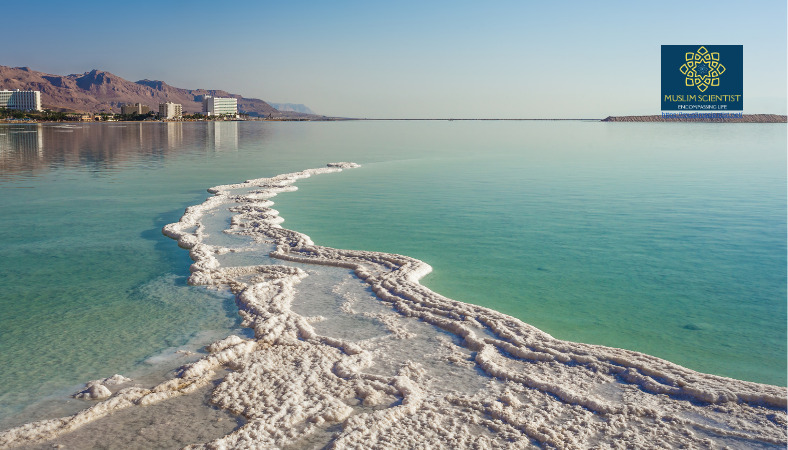
The Dead Sea region holds an explosive Islamic significance—it stands as the geographical and historical witness to one of the Quran’s most precise prophecies: Rome’s defeat and miraculous resurgence, a sign heralding the truth of Islam’s message.
In the early 7th century CE, as the nascent Muslim community in Mecca faced severe persecution, the Quran delivered a stunning prediction that defied all contemporary logic. It spoke not of local Arabian affairs, but of a distant, world-altering conflict between the two superpowers of the age: the Byzantine (Eastern Roman) Empire and the Sasanian Persian Empire. The prophecy’s fulfillment, centered geographically around this very region, became a monumental sign (Ayat) for the believers and a challenge to the skeptics. The Dead Sea, in its timeless stillness, anchors this pivotal moment in Islamic theology.
The Verse of Rome: A Prophecy Against All Odds
The revelation is encapsulated in the opening verses of Surah Ar-Rum (The Romans, Chapter 30):
“Alif-Lam-Mim. The Romans have been defeated. In the nearest land. But they, after their defeat, will triumph. Within three to nine years. To Allah belongs the command before and after. And that day the believers will rejoice. In the victory of Allah. He gives victory to whom He wills, and He is the Exalted in Might, the Merciful.” (Quran 30:1-5)
To understand the gravity of this, one must step into the world of 615 CE. The mighty Christian Byzantine Empire, which controlled the lands north and west of Arabia (including Syria, Palestine, and Anatolia), had just suffered a catastrophic defeat. The Zoroastrian Sasanian Persians, under King Khosrow II, had swept through the Levant. They captured Damascus in 613 CE and Jerusalem in 614 CE, famously seizing the “True Cross” and slaughtering thousands. The Persians pushed deep into Anatolia, reaching the gates of Constantinople itself.
The pagan Quraysh of Mecca, who were polytheists, celebrated this Persian victory. They identified with the Persians (non-“People of the Book”) and saw the Byzantines’ defeat as a bad omen for the Muslims, who were monotheists like the Christians. The world order seemed irrevocably shattered in Persia’s favor.
Then came these verses. They made three bold, testable claims:
- The Romans (Byzantines) have been defeated (a current, known fact).
- They will be victorious again (an improbable prediction).
- This will happen in “the nearest land” within “a few years” (bid’ sinin)—interpreted as 3 to 9 years.
To the Quraysh, this was laughable. They immediately made a wager with Abu Bakr (RA), the Prophet’s closest companion, betting that the Byzantines could never recover so quickly. The Quran had staked its credibility on the outcome of a distant war.
The Geographical Crucible: “In the Nearest Land”
This is where the Dead Sea region becomes crucial. The phrase “fi adna al-ard” is profoundly significant. It does not mean “a low-lying land” but “the nearest land”—the region closest to the Arabs in Arabia. This pointed unequivocally to the Levant: Syria, Palestine, Jordan—the very lands bordering the Dead Sea.
The decisive battle for the resurrection of the Roman Empire did not take place in the heart of Greece or at the walls of Constantinople. It culminated here, in this geographical theater. After years of a desperate holding action, the Byzantine Emperor Heraclius launched a brilliant counter-offensive in 622 CE (interestingly, the same year as the Hijrah). His campaigns swept through Armenia and Anatolia before turning south into the “nearest land”—the Levant.
The climactic, history-altering confrontation was the Battle of Issus (or the Battle of the Taurus Mountains) in 622 CE, followed by the decisive Battle of Nineveh in 627 CE. However, the final act that secured the “triumph” was the recapture of Jerusalem and the restoration of the True Cross to the Church of the Holy Sepulchre in 629 or 630 CE.
Jerusalem lies a mere 15 miles west of the Dead Sea. The Byzantine triumph was realized in the nearest land, in the shadow of the Dead Sea’s mountains. The prophecy was fulfilled to the letter, within the specified timeframe.
A Dual Miracle: Validation and Distinction
The fulfillment of the Roman prophecy served two profound theological purposes in Islam:
1. A Sign of Divine Knowledge: For the early Muslims, the victory was a direct divine intervention that bolstered their faith during intense hardship. It proved that the Quran’s source was not human but transcendent, possessing knowledge of the unseen (Ilm al-Ghayb). As the verse concludes, “To Allah belongs the command before and after.” The rise and fall of empires were under His control, and He had just revealed a glimpse of that ultimate authority to affirm His Prophet.
2. A Clarification of Muslim Identity: The Muslim rejoicing was not a celebration of Christian victory over Persians per se. It was, as the verse states, a rejoicing “in the victory of Allah.” It affirmed that God helps whom He wills. Furthermore, it drew a critical line. While the Muslims shared a monotheistic lineage with the Christians (“People of the Book”), the subsequent verses of Surah Ar-Rum immediately pivot to affirming pure Tawhid (Oneness of God), rejecting the Christian doctrine of Trinity (30:30). The prophecy thus validated the Messenger while simultaneously distinguishing Islam as the final, uncorrupted truth.
The Dead Sea as the Eternal Witness
So, what has this to do with the salty, silent Dead Sea?
- The Historical Crossroads: The Dead Sea basin has always been a crossroads. The ancient King’s Highway on its eastern shore and routes to Jerusalem on its west made it a strategic corridor. The armies and news of the Byzantine-Persian wars flowed through this region. It is the “nearest land” made physical.
- A Monument to Divine Promise: Just as the Dead Sea’s lifeless state is a physical sign (
Ayat) of the narrative of Lut, its location is a geographical sign of the prophecy of Rome. A believer standing on its shores can look west and reflect: Here, in the lands visible from this spot, God’s word in the Quran was manifested in the concrete events of history. - A Lesson in the Unfolding of Qadar (Divine Decree): The Dead Sea embodies constancy amidst change. Empires rose and fell around it—Romans, Persians, later Muslim Caliphates. The Quranic prophecy revealed that these colossal shifts were not random but part of a divine plan, with this region as a chosen stage. The sea itself becomes a metaphor for the deep, often imperceptible currents of God’s will that surface in human history at appointed times.
Modern Reflection: A Timeless Paradigm of Faith
Today, the prophecy of Rome is not a dusty historical footnote for Muslims. It is a living lesson:
- For Times of Despair: It teaches that no matter how dire the circumstances of the believers (Meccan persecution) or how overwhelming the defeat of good seems (Byzantine collapse), God’s promise of relief and victory is certain, on His timeline.
- For Engaging with World Affairs: It demonstrates that Muslims are to be observant of global events, seeing in them potential signs and lessons, while never tying their ultimate hope to any worldly power—be it Rome or Persia.
- For Certainty in Revelation: In an age of skepticism, it stands as a formidable, historically verified miracle of the Quran. Scholars like historian Dr. Keith L. Moore have noted the precision of the prophecy as intellectually remarkable.
Conclusion: The Confluence of Prophecies
The Dead Sea, therefore, is a unique spiritual confluence. Its horizons echo with the triumph of Rome, a promise. It speaks of miraculous victory affirming divine truth.
Reference: here
Other Articles: