Before it fueled the Industrial Revolution, before it financed empires, before it became the $460 billion global commodity that 2.25 billion cups are made from every single day — coffee was a secret. And for centuries, that secret belonged to the Muslim world.
New historical research published by the Foundation for Science Technology and Civilisation (FSTC) reveals that the beloved beverage now consumed by 80% of American adults daily did not “arrive” in Europe fully formed. Rather, it traveled a 900-year journey from the highlands of Yemen to the coffeehouses of Oxford, Venice, and Vienna — carried not by conquistadors or colonialists, but by Sufi mystics, Yemeni farmers, Ottoman diplomats, and Armenian entrepreneurs.
And here is the detail that may surprise you: While Europe was still in the Dark Ages, Muslim physicians were already prescribing coffee as medicine.
THE DEEP ROOTS: COFFEE IN ISLAMIC CIVILIZATION
Most history textbooks tell us coffee “emerged” in the 15th century. Dr. Salah Zaimeche and Professor Salim Al-Hassani, the authors of The Coffee Trail: A Muslim Beverage Exported to the West, beg to differ — and they have the manuscripts to prove it.
The earliest known references to coffee as a beverage come from 15th-century Arabic manuscripts. But here is the critical distinction the authors make: First documentation is not first discovery.
Consider this: Ibn Sina (known in the West as Avicenna), the towering Persian polymath who died in 1037, described coffee’s medical properties in his monumental work Qanun Al-Tib (The Canon of Medicine). He wrote:
“It is a material that comes from the Yemen. It revives the body, it cleans the skin, and dries up the humidities that are under it, and gives an excellent smell to all the body.”
That is 10th century — nearly 500 years before conventional Western histories acknowledge coffee’s existence.
Even earlier, the 9th-century physician Al-Razy (Rhazes) documented coffee’s medicinal applications. And legendary coffee historian William Ukers traced the discovery back to 750 CE, when an Ethiopian Arab shepherd named Khalid observed his goats dancing with unusual energy after eating red berries from a particular bush.
The pattern is unmistakable: Coffee was not discovered by Europe. It was discovered, cultivated, refined, and intellectualized by the Muslim world — and then shared.
WHO DRANK FIRST? THE SUFI CONNECTION
Perhaps the most fascinating revelation in this research concerns who first embraced coffee — and why.
The first systematic consumers of coffee were not merchants or monarchs. They were Sufi mystics.
These spiritual seekers in Yemen used coffee — then called Al-Qahwa — as a tool for devotion. The beverage allowed them to stay awake through long nights of Thikr (remembrance of God), maintaining alertness without the intoxicating effects of substances Islam prohibited.
Sheikh Al-Dhabhani, the Mufti of Aden, reportedly discovered coffee during an illness and found it relieved his headache, “enlivened his spirits,” and prevented drowsiness. He recommended it to his fellow Sufis. From these circles of devotion, coffee flowed outward — to Mecca, to Cairo, to Istanbul, and eventually to the world.
TABLE 1: KEY MILESTONES IN COFFEE’S GLOBAL JOURNEY
| Year | Event | Significance |
|---|---|---|
| 750 CE | Khalid the shepherd observes goats eating coffee berries | Legendary first discovery, Ethiopia |
| 900s CE | Ibn Sina (Avicenna) documents coffee in Qanun Al-Tib | First medical documentation |
| 1400s | Sufi orders in Yemen systematize coffee drinking | Birth of coffee as a social/ritual beverage |
| 1475 | Kiva Han opens in Istanbul | First coffeehouse in history |
| 1570 | Venetian merchants begin coffee importation | Coffee enters Europe commercially |
| 1645 | First coffeehouse opens in Venice | European coffee culture begins |
| 1650 | First coffeehouse opens in Oxford | Coffee arrives in England |
| 1683 | Battle of Vienna; coffee sacks “captured” | Cappuccino and croissant born |
| 1720 | First coffeehouse in Berlin | Coffee completes European spread |
THE TRANSFER: HOW COFFEE REACHED EUROPE
The story of coffee’s migration to Europe is not a story of discovery. It is a story of relationship.
Venice, the great maritime republic, maintained intensive trade links with North Africa, Egypt, and the Ottoman Levant. Venetian merchants tasted coffee in Cairo and Alexandria. They recognized its commercial potential. By 1570, they were importing it systematically.
But trade was only one channel.
Diplomats brought coffee in their luggage and described it in their dispatches. Gian Francesco Morosini, the Venetian ambassador to the Ottoman Sultan, filed reports in 1582 describing “business premises where public used to meet several times a day over a dark hot beverage.”
Physicians and botanists carried coffee for study. Prospero Alpino, a Paduan botanist, brought coffee sacks from Egypt and published descriptions of the coffee tree in his 1591 work History of the Egyptian Plants.
Travelers introduced coffee through personal networks. Mr. Thevenot, a French traveler to the East, brought coffee beans to Paris in 1657 and served them to friends — including the King’s interpreter.
And then came the Armenian and Turkish merchants who established Europe’s first coffeehouses, taught Europeans how to roast and brew, and gave the West its first vocabulary of coffee.
THE CONTROVERSY: WHEN COFFEE WAS FORBIDDEN
Here is a historical irony that deserves attention.
Western accounts often emphasize that coffee faced opposition in the Muslim world. This is true — but it is also incomplete. Coffee faced equally fierce opposition in Christian Europe.
In both civilizations, the opposition was not primarily religious. It was political and commercial.
In Mecca and Cairo, coffeehouses were viewed with suspicion because they became gathering places for political discussion, literary debate, and social mixing. The same happened in London.
King Charles II, in 1675, issued a proclamation describing coffeehouses as “seminaries of sedition” and ordered them closed. The public outcry was so intense that he reversed his order within days.
In Rome, Pope Clemente VIII was urged to ban coffee as “the Muslim’s drink.” The story — possibly apocryphal but culturally significant — holds that he tasted it first, found it delicious, and reportedly said: “This devil’s drink is so good we should cheat the devil by baptizing it.”
The Pope’s blessing became European coffee’s baptism indeed.
THE PENNY UNIVERSITIES: COFFEEHOUSES AS KNOWLEDGE CENTERS
Perhaps nothing illustrates coffee’s transformative impact on Western civilization better than the nickname Londoners gave their coffeehouses: Penny Universities.
For the price of a penny — the cost of a cup of coffee — any Englishman could enter a coffeehouse and encounter the leading thinkers, writers, scientists, and merchants of his age. He could read newspapers, debate politics, learn of distant lands, and conduct business.
These were not taverns. Taverns sold alcohol, which clouded the mind. Coffeehouses sold coffee, which sharpened it.
The names of these establishments tell their own story: The Saracen’s Head, The Sultan’s Head, The Turk’s Head decorated London streets. Tokens bearing the portrait of turbaned figures circulated among loyal customers. The British were not merely consuming coffee. They were publicly acknowledging — indeed, advertising — its Islamic origins.
TABLE 2: COFFEEHOUSE PENETRATION IN MAJOR EUROPEAN CITIES
| City | First Coffeehouse | Number by 1700s | Local Name | Cultural Impact |
|---|---|---|---|---|
| Istanbul | 1475 (Kiva Han) | Hundreds by 1600 | Kahvehane | Birthplace of coffeehouse culture |
| Venice | 1645 | 218 by 1763 | Bottega del caffè | Commercial gateway to Europe |
| Oxford | 1650 | Multiple by 1660 | Coffee house | “Penny University” concept |
| London | 1652 (Pasqua Rosee’s) | 500+ by 1700 | Penny University | Intellectual & commercial revolution |
| Paris | 1671 (Marseilles) | 300+ by early 1700s | Café | Literary and artistic hub |
| Vienna | 1683 (post-battle) | Dozens by 1700 | Kaffeehaus | Birthplace of cappuccino |
| Berlin | c. 1720 | Expanding | Kaffeehaus | Northern European spread |
THE SWEET IRONY: CAPPUCCINO AND CROISSANT
And now, a story that coffee drinkers will appreciate every time they order their morning espresso.
In 1683, the Ottoman army besieged Vienna. After the battle — won by a coalition of European forces including Germans, Poles, and Austrian volunteers — the retreating Turks left behind sacks of coffee beans.
The Viennese found Turkish coffee too strong. So they did something characteristically Viennese: they added cream and honey.
The resulting beverage was brown — the exact shade of the robes worn by the Capuchin monastic order. The Viennese, honoring a Capuchin priest named Marco d’Aviano who had rallied Catholic and Protestant forces against the Ottomans, named their new drink cappuccino.
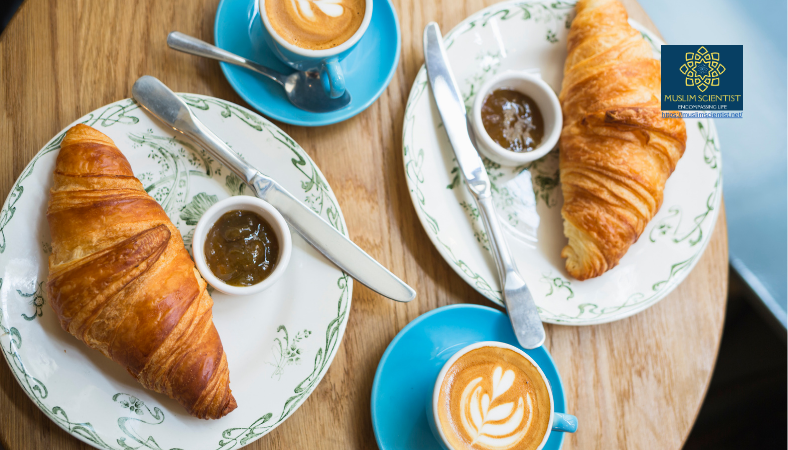
The croissant tells a similar story. Hungarian bakers, celebrating the defeat of the Ottoman army, created a pastry in the shape of the crescent moon — the symbol of Islam — and invited their customers to quite literally “eat” the Ottoman standard.
Today, the croissant is synonymous with French breakfast. But its origin? 1686. Vienna. And an Ottoman crescent.
WHAT THIS MEANS TODAY
Why does this history matter — beyond winning arguments at dinner parties?
First, it corrects a persistent cultural amnesia. Many Westerners believe coffee is European because Europe industrialized its production and globalized its distribution. But invention and industrialization are not the same thing. The invention of coffee as a beverage — the insight that roasting and brewing these beans creates something delicious and useful — belongs to the Muslim world.
Second, it demonstrates that globalization is not new. Coffee traveled from Ethiopia to Yemen, from Yemen to Mecca and Cairo, from Cairo to Istanbul, from Istanbul to Venice, from Venice to London and Paris and Vienna. It was carried by Sufis and sheikhs, merchants and diplomats, physicians and travelers. It crossed linguistic, religious, and political boundaries because people liked it and found it useful.
Third, it offers a counternarrative to clash-of-civilizations thinking. Coffee did not arrive in Europe through conquest or colonization. It arrived through trade, diplomacy, and curiosity. Europeans did not steal coffee; they received it — and then adapted it to their tastes.
THE BOTTOM LINE
The next time you order a cappuccino, consider this: you are drinking a beverage first cultivated in Yemen, first brewed by Sufi mystics, first prescribed by Persian physicians, first traded by Venetian merchants, and finally transformed by Viennese confectioners honoring a Capuchin priest.
The next time you bite into a croissant, consider this: you are eating a 338-year-old Hungarian joke about an Ottoman crescent.
The next time you sit in a coffee shop to read, write, or debate, consider this: you are sitting in a 21st-century version of the Penny University — an institution London borrowed from Istanbul, which borrowed it from Cairo, which borrowed it from Mecca, which borrowed it from Yemen.
Coffee has always been about connection. And the connections run deeper than most of us ever imagined.
reference: here
Other Articles: