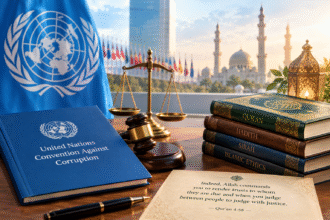
For years, a quiet debate has simmered in the world of finance: Does Sharia compliance make any real difference to a company’s performance, or is it just a label? Some scholars have argued that Islamic finance, in practice, looks no different from conventional finance. But a study published in Humanities and Social Sciences Communications, a Nature journal, provides powerful evidence to the contrary.
The study, titled “Sharia compliance, national governance, and value of cash in Organization of Islamic Cooperation countries,” analyzed nearly 11,000 firm-year observations across 16 OIC member countries from 2000 to 2015. Its findings are striking: Sharia-compliant firms are significantly better at using their cash to create value for the business compared to firms that do not comply with Islamic principles.
And there is more good news. The study also found that this positive effect of Sharia compliance is amplified when national governance is strong—meaning countries with good rule of law, low corruption, and effective regulation see an even greater benefit from Islamic business ethics.
Let’s break down what this means for businesses, for governments, and for everyday Muslims who want their faith to guide not just their worship but their livelihoods.
The Core Question: Does Holding Cash Help or Hurt?
First, some background. Every company holds cash—for daily operations, for emergencies, and for taking advantage of new opportunities. But here is the problem: cash can be wasted. Managers with poor oversight might use excess cash on bad investments, pet projects, or even outright corruption. In the worst cases, hoarding cash destroys company value.
Economists call this the “agency problem”—the conflict of interest between managers (who control the cash) and shareholders (who own the company). The value of cash, therefore, depends heavily on how well a company is governed.
The study’s first major finding is that, overall, cash is value-enhancing in OIC countries. That is, holding cash generally increases firm value. But the real insight comes when we distinguish between Sharia-compliant firms and non-compliant firms.
The Sharia Advantage: 4.6 Times More Value from Cash
The study measured the value of cash by looking at how changes in cash holdings affect a firm’s market-to-book ratio (a measure of market value relative to accounting value). Here is what they found:
- For non-Sharia-compliant firms, a one-unit increase in cash holdings increased firm value by 0.198 units.
- For Sharia-compliant firms, the same one-unit increase in cash increased firm value by 0.912 units.
The Sharia Advantage in Cash Value
| Firm Type | Cash Value Coefficient | How Much Value Each Cash Unit Creates |
|---|---|---|
| Non-Sharia Compliant Firms | 0.198 | Baseline (1x) |
| Sharia-Compliant Firms | 0.912 | 4.6 times more value |
| Difference | +0.714 | Statistically significant at p < 0.01 |
In simple terms: A dollar of cash held by a Sharia-compliant firm generates nearly five times more value than a dollar held by a non-compliant firm.
Why? The study argues that Sharia compliance is not just about avoiding prohibited activities (alcohol, gambling, conventional interest-based finance, etc.). It is a comprehensive ethical framework that includes:
- Accountability to God (not just to shareholders)
- Broader stakeholder responsibility (workers, community, environment)
- Honesty, justice, and transparency in all dealings
- Long-term orientation (balancing this life and the afterlife)
These principles naturally lead to better corporate governance. Managers who believe they are accountable to a higher power are less likely to waste cash on selfish or corrupt projects. They are more likely to invest wisely, honor contracts, and build sustainable value.
The Governance Effect: Good Government Makes It Even Better
The study also examined the role of national governance—factors like rule of law, control of corruption, political stability, and regulatory quality. The results show that cash is particularly valuable in countries with strong national governance. But here is the exciting part: The positive effect of Sharia compliance is significantly stronger when national governance is also strong.
Synergy Between Sharia Compliance and National Governance
| National Governance Level | Cash Value (Non-Sharia Firms) | Cash Value (Sharia-Compliant Firms) | Sharia Advantage |
|---|---|---|---|
| Weak Governance | 0.170 | 0.662 | +0.492 |
| Strong Governance | 0.234 | 0.783 | +0.549 |
| Increase due to good governance | +0.064 | +0.121 | Sharia firms benefit twice as much |
As the table shows, when national governance is weak, Sharia-compliant firms still outperform non-compliant firms significantly (0.662 vs. 0.170). But when national governance is strong, both types of firms benefit, but Sharia-compliant firms benefit twice as much (an additional 0.121 increase compared to only 0.064 for non-compliant firms).
The study’s authors conclude: “Sharia compliance and strong national governance should coexist to maximize the value of cash.” In other words, internal ethics (Sharia) and external regulation (good government) are not substitutes—they are complements that reinforce each other.
Connecting to Islamic Teaching: A Virtuous Circle of Trust and Value
For a Muslim, these findings are deeply affirming. The study provides empirical, peer-reviewed evidence that following Allah’s commands is not a drag on business—it is a competitive advantage.
1. Accountability as a Governance Mechanism
The Qur’an is clear: “And do not consume one another’s wealth unjustly or send it [in bribery] to the rulers in order that [you might] consume a portion of the wealth of the people in sin, while you know [it is unlawful].” (Qur’an 2:188). The Prophet Muhammad (peace be upon him) said: “Each of you is a shepherd and each of you is responsible for his flock.” (Bukhari & Muslim). This sense of ultimate accountability—that we will answer to Allah for how we managed resources—is a powerful internal control that no external auditor can fully replicate. The study’s finding that Sharia-compliant firms create more value from cash is a direct reflection of this Islamic ethic of trusteeship (amanah).
2. The Prohibition of Waste (Israf) and Hoarding
Islam forbids wastefulness and hoarding of wealth. The Qur’an says: “Indeed, the wasteful are brothers of the devils” (Qur’an 17:27). And the Prophet ﷺ warned against hoarding wealth that is not used for good. The study shows that Sharia-compliant firms do not simply hoard cash; they deploy it effectively to create value. This aligns with the Islamic principle that wealth is a tool for good, not an end in itself.
3. Justice (Adl) and Transparency
Islamic finance is built on justice—no exploitation through interest (riba), no gambling (maysir), no excessive uncertainty (gharar). The study’s emphasis on “strong national governance” (rule of law, control of corruption) mirrors the Qur’anic command: “O you who have believed, be persistently standing firm for Allah, witnesses in justice…” (Qur’an 4:135). When a society has just laws and enforces them fairly, Sharia-compliant firms thrive even more.
4. The Virtuous Circle: Cash Waqf and Community Benefit
Perhaps the most inspiring part of the study is its discussion of cash waqf. Waqf is an Islamic charitable endowment—money or assets permanently dedicated to community benefit (schools, hospitals, poverty relief). Cash waqf is a modern innovation where cash is invested, and the returns are used for charity.
The study argues that Sharia-compliant firms, precisely because they are better at managing cash, are ideal candidates to lead cash waqf initiatives. By participating in cash waqf, these firms:
- Fulfill the Islamic duty of charity (sadaqah)
- Enhance their reputation as ethical businesses
- Improve firm performance (because reputation increases customer loyalty and investor confidence)
- Which then allows them to contribute even more to waqf
This is a virtuous circle—faith leads to ethical behavior, which leads to better governance, which leads to higher profits, which enables more charity, which pleases Allah. The study’s authors explicitly state that Sharia-compliant firms can “participate directly and proactively in cash waqf by serving as an initiator and managing cash investments.”
What This Means for Different Audiences
For Business Owners and Managers in Muslim-Majority Countries:
- Sharia compliance is not just a religious obligation; it is a strategic advantage. Your commitment to Islamic ethics makes you a better steward of cash and other resources.
- Consider not just avoiding haram activities, but actively embracing the positive principles of justice, transparency, and long-term thinking.
- Explore opportunities to participate in cash waqf. It is good for the community and good for your business reputation.
For Policymakers and Regulators:
- Strengthen national governance—rule of law, anti-corruption measures, judicial independence. This is not just a Western concept; it is an Islamic one (justice is a core Qur’anic value).
- Recognize that Sharia compliance and good governance work together. Encourage both. Do not see Islamic finance as a substitute for strong regulation; see it as a complement.
- Support cash waqf initiatives. Provide a legal and regulatory framework that allows Sharia-compliant firms to manage waqf assets effectively.
For Investors:
- Consider Sharia-compliant firms as potentially better-governed investments. The study suggests they create more value from cash, meaning your money is less likely to be wasted.
- Pay attention to national governance as well. The best returns may come from Sharia-compliant firms in countries with strong rule of law.
For Everyday Muslims:
- Be proud that your faith’s economic teachings are being validated by mainstream science (Nature journal, no less).
- Support Sharia-compliant businesses. Your consumer choices matter.
- Learn about cash waqf. Consider how even small contributions, pooled together and managed ethically, can create lasting community benefit.
A Final Reflection: Faith and Finance in Harmony
For too long, there has been a false dichotomy: either you follow your faith and accept lower worldly returns, or you chase profits and compromise your principles. This study, published in one of the world’s most prestigious scientific journals, demolishes that false choice.
Sharia compliance is not a constraint on business; it is a discipline that creates value. The same principles that please Allah—honesty, accountability, justice, transparency—are the very principles that good corporate governance requires. And good corporate governance, as this study shows, makes cash more valuable.
The Qur’an promises: “Whoever fears Allah, He will make for him a way out and will provide for him from where he does not expect.” (Qur’an 65:2-3). This study provides empirical evidence for that divine promise. Firms that follow Allah’s commands—including in their financial practices—find unexpected blessings. Their cash works harder. Their governance is stronger. And they are positioned to be a source of good for their communities through initiatives like cash waqf.
This is not just economics. This is barakah—divine blessing—measured in data.
Reference: here
Other Articles: