More than 1,400 years ago, a prophetic tradition spoke of a time when the most humble of people—barefoot, poor shepherds—would compete in the construction of towering buildings. Today, from the Gulf deserts to the skylines of Southeast Asia, that prophecy is manifesting before our eyes.
It is one of the most quoted, yet often misunderstood, prophetic traditions in Islamic eschatology. The hadith, narrated by Sahih Muslim, captures a moment when the Angel Jibril (Gabriel) came to the Prophet Muhammad (peace be upon him) in the guise of a traveler. After a series of questions about faith, destiny, and the signs of the Hour, Jibril asked the Prophet to describe the coming of the Last Day.
The Prophet’s response included a striking image. He said:
“When you see the barefoot, naked, destitute shepherds competing in the construction of tall buildings.”
(Sahih Muslim, Book 1, Hadith 1)
For centuries, scholars pondered this sign. How could the most marginalized people of the Arabian desert—those without shoes, without wealth, without status—ever rise to become masters of architecture, competing to erect the tallest structures on Earth?
Today, we see the answer in glittering cityscapes that would have been unimaginable to those early listeners.
From Sandals to Skyscrapers: A Prophetic Vision Fulfilled
The hadith speaks of ru’aa’ al-ghanam—shepherds, people of the lowest social stratum in 7th-century Arabia. It speaks of al-hafah al-‘urah—the barefoot and the naked, a description of extreme poverty. And it speaks of al-bunyani—the construction of buildings, not just any buildings, but a competitive race to build tall.
When we look at the modern world, particularly in the heart of the Muslim world, we see exactly this phenomenon unfolding across the last half-century.
The most dramatic fulfillment is found in the very lands where those Bedouin shepherds once roamed. The United Arab Emirates, Saudi Arabia, Qatar, and Kuwait—nations whose populations were, within living memory, largely nomadic or semi-nomadic—have transformed into global centers of architectural ambition.
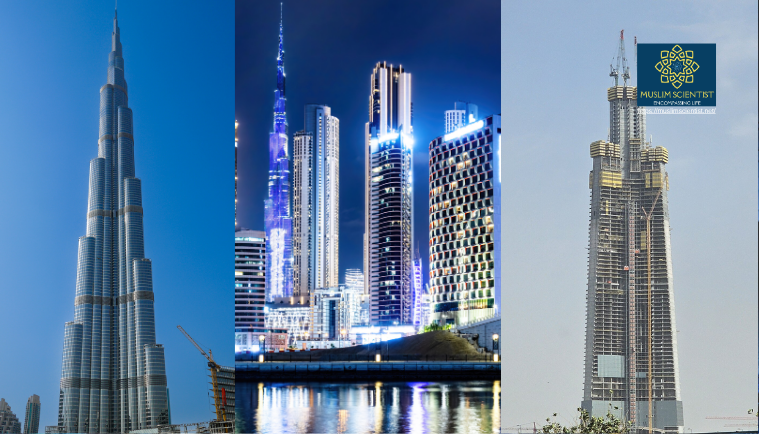
Dubai, a fishing and pearl-diving village just 50 years ago, now boasts the Burj Khalifa, the tallest building in the world at 828 meters. It is a structure so tall that its construction required technology never before used in human history. Saudi Arabia is now constructing the Jeddah Tower, designed to surpass the Burj Khalifa and reach one kilometer into the sky. Across the Gulf, entire new cities are rising: NEOM in Saudi Arabia, Lusail in Qatar, Kuwait’s Silk City.
These are not merely functional structures. They are statements. They are competitions.
The hadith spoke of a competition (yatawataluna or yatabahuna in various narrations) in construction. And indeed, we see a modern “race to the sky.” For years, the Petronas Towers in Kuala Lumpur held the title of world’s tallest. Then Taipei 101 took it. Then Burj Khalifa took it. Now Jeddah Tower aims to reclaim it. The competition is not just between nations, but within them—a constant one-upmanship of architectural wonder.
What Did the Prophet Mean? Scholarly Reflections
Scholars of hadith have long reflected on the meaning of this tradition. The 14th-century scholar Ibn Hajar al-Asqalani, in his commentary Fath al-Bari, noted that this sign was among the minor signs of the Hour and that its fulfillment was already beginning to be seen in his time, with the construction of tall buildings by people of humble origins.
What is remarkable is how the fulfillment has accelerated in modern times. The tradition is often cited alongside another prophetic saying: “The Hour will not come until the Hijaz (Arabia) is covered with gardens and rivers.” That too, we see today with the greening and urban development of the Arabian Peninsula, a land once known only for its arid desert.
The Deeper Meaning: Transformation and Responsibility
But the hadith is not merely a prophecy of architectural achievement. It carries a deeper moral and spiritual message.
The barefoot, poor shepherd symbolizes a certain kind of innocence—a simplicity untouched by worldly ambition. The hadith suggests that one sign of the end times is that those who were once focused on simple, essential things become consumed by competition over material grandeur.
This mirrors a concern expressed in another famous hadith: “If the son of Adam were given a valley of gold, he would desire a second. And if he were given a second, he would desire a third. Nothing fills the belly of the son of Adam except dust.” (Sahih al-Bukhari)
The competition in building, therefore, is not celebrated in Islamic tradition. It is presented as a sign—a warning—of a time when spiritual priorities are overtaken by worldly ones. The poor shepherd who once found contentment in a tent and a flock now finds himself unsatisfied without the tallest tower.
A Modern Mirror
As we look at the skylines of Dubai, Kuala Lumpur, Doha, and Jeddah, we are looking at a prophecy made manifest. The barefoot shepherds of Arabia have, in the span of a generation, built monuments of steel, glass, and concrete that reach toward the heavens.
For believers, this is a moment of reflection. The fulfillment of prophecy is not merely a curiosity; it is a reminder. The hadith asks us to consider where our ambitions lie. Are we building for the sake of the next world, or are we competing for the tallest structure in this one?
The towers will eventually fall. The empires will fade. But the lesson of the hadith endures: true success lies not in how high we build, but in what we build for.
“And the earth will shine with the light of its Lord, and the record will be placed, and the prophets and the witnesses will be brought, and it will be judged between them in truth, and they will not be wronged.”
*(Qur’an, Surah Az-Zumar, 39:69)*
Summary: The Hadith in Focus
| Element | The Prophecy | Modern Fulfillment |
|---|---|---|
| People | Barefoot, naked, poor shepherds/Bedouins | Gulf Arabs within living memory, largely poor and agrarian or nomadic. |
| Action | Competing in the construction of tall buildings | The race to build the world’s tallest skyscrapers, from the Burj Khalifa to the Jeddah Tower |
| Setting | Arabian Peninsula & broader Muslim world | The skylines of Dubai, Riyadh, Doha |
| Meaning | A sign of the Hour; a warning about worldly ambition | A call to reflect on whether material competition has overtaken spiritual priorities. |
Sources: Sahih Muslim, Book 1, Hadith 1; Sahih al-Bukhari; Ibn Hajar al-Asqalani, Fath al-Bari.