For 4,000 years, Zamzam water has been a symbol of divine blessing for Muslims worldwide. Now, a comprehensive scientific review reveals that this ancient water from the heart of Mecca possesses a unique mineral fingerprint, unusual optical properties, and potential health benefits that distinguish it from any other drinking water on Earth.
Introduction: Faith Meets Science
In the barren valley of Mecca, where summer temperatures regularly exceed 40°C (104°F), a single well has supplied billions of pilgrims with fresh, clean water for nearly four millennia. The Zamzam well, located just 20 meters from the Kaaba, has never dried up—even as over two million people visit during Hajj alone.
For Muslims, Zamzam is a sacred gift from Allah, tied directly to the story of Prophet Ibrahim (Abraham), his wife Hajar, and their son Ismail. But in recent decades, scientists have begun asking a different question: Is there something physically and chemically unique about Zamzam water?
According to a comprehensive review published in the International Journal of Food Properties by Nauman Khalid and colleagues from universities in Japan and Pakistan, the answer is a resounding yes. The researchers analyzed over 80 years of scientific studies—from a 1935 Egyptian commission to modern neutron activation analyses—and concluded that Zamzam water possesses a mineral composition, radiological profile, and even optical behavior that sets it apart from both tap water and commercial bottled water.
Part 1: What Makes Zamzam Water Different?
A Unique Mineral Signature
The most striking finding is Zamzam’s rich concentration of essential minerals. Compared to typical bottled drinking water, Zamzam contains significantly higher levels of calcium, magnesium, sodium, chloride, and sulfates.
Table 1: Key Minerals in Zamzam Water vs. Typical Bottled Water (mg/L)
| Mineral | Zamzam Water | Typical Bottled Water | Health Benefit |
|---|---|---|---|
| Calcium (Ca²⁺) | 220 | 136 | Strong bones, nerve signaling, muscle contraction |
| Magnesium (Mg²⁺) | 80 | 92 | Energy production, muscle function, sleep quality |
| Sodium (Na⁺) | 130.5 | 20–50 | Fluid balance (healthy levels) |
| Potassium (K⁺) | 44.4 | 2–5 | Blood pressure regulation, heart function |
| Chloride (Cl⁻) | 260 | 100 | Digestion, cellular fluid balance |
| Sulfate (SO₄²⁻) | 180 | 0–50 | Detoxification, joint health |
| Fluoride (F⁻) | 0.59 | 0.1–0.3 | Cavity prevention, dental health |
| Nitrates (NO₃⁻) | 31.6 | <10 | *Note: above some guidelines |
*Sources: Khalid et al., 2014; El-Zaiat, 2007; Alfadul & Khan, 2011*
The review notes that while nitrate levels exceed some international ideal limits, they remain below the World Health Organization’s maximum of 50 mg/L. More importantly, toxic elements like arsenic (As), cadmium (Cd), lead (Pb), and selenium (Se) are all well below danger thresholds—a crucial finding given past media concerns.
Total Dissolved Solids (TDS) and Conductivity
Zamzam water has a total dissolved solids concentration of approximately 1,000–1,100 mg/L, compared to 450–500 mg/L in most bottled waters. Its electrical conductivity is nearly double that of regular bottled water (1,390 μS/cm vs. 740 μS/cm), indicating a much higher concentration of charged mineral ions.
“The supposed health-promoting value of Zamzam may be attributable to these balanced levels of mineral content,” the authors write.
Part 2: Ancient Water from a Distant Climate
One of the most fascinating discoveries involves the age and origin of Zamzam water. Using isotopic analysis of oxygen-18 and deuterium (heavy hydrogen), researchers determined that Zamzam water is not modern rainfall. Instead, it is palaeowater—ancient groundwater that fell as rain between 11,000 and 40,000 years ago.
The isotopic signature of Zamzam water (δ¹⁸O = -10.04‰, δ²H = -90.36‰) places it in the same category as other ancient aquifers from the last humid period of the Quaternary era. This explains why the well continues to flow even though modern rainfall in the Mecca region is minimal.
“The recharge occurred during the last Holocene humid period, and the aquifer is now discharging ancient groundwater resources,” the review explains.
This finding has profound implications: the water pilgrims drink today fell from the sky during a time when the Arabian Peninsula was green and lush—long before recorded history.
Part 3: Radiological Safety—Good News for Pilgrims
Some readers may worry about natural radioactivity in groundwater. The review addresses this directly. Zamzam water contains naturally occurring radionuclides from the uranium and thorium decay chains, but all levels fall within or near international safety standards.
Table 2: Radiological Characteristics of Zamzam Water vs. Safety Limits
| Parameter | Zamzam Water | WHO Limit | Canadian Standard |
|---|---|---|---|
| Uranium (U) | 1.6 Bq/L | 0.1 Bq/L | 0.02 mg/L |
| Thorium (Th) | 1.2 Bq/L | 0.1 Bq/L | – |
| Potassium-40 (K-40) | 3 Bq/L | 0.1 Bq/L | – |
| Cesium-137 (Cs-137) | 0.7 Bq/L | 1 Bq/L | 10 Bq/L |
Source: Khalid et al., 2014, citing Ali et al., 2009
The review concludes that Zamzam water is safe for human consumption from a radiological perspective. The levels of radium (²²⁶Ra) and other decay products are below maximum permissible concentrations set by the US National Committee on Radiation Protection.
Part 4: Potential Health Benefits—What the Research Shows
The review compiles several animal and human studies investigating the health effects of Zamzam water. While the authors caution that more research is needed, the preliminary findings are encouraging.
Cancer Research
In an animal study using rats with chemically induced colon tumors, those given 500 cc of Zamzam water daily for one month showed a significant reduction in tumor size—from an average of 3.1 cm to 1.5 cm (p < 0.05). The number of lymphocytes (immune cells that fight cancer) increased from 1,016 to 1,688. Serum somatostatin, a hormone that inhibits tumor growth, rose from 3.3 to 18.2 units.
The review also reports that women who drank Zamzam water for one month showed increased levels of three natural cancer-preventive proteins: bikunin, lunasin, and Bowman-Birk inhibitor—all known for their onco-preventive qualities.
Reproductive Health
In a study of 50 healthy fertile women, those who consumed 500–750 cc of Zamzam water daily for one month showed new expression of aquaporin water channels (AQP7, AQP9, and AQP10) in their endometrium. Aquaporins are proteins that regulate water flow into and out of cells. The researchers suggest this could potentially aid in embryo implantation, though they call for larger randomized trials.
Dental Health
A comparative study of schoolgirls in Saudi Arabia found that those who regularly drank Zamzam water had the lowest DMFT scores (decayed, missing, and filled teeth) compared to girls drinking other water sources. The authors attribute this to Zamzam’s fluoride content of 0.59 mg/L, which is within the optimal range for cavity prevention (0.5–1.0 mg/L).
Plant Growth—A Surprising Finding
In an unexpected application, researchers found that crops irrigated with Zamzam water produced higher yields, more protein, and more carbohydrates than those given desalinated water or ordinary well water. Wheat and broad bean plants showed increased germination rates, shoot length, and total biomass. Lentil seedlings irrigated with Zamzam had higher RNA, DNA, total phenolic content, and antioxidant activity.
“Crops irrigated with Zamzam water gave the highest values of yield, soluble carbohydrates, total carbohydrates, protein, and total nitrogen contents,” the review states.
Part 5: The Optical Mystery—Light Behaves Differently in Zamzam
One of the most technical—and intriguing—findings involves how light passes through Zamzam water. The Abbe number (a measure of how much a material disperses light) for Zamzam is 112.4, compared to 46.3 for bottled water—more than double.
The refractive index, group index, permittivity, polarizability, and transmittance of Zamzam water all differ significantly from both bottled and distilled water. These optical properties are likely due to the unique chemical structure of the rocks surrounding the well, which interact with the water over thousands of years.
“These different optical properties of Zamzam water may be due to the chemical structures of rocks around the Zamzam well,” the authors explain.
Interestingly, Japanese researcher Masaru Emoto—famous for his water crystal experiments—reported that Zamzam water refused to crystallize even after 1,000-fold dilution. When he finally did obtain crystals, they formed a unique “double” structure with one crystal on top of another.
Part 6: Islamic Context—A Gift That Keeps Giving
For Muslims, these scientific findings do not replace faith—they enrich it. The Qur’an repeatedly invites believers to reflect on the natural world as evidence of divine wisdom:
“We will show them Our signs in the horizons and within themselves until it becomes clear to them that it is the truth.” (Qur’an 41:53)
The story of Zamzam is deeply embedded in Islamic tradition. When Prophet Ibrahim left his wife Hajar and infant son Ismail in the barren valley of Mecca at Allah’s command, their water soon ran out. Hajar ran seven times between the hills of Safa and Marwah searching for help. After the seventh round, the angel Jibril (Gabriel) struck the ground, and water burst forth. As it gushed, he said “Zamzam”—meaning “stop flowing”—and the well was contained.
This event is commemorated by the Sa’i ritual during Hajj and Umrah, where pilgrims walk the same 450-meter path seven times.
The Prophet Muhammad (peace be upon him) said:
“The water of Zamzam is for whatever it is drunk for.” (Ibn Majah)
He also stated that Zamzam is “a healing for sickness” and would drink from it and use it to treat ill companions.
The Islamic concept of tayyib (pure, wholesome, beneficial) applies directly here. Zamzam water is not only ritually pure but, based on the scientific evidence, physically distinct and potentially health-promoting.
Part 7: Cautions and Limitations
The review authors are careful to note limitations:
- Nitrate levels (31.6 mg/L) approach the WHO guideline of 50 mg/L. While not dangerous for most healthy adults, individuals with certain medical conditions should consult a doctor.
- Most health studies were small-scale animal or pilot human trials. Large, randomized controlled trials are still needed.
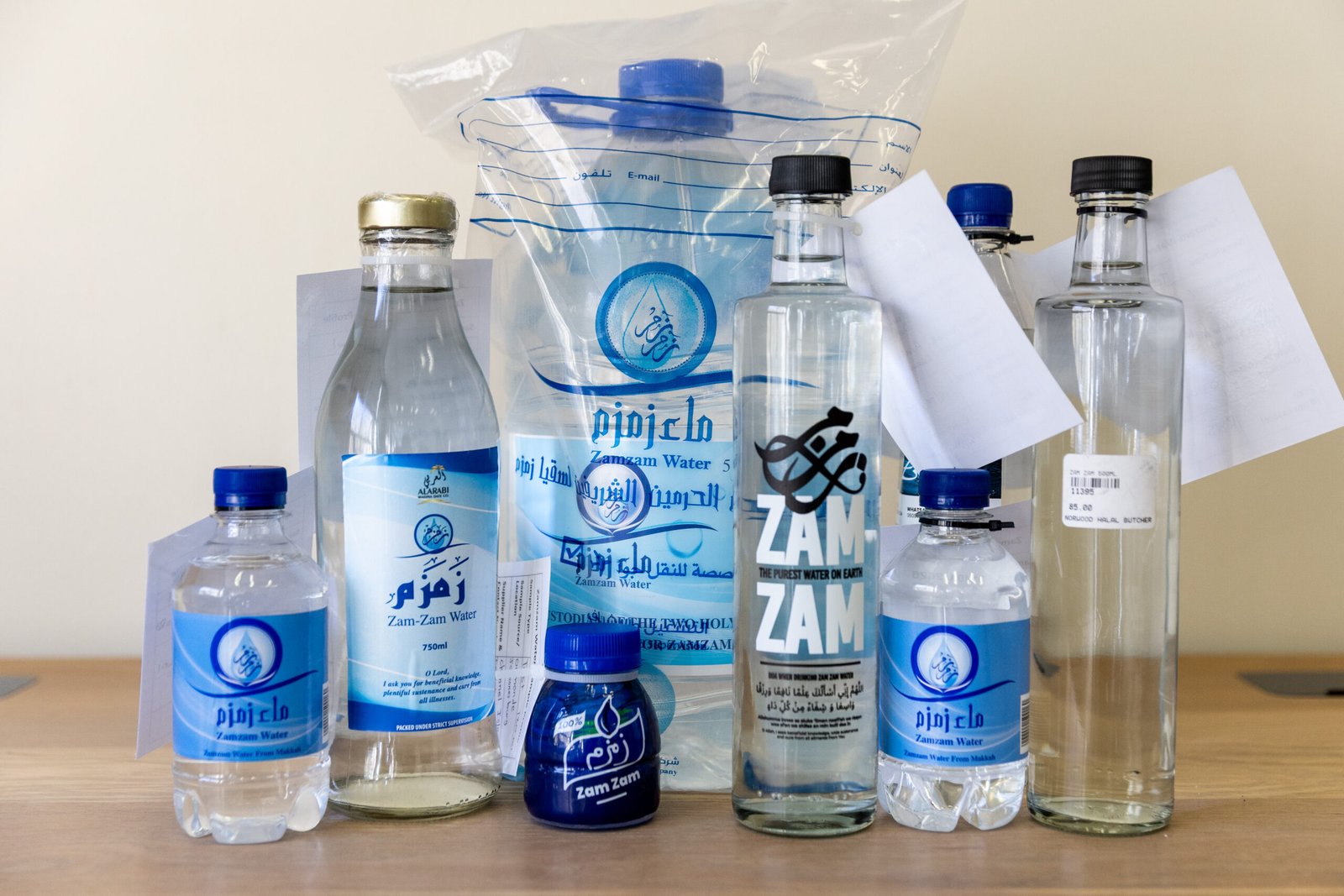
- Bottled Zamzam water sold outside Saudi Arabia has occasionally shown quality issues. The review recommends drinking directly from well sources or trusted, certified suppliers.
- The arsenic concerns raised in European media were not supported by repeated analyses (levels were 9.68–10.75 μg/L, well within the 10 μg/L WHO limit).
Conclusion: A Meeting of Faith and Evidence
This review by Khalid and colleagues does not claim that Zamzam water is miraculous in a supernatural sense. What it does provide is rigorous, peer-reviewed documentation that this water is genuinely different from any other drinking water studied to date.
- Higher essential minerals
- Unique isotopic age (11,000–40,000 years old)
- Safe radiological profile
- Distinct optical properties
- Preliminary evidence of biological effects (immune stimulation, tumor reduction, dental benefits, plant growth enhancement)
For the 1.8 billion Muslims worldwide, Zamzam water has always been a blessing. Now, the scientific community is beginning to understand why.
“And whoever honors the symbols of Allah—indeed, it is from the piety of hearts.” (Qur’an 22:32)
Reference: here
Other Articles: