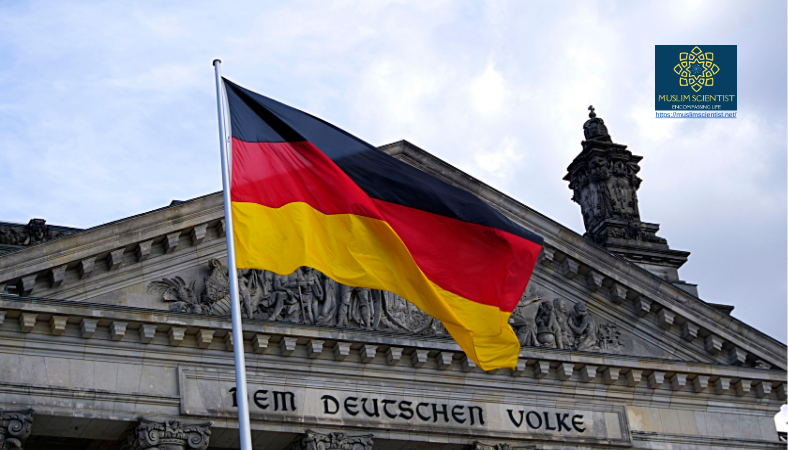
The collapse of Germany’s export model is not just an economic failure — it is a moral one. Islamic principles of justice, balance, and social solidarity offer a roadmap out of stagnation.
When a country as rich as Germany cannot secure stable jobs, rising wages, or public investment, the problem is not technical — it is ethical. Dr. Kalim Siddiqui’s analysis of Germany’s deepening crisis (World Financial Review, February 2025) describes an economy hollowed out by neoliberal policies: privatization, wage suppression, financial deregulation, and a worship of exports at the expense of domestic well-being.
From an Islamic perspective, these policies violate core Quranic principles of ‘adl (justice), tawazun (balance), and maslahah (public interest). The crisis is a symptom of a deeper spiritual and structural illness: replacing human welfare with shareholder value, and social solidarity with market absolutism.
The Prohibition of Hoarding (Ihtikar) and Germany’s Trade Surplus
Germany’s current account surplus — praised by mainstream economists as “competitiveness” — is seen differently in Islamic economics. The Prophet Muhammad (peace be upon him) said: “Whoever hoards foodstuffs for forty days, seeking a high price, has disassociated himself from Allah.” While classical hoarding refers to essential goods, modern scholars extend the principle to any practice that withholds resources from fair circulation.
Germany’s surplus (€65 billion with the U.S. alone in 2024) means the country saves more than it invests at home, while other nations go into debt to buy German goods. This is not balanced trade — it is structural hoarding. Allah commands in Surah Al-Hashr (59:7): “…so that it (wealth) does not become a monopoly circulating only among your rich.”
Instead of using its surplus savings to rebuild crumbling bridges, schools, and digital networks (net public investment near zero for 25 years), Germany exports capital. An Islamic economy would prioritize infrastructure development within the country first — creating local jobs and meeting local needs — before chasing external markets.
Wage Suppression and the Denial of Adl
One of Siddiqui’s most striking findings: real wages in Germany have barely increased in decades, even as productivity rose. This is a direct violation of the Islamic principle of fair compensation. The Prophet said: “Give the worker his wages before his sweat dries.” (Ibn Majah).
Neoliberal reforms, such as the notorious Arbeitslosengeld II (Hartz IV), replaced social security with punitive “workfare.” After 12 months of unemployment, a person who paid into the system for years receives nothing. This atomizes society, destroys dignity, and creates poverty even in a rich country.
In Islam, the state (wilayat al-hisbah) is responsible for ensuring basic needs — food, shelter, clothing, and healthcare — for all citizens, regardless of employment status. The Caliph Umar ibn al-Khattab famously said: “If a dog dies hungry on the banks of the Euphrates, Allah will hold me responsible.” A system that leaves its own contributors destitute after one year is not only economically unsound — it is un-Islamic.
Riba, Speculation, and the Destruction of Patient Capital
Germany was once a model of “patient capital” — banks and firms held long-term stakes, allowing companies to plan decades ahead. But financial deregulation (encouraged by neoliberal EU rules) brought hedge funds, private equity, and short-term value maximization. Siddiqui notes: “Unregulated financial markets further favoured asset purchases over asset creation.”
This is the world of riba (usury/interest) and gharar (excessive uncertainty). The Quran is explicit: “Allah has permitted trade and forbidden usury” (2:275). When financial engineering replaces productive enterprise, wealth becomes detached from work. Speculators profit without creating value — a practice Islam condemns.
An Islamic economic system would replace interest-based lending with profit-and-loss sharing (mudarabah, musharakah). Banks would invest as partners, not creditors. This encourages long-term, real-economy projects — exactly what Germany needs to rebuild its green energy grid and digital infrastructure.
The Debt Brake: A Rejection of Istikhlaf (Trusteeship)
Germany’s constitutional “debt brake” limits the federal structural deficit to 0.35% of GDP. This sounds prudent, but in practice it has strangled public investment. Schools decay, rail tracks buckle, and internet speeds lag behind Albania.
In Islam, the state does not operate like a household budget. The government is a trustee (khalifah) over public wealth. It has a duty to spend on collective goods, even if that requires borrowing — as long as the borrowing is not for wasteful consumption or riba-based. The Prophet said: “The ruler is a shepherd and is responsible for his flock.” (Bukhari). A shepherd who refuses to build a fence because he is “saving money” is negligent.
Islamic public finance allows for borrowing in the public interest (qard hasan or even conventional borrowing when no alternative exists) as long as the projects generate social returns. Germany does not lack resources — it lacks political will. Its surplus savings are idle while its people suffer from underinvestment.
What Would an Islamic Solution Look Like?
- Redirect surplus savings into domestic infrastructure and public transport.
- Raise wages so that consumption drives growth, not exports.
- Re-regulate finance to favor partnership models and long-term investment.
- Reinstate social security as a right, not a temporary mercy.
- Balance trade — surplus nations should help deficit nations by increasing imports, not hoarding dollars or euros.
Siddiqui concludes that “capitalism in Germany has failed as a social system.” From an Islamic viewpoint, it was never designed to succeed. A system built on interest, hoarding, wage suppression, and financial speculation cannot produce falah (human flourishing). Only a return to tawhidic principles — where all economic activity is accountable to Allah and serves the common good — can break the cycle of stagnation, inequality, and social breakdown.
As the Quran reminds us: “Indeed, Allah does not change the condition of a people until they change what is in themselves” (13:11). Germany’s crisis is a mirror. The question is whether we have the courage to see our own reflection.
Reference:
Siddiqui, K. (2025). The Political Economy of Germany’s Deepening Economic Crisis. World Financial Review.
Other Articles