Introduction: A Book Beyond Its Time
In the 7th century CE, the Arabian Peninsula was a land of oral poetry, tribal warfare, and superstition. The night sky, while beautiful, was a canvas for astrology and myth. The common belief was that the sun orbited the Earth, that the moon was a deity, and that stars were mere decorations or shooting arrows against devils. It was into this environment that the Quran was revealed to Prophet Muhammad (peace be upon him), a man who could neither read nor write.
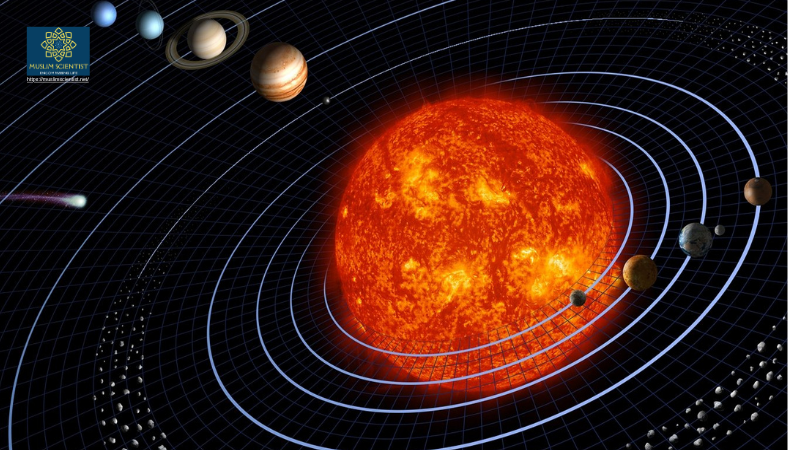
Remarkably, the Quran contains numerous verses that, when read today, align strikingly with modern astrophysics. One of the most profound scientific miracles (I’jaz ‘Ilmi) is the Quran’s consistent and emphatic description of celestial bodies—the sun, the moon, and the planets—each moving in a falak (an orbit or a curved path).
This article explores the miraculous nature of these verses, compares them with the history of science, and demonstrates why the Quran’s statements about orbital mechanics could not have been known to any human in the 7th century.
The Key Arabic Term: “Falak” and “Sabaha”
The primary miracle lies in the Quran’s precise vocabulary. Two key Arabic words are used:
- Falak (فلك) – This means an orbit, a curved path, a celestial sphere, or a rotating cycle.
- Sabaha (سبح) – This means to swim, to float, or to move swiftly in a fluid medium.
When we combine these, the Quran describes celestial bodies as “swimming” in their “orbits.” This is not a static, geocentric model. This is a dynamic, heliocentric-esque model of perpetual motion.
Verse 1: The Sun and Moon in Their Own Orbits
The most famous verse on this topic is Surah Al-Anbiya (The Prophets), Chapter 21, Verse 33:
“And He it is Who created the night and the day, and the sun and the moon. Each (just like a ship in water) is floating / swimming in its own orbit (falak).” (Quran 21:33)
Let us analyze the miraculous elements here:
- “Each” (Kullun): This word is inclusive. It separates the sun and the moon. In 7th-century thinking, the sun and moon were often considered a pair with similar functions. The Quran says they are each distinct and operate individually.
- “Swimming” (Yasbahoona): The verb implies motion through a medium. Today, we know the sun is moving through the Milky Way galaxy at 720,000 km/h towards the star Vega (the Solar apex). The moon is moving through space around the Earth at 3,683 km/h. They are literally “swimming” through the vacuum of space, governed by gravity.
- “Its own orbit” (Fi Falakin): This is the coup de grâce. The Quran says the sun has its own orbit, and the moon has its own orbit. For centuries, astronomers believed the sun was stationary or that only the moon orbited Earth. It wasn’t until Nicolaus Copernicus (1543 CE) and later Johannes Kepler (1609 CE) that the heliocentric model proved the Earth orbits the sun. Even then, it took until the 20th century to discover that the sun itself orbits the center of the Milky Way—a galactic orbit taking 225–250 million years.
Verse 2: The Sun’s “Resting Place” – A Dynamic System
Surah Ya-Sin, Chapter 36, Verse 38:
“And the sun runs on its fixed course (mustaqarrin laha) for a term appointed. That is the decree of the Almighty, the All-Knowing.” (Quran 36:38)
The word Mustaqarr has two meanings: (1) a fixed resting place, and (2) a determined time/term. Classical commentators debated this. Some said it meant the sun sets in a muddy spring (metaphorical). But modern science reveals a stunning reality:
- The sun does have a resting place: The Solar Apex (the direction towards which the sun is moving).
- The sun does have an appointed term: In about 5 billion years, the sun will exhaust its hydrogen fuel, expand into a red giant, and eventually collapse into a white dwarf. The sun’s “running” has an expiry date.
Furthermore, the verse says the sun runs. It does not say it stands still. For 1,400 years, this contradicted the geocentric model (where the sun rose and set due to Earth’s rotation, but the sun itself was fixed relative to the stars). Today, we know the sun is racing through space.
Verse 3: The Moon’s Measured Phases and Orbit
Surah Al-Furqan, Chapter 25, Verse 61:
“Blessed is He Who has placed in the sky great stars and placed therein a [great] lamp (sun) and a moon giving light. And He it is Who has made the night and the day successive, for whoever desires to remember or desires to show gratitude.”
But the detailed orbit is in Surah Ya-Sin, Verse 39:
“And the moon – We have measured for it mansions (until it returns like an old dried curved date stalk).” (Quran 36:39)
This verse describes the moon’s orbit in 28 distinct phases (“mansions” or manazil). The moon’s orbit is not a perfect circle; it’s an ellipse. As it moves, it appears to change shape from a thin crescent (like an old date stalk) to a full moon. The Quran’s analogy of a “dried curved date stalk” is visually perfect for the thin crescent moon just after a new moon.
Verse 4: The Planets and All Celestial Bodies
The Quran does not stop at the sun and moon. It expands the rule to all celestial objects.
Surah An-Nazi’at (Chapter 79, Verse 30-33):
While discussing the creation of the heavens and earth, the context implies order.
More directly, Surah Ar-Rahman (Chapter 55, Verse 5):
“The sun and the moon follow precisely computed courses (husban).”
But Surah Al-Anbya (21:33) already used “each” – a universal pronoun. And Surah Ash-Shu’ara (26:176-184) speaks of the “stars” and “paths.”
Most explicitly, the Quran states in Surah Al-An’am (6:75-79) that Abraham witnessed a celestial body (a planet – possibly Venus or Jupiter) and noted it “set” (had an orbit), concluding that only the Creator of these orbits is worthy of worship.
Comparative Analysis: Quran vs. History of Science
To understand the miracle, we must see the timeline.
Historical Beliefs vs. The Quranic Statement
| Civilization / Era | Belief About the Sun | Belief About the Moon | Belief About Planets |
|---|---|---|---|
| Ancient Babylonians (2000 BCE) | A god (Shamash) who rode a chariot across the sky. | A god (Sin) with its own chariot. | Wandering stars with no fixed orbits; omens from gods. |
| Ptolemaic / Greek (150 CE) | Geocentric: Sun orbits the Earth in a perfect circle. | Geocentric: Moon orbits Earth, but with epicycles. | Planets move in “epicycles” (circles on circles) around Earth. |
| European Middle Ages (500-1500 CE) | Church dogma: Earth is fixed, sun moves. | A subordinate light that orbits Earth. | Wandering stars in a crystalline sphere. |
| Copernicus (1543 CE) | Heliocentric: Earth orbits the sun. But sun is fixed in space. | Moon orbits Earth. | Planets orbit the sun. |
| Galileo (1610 CE) | Proved heliocentric model, but still thought sun was fixed. | Saw moons of Jupiter (other bodies have orbits). | Confirmed planetary orbits. |
| Modern Astrophysics (20th-21st Century) | The sun has its own orbit around the galactic center (230 million years). | Moon’s orbit is expanding at 3.8 cm/year. | Every planet has a unique elliptical orbit. |
| The Quran (609-632 CE) | The sun swims in its own orbit (21:33) and has an appointed term (36:38). | The moon swims in its own orbit (21:33) with measured phases (36:39). | Each (kullun) – meaning all celestial bodies – have their own orbit. |
The Miracle of Precision: No Geocentrism, No Errors
What makes this a miracle is what the Quran does not say. It does not say the sun orbits the Earth. It does not say the stars are fixed. It does not say the moon gives its own light (it calls the sun a “lamp” or “blazing fire” – siraj – and the moon a “reflected light” – noor – a distinction made in 10:5). The Quran distinguishes between the sun’s generated light and the moon’s reflected light, a fact only proven by science in the 17th century via Newton’s optics.
How Could an Illiterate Man Know?
The Prophet Muhammad (PBUH) lived in Mecca and Medina. There were no telescopes (invented 1608 CE), no astrophysics (Newton, 1687 CE), no spectroscopy (Fraunhofer, 1814 CE). The Arabs were masters of language, not astronomy. They believed the sun set into a muddy spring (based on a misinterpreted folk story, not the Quran). The Quran came and corrected their local myths with universal truths.
The only logical conclusion for a believing Muslim is that the Creator of the heavens revealed this knowledge. For a neutral observer, the predictive accuracy is a profound anomaly that demands explanation.
Verse 5: The Harmony of Orbits – No Collisions
Surah Ya-Sin (36:40) provides the ultimate conclusion:
“It is not permitted for the sun to catch up to the moon, nor can the night outrun the day. Each (just like a ship in water) is floating / swimming in its own orbit (falak).”
This verse is a masterpiece of scientific foresight. The sun and moon are on vastly different orbital paths:
- The sun’s orbit (galactic): 225 million years.
- The moon’s orbit (around Earth): 27.3 days.
They will never collide. The “night” and “day” are results of Earth’s rotation, not the sun moving. The night cannot “outrun” the day because the Earth’s spin is constant. The Quran presents a clockwork universe of precise, non-conflicting orbits.
Modern Scientific Data Confirming Quranic Verses
| Quranic Verse | Claim | Modern Scientific Fact | Date of Scientific Discovery |
|---|---|---|---|
| 21:33 | Each (sun & moon) swim in an orbit. | Sun orbits Galactic Center; Moon orbits Earth; Earth orbits Sun. | 1915 CE (Galactic rotation confirmed by Shapley) |
| 36:38 | Sun runs to a fixed resting place for a term. | Sun moves towards Solar Apex (constellation Hercules) and will die in 5 billion years. | 1850 CE (Solar apex discovered by Argelander) |
| 36:39 | Moon has measured mansions and returns like a dry date stalk. | Moon has 28 phases (mansions). The crescent looks exactly like a dry, curved date stalk. | Ancient observation, but physics explained by 1687 CE (Newton) |
| 36:40 | Sun cannot catch moon; night cannot outrun day. | Orbital planes are different (Earth’s orbital plane vs Moon’s is tilted 5°). Earth’s rotation is constant. | Known with certainty by 1700 CE |
| 10:5 & 25:61 | Sun = Diya (blazing light/lamp), Moon = Noor (reflected light). | Sun produces light via nuclear fusion. Moon reflects sunlight. | 1660s CE (Newton’s prism experiments) |
Conclusion: A Sign for Thinking People
The Quran repeatedly calls upon humanity to reflect on the heavens. In Surah Al-Imran (3:190), it says: “Indeed, in the creation of the heavens and the earth and the alternation of the night and the day are signs for those of understanding.”
The orbital verses are not just poetry. They are precise, testable, and falsifiable claims made in a pre-scientific age. The fact that they have passed every test of modern astrophysics—from Kepler’s laws to galactic dynamics—is, for the believer, a clear miracle. It demonstrates that the Quran is not the word of a man, but the word of the One who created the orbits, the One who set the sun and moon into their eternal, swimming motion.
Reference: here
Other Articles: