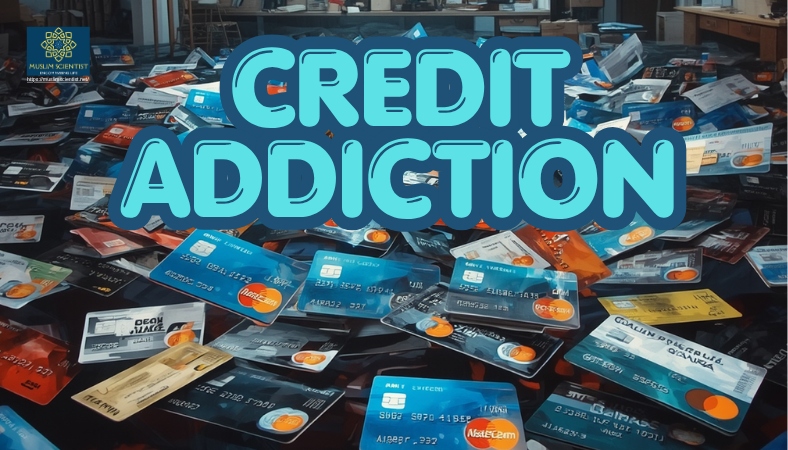
When you hear the word “addiction,” you probably think of alcohol, drugs, or gambling. But a growing body of research suggests that for millions of people, the act of borrowing money has become just as compulsive – and just as destructive.
It is called creditholism (credit addiction). And according to a study by Polish researcher Robert Jeżewski of the Pomorska Szkoła Wyższa, it follows the exact same psychological pattern as alcoholism: euphoria, tolerance, withdrawal, shame, and relapse.
The difference is that while most people recognize the dangers of drinking too much, almost no one recognizes the dangers of borrowing too much – until it is too late.
But fourteen centuries ago, Islam had already identified the spiritual disease that drives this behavior. The Quran and the teachings of Prophet Muhammad (peace be upon him) offer not only a diagnosis but a cure.
The Debt Spiral: How It Starts
For most people, taking out a loan is a practical tool. You borrow to buy a house, a car, or to cover an unexpected medical bill. You repay it. Life goes on.
But for a creditholic, the experience is entirely different.
According to Jeżewski’s study, when a vulnerable person takes out a loan, they experience a sudden feeling of relief, relaxation, and even euphoria – strikingly similar to the feeling after drinking alcohol. The money itself is almost secondary. What matters is the emotional effect.
“Quick and easy help in the form of financial resources results in the appearance of relief and relaxation similar to the feelings after drinking alcohol,” Jeżewski writes.
Over time, the borrower needs larger or more frequent loans to achieve the same feeling. They may start with standard bank loans, then move to high-interest payday loans, then to borrowing from relatives, then to pawning possessions.
Eventually, they fall into what researchers call a “debt spiral” or “credit loop.” They cannot repay their existing debts, so they take out new loans to cover the old ones. Each new loan provides temporary relief – followed by even greater stress. The only “solution” they can see is to borrow again.
What Islam Says About Debt: A Surprising Urgency
For many Muslims, debt is a sensitive topic. Some think borrowing is completely forbidden. Others treat it too casually. The truth is somewhere in between – and it is far more urgent than most realize.
The Prophet Muhammad ﷺ spoke about debt with remarkable seriousness. In a famous hadith recorded in Sahih al-Bukhari, he said:
“O Allah, I seek refuge in You from sin and debt.”
Notice the order. The Prophet sought protection from debt immediately after seeking protection from sin. Some scholars explain that the burden of debt affects not only this life but also the next. Another hadith states that a martyr (shahid) is forgiven for everything except debt. The Prophet ﷺ even refused to perform the funeral prayer for a person who died with unpaid debt until a companion agreed to repay it.
This does not mean borrowing is haram (forbidden). Islam permits borrowing in cases of genuine need. But it strongly warns against unnecessary borrowing and any borrowing that leads to harm – which is exactly what creditholism does.
Allah says in the Quran:
“And do not kill yourselves (nor kill one another). Surely, Allah is Most Merciful to you.” (Quran 4:29)
Compulsive borrowing that leads to depression, stress-related illnesses, broken families, and suicidal thoughts is a form of self-harm. And self-harm is forbidden.
Key Symptoms of Creditholism – And What Islam Says
| Symptom | Percentage | Islamic Ruling / Warning |
|---|---|---|
| Hiding borrowing behavior from family | 100% | Deception is forbidden; believers are truthful. |
| Frustration when loan application rejected | 94% | Attachment to wealth is a trial; contentment (qana’ah) is a virtue. |
| Compulsive checking of loan offers | 81% | This is waswas (whisperings of Shaytan); seek refuge in Allah. |
| Anxiety if not checking loan offers | 81% | Trust in Allah (tawakkul) replaces anxiety. |
| Abandoning activities for loan browsing | 75% | Waste of time (israf) is forbidden. |
| Having other behavioral addictions | 100% | Cross-addiction indicates spiritual emptiness. |
The Quranic Diagnosis: “Competition for More” (Surah At-Takathur)
The psychology of creditholism is not new. The Quran described it vividly 1,400 years ago in Surah At-Takathur (Chapter 102):
“The competition for more (wealth, children, status) distracts you, until you visit the graves.” (Quran 102:1-2)
This verse captures the essence of compulsive borrowing perfectly. The addict is not borrowing to meet a genuine need. They are borrowing because they are distracted by the desire for “more” – more comfort, more status, more illusion of stability. And this distraction continues until death.
The Prophet ﷺ explained that even a person who has enough can be afflicted by this disease. He said: “If the son of Adam had a valley full of gold, he would desire to have two valleys. Nothing fills his mouth except dust (the grave). And Allah accepts the repentance of those who turn to Him” (Sahih al-Bukhari).
This is the root of creditholism: insatiable desire. And Islam teaches that the only cure is to redirect that desire toward Allah – through contentment (qana’ah), gratitude (shukr), and trust (tawakkul).
The Role of Riba (Usury/Interest) – Fueling the Fire
Many creditholics do not borrow from family or interest-free sources. They borrow from banks and payday lenders that charge riba (interest) – which is explicitly forbidden in the Quran.
Allah says:
“Those who consume interest will not stand (on the Day of Resurrection) except like the standing of a person beaten by Shaytan into insanity.” (Quran 2:275)
The comparison to insanity (or possession) is striking. Modern science now shows that compulsive borrowing creates neurological changes similar to drug addiction. The Quran described this spiritual and psychological state centuries ago.
Riba-based loans make the debt spiral worse. High interest rates mean that even if the borrower tries to repay, the debt grows faster than they can pay. This leads to the “snowball effect” described by Jeżewski – small debt becomes unmanageable debt, and the borrower feels trapped.
Islam offers an alternative: interest-free loans (qard hasan) – a beautiful loan given for the sake of Allah, without any profit for the lender. The Quran promises that Allah will multiply the reward of those who give qard hasan (57:11). This system prevents the debt spiral by removing the compounding interest that destroys borrowers.
Demographics – Who Is Most at Risk? (Islamic Reflection)
| Demographic Factor | Risk Level | Islamic Perspective |
|---|---|---|
| Men vs. women | Men: 120% higher risk | Men may feel greater social pressure to provide; Islam teaches provision is from Allah. |
| Primary/secondary education vs. higher | Twice as likely | Ignorance of halal alternatives and budgeting is harmful; seeking knowledge is an obligation. |
| Having another behavioral addiction | 100% | Spiritual emptiness leads to multiple substitutes; filling the heart with dhikr is the cure. |
| Having three or more other addictions | 29% | Severe disconnection from purpose of life (tawhid). |
The “Learned Helplessness” Trap – And the Islamic Solution
Many debtors suffer from what psychologists call learned helplessness. When financial problems begin to overwhelm them, they either run away from them or become completely indifferent. They hope that someone else will fix the problem – or that it will miraculously solve itself.
Islam has a direct answer to this: tawakkul (trust in Allah) combined with action (as-sabab) . The Prophet ﷺ famously said: “Tie your camel first, then put your trust in Allah” (Sunan al-Tirmidhi).
Learned helplessness means someone has stopped tying their camel. They have given up. Islam commands the opposite: seek help, make a plan, work hard, repent, and then leave the result to Allah. The Quran says:
“Indeed, Allah will not change the condition of a people until they change what is in themselves.” (Quran 13:11)
For the creditholic, this means: stop the behavior, seek professional help, make sincere repentance (tawbah), and take practical steps – budgeting, debt consolidation (in a halal way), and seeking financial counseling.
The Consequences: More Than Just Debt – A Spiritual Crisis
The damage caused by creditholism is not limited to bank accounts. According to the study, by the time creditholics seek help, they are usually already in a very advanced stage of the addiction.
Many have:
- Bailiffs seizing their possessions
- Multiple court cases
- Stress-related illnesses (hypertension, insomnia, depression)
- Strained or broken family relationships
- Suicidal thoughts
From an Islamic perspective, these are not just worldly problems. The Prophet ﷺ taught that the body has a right over us, and our families have rights over us. Destroying one’s health and family relationships through compulsive borrowing is a violation of these rights. It is a form of dhulm (oppression) – against oneself and against others.
The Quran warns:
“And do not throw yourselves into destruction with your own hands.” (Quran 2:195)
Compulsive debt that leads to stress, broken homes, and self-harm is exactly the kind of destruction the Quran commands us to avoid.
Islam’s Practical Path Out of the Debt Spiral
Islam does not leave the addict without hope. The door of repentance (tawbah) is always open. Allah says:
“Say: O My servants who have transgressed against themselves (through sin), do not despair of the mercy of Allah. Indeed, Allah forgives all sins.” (Quran 39:53)
For the creditholic, the following Islamic steps are essential:
1. Sincere Repentance (Tawbah)
Stop the behavior immediately. Feel genuine remorse. Resolve never to return to compulsive borrowing. Ask Allah for forgiveness.
2. Seeking Halal Alternatives
If there is genuine need, seek interest-free loans (qard hasan) from family, community funds, or Islamic financial institutions. Avoid riba completely.
3. Contentment (Qana’ah)
The Prophet ﷺ said: “Richness is not having many possessions. Rather, true richness is the richness of the soul” (Sahih al-Bukhari). Learn to be content with what Allah has provided. This directly counters the insatiable desire that drives creditholism.
4. Professional Help
Islam does not forbid seeking medical or psychological treatment. Compulsive borrowing is a disease of the heart and mind. Counseling, support groups (like Anonymous Creditholics), and financial advice are permissible and encouraged.
5. Zakat and Community Support
If you are trapped in debt, you may be eligible to receive zakat funds. Allah explicitly lists debtors as one of the eight categories of zakat recipients (Quran 9:60). Do not be too proud to ask for halal help.
6. Du’a (Supplication)
The Prophet ﷺ taught specific prayers for debt relief. One of them is:
“O Allah, I seek refuge in You from anxiety, grief, incapacity, laziness, miserliness, cowardice, the burden of debt, and being overpowered by men” (Sunan al-Tirmidhi).
Make this du’a daily.
Why Isn’t Creditholism Recognized – And Why Muslims Should Care
Despite the severity of its consequences, creditholism remains marginalized in addiction research. Jeżewski notes that researchers focus heavily on well-known behavioral addictions like alcoholism and gambling, while newer addictions like shopaholism and phonoholism receive less attention.
Creditholism, he writes, is “completely alienated.”
Muslims should care about this for two reasons:
- Prevention. Islam forbids waste, extravagance, and harmful behavior. Raising awareness about creditholism within Muslim communities can prevent people from falling into the debt spiral in the first place.
- Compassion. The Prophet ﷺ was known for his mercy. He forgave debts, helped the indebted, and encouraged others to do the same. Muslims should be at the forefront of helping those trapped by credit addiction – without judgment, with practical support.
A Final Word: The Way Out Is Up
Creditholism is not a hopeless condition. People recover. Brains rewire. Debts get repaid. And Allah’s mercy is vast.
If you or someone you know is caught in the debt spiral, take the first step today. Stop the cycle. Ask for help. Make du’a. And remember the words of the Prophet ﷺ:
“Whoever would like Allah to save him from the distress of the Day of Resurrection, let him give respite to an indebted person who is in difficulty or let him forgive the debt” (Sahih Muslim).
This is how Islam transforms the debt crisis – not through shame, but through mercy, community, and trust in Allah.
Reference: here
Other Articles: