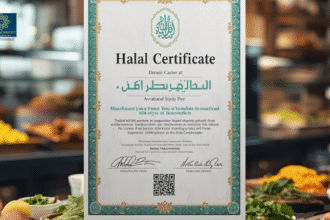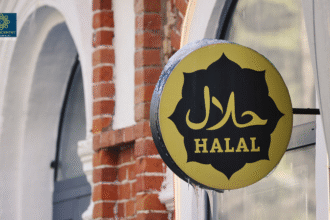
Every day, millions of Muslims around the world check food labels. They look for that small halal logo. It gives them confidence. It tells them the chicken, the beef, or the packaged meal meets Islamic dietary laws.
But how reliable are those labels? Can consumers really trust that every certified product is truly halal?
Researchers at the University of Sharjah in the United Arab Emirates have built an answer. They developed a blockchain-based system that makes halal food certification transparent, tamper-proof, and highly efficient. Their work was published in the journal Blockchain Research and Applications.
What Is Blockchain, in Simple Words?
You have probably heard of blockchain because of Bitcoin or cryptocurrency. But blockchain is much more than digital money.
Think of a blockchain as a digital notebook. This notebook is shared across many computers. Once someone writes something in it, no one can erase or change it. Every entry has a timestamp and a digital signature. Everyone in the network can see the same information.
This makes blockchain perfect for certification systems. No one can forge a certificate. No one can hide a mistake. Everything stays on the record forever.
How Blockchain Fixes Problems in Current Halal Certification
| Current Problem | How Blockchain Solves It | Benefit for Consumers |
|---|---|---|
| Paper certificates can be forged | Digital records cannot be altered | No more fake halal labels |
| Low transparency between parties | Everyone in network sees same data | You can trust the process |
| Slow manual processes | Smart contracts automate steps | Faster certification |
| Lost or damaged documents | IPFS cloud storage keeps files safe | Permanent record of halal status |
| One central point of failure | Semi-decentralized network | No single authority can manipulate data |
Source: Adapted from Abu Talib et al. (2025), Blockchain Research and Applications
The Current Halal Certification System Has Weak Spots
The UAE currently runs its halal certification through the Ministry of Industry and Advanced Technology (MoIAT). Manufacturers apply for certification. Conformity Assessment Bodies (CABs) inspect factories and test products. Then MoIAT grants or denies the halal certificate.
This system works. However it has limitations.
Paper documents can be lost or forged. Different parties do not always share information openly. Human errors can occur during manual processing. And because the system is centralized, one weak point could affect everything.
Muslim consumers in the UAE have shown concern about halal status before. A 2011 survey found that people worried specifically about beef, chicken, and turkey products. Their anxiety was not imaginary. Food fraud is a real global problem.
Performance of the New Blockchain System (Test Results)
| Type of Operation | Transactions Per Second | Average Latency | Success Rate |
|---|---|---|---|
| Reading a certificate (query) | Up to 197 TPS | 0.01 seconds | 100% |
| Issuing a new certificate (write) | Approximately 23 TPS | 6 to 80 seconds | Over 99% |
| Unauthorized approval attempt | 0 successful out of 200 | N/A | 100% blocked |
Source: Abu Talib et al. (2025), performance benchmarking using Hyperledger Caliper
The numbers show an important pattern. Checking a halal certificate is almost instant. The system can handle nearly 200 verification requests per second with virtually no delay. Issuing a new certificate is slower, but still efficient. Most importantly, the system completely blocked all fake approval attempts during testing.
How the New System Actually Works
The researchers built a full working prototype. It includes a user interface, a backend server, a database, and a Hyperledger Fabric blockchain network.
Two main actors interact with the system. The manufacturer submits applications and ingredients lists. MoIAT reviews requests, checks compliance, and issues certificates.
Every step gets recorded on the blockchain. When a manufacturer applies, a transaction is written. When MoIAT approves, another transaction follows. No one can skip steps. No one can change past decisions.
Documents like ingredients lists and halal certificates are not stored directly on the blockchain. That would be too expensive and slow. Instead, the system uses IPFS, a decentralized file storage system. Each document receives a unique digital fingerprint called a CID. Only that fingerprint goes onto the blockchain.
This clever design keeps costs low while maintaining security. The actual document can be retrieved when needed, but the fingerprint proves it has not been tampered with.
Smart Contracts Automate the Process
The brains of the system are smart contracts, also called chaincode in Hyperledger Fabric. These are self-executing programs that follow strict rules.
A manufacturer cannot approve their own application. The smart contract checks the user’s identity first. Only MoIAT officials can change an application status from “requested” to “pending” to “approved.”
The system also follows a strict sequence. An application cannot go from “requested” to “approved” directly. It must pass through “pending” first. This mirrors the real certification process where factory inspections and product testing must happen before a decision.
If MoIAT rejects an application, the manufacturer can appeal once. The smart contract allows this but only one time. After that, the decision is final.
Security Test: Hackers Could Not Break In
The researchers specifically tested whether the system could resist unauthorized actions. They wrote a malicious script. It pretended to be a manufacturer trying to approve its own halal certificate.
They ran 200 attempts. Every single one failed.
The smart contract checked the caller’s identity at the start of each function. Since the manufacturer did not have MoIAT credentials, the transaction was rejected immediately. No certificate was issued. No ledger was altered.
This test proves that blockchain access control works. Even if someone hacks into the application interface, they cannot bypass the rules written into the smart contract.
Why This Matters for Muslim Consumers
For ordinary Muslims buying food, this technology offers real peace of mind.
Currently, you trust the halal logo because you trust the certification body. But you have no way to verify the certificate yourself. You cannot see the inspection reports. You cannot trace the chicken back to the slaughterhouse.
With a blockchain-based system, all of that becomes possible. A consumer could scan a QR code on a product package. The code would pull up the halal certificate from the blockchain. They could see when it was issued, who approved it, and whether it is still valid.
This transparency does not exist today. Blockchain makes it possible without compromising security or privacy.
The UAE’s Strategic Advantage
The UAE wants to become a global hub for the Islamic economy. Halal food is a huge part of that vision. The country currently issues approximately 7,585 Halal National Mark certificates annually.
But demand is growing. The UAE halal food market is projected to grow at 6.45% annually. By 2035, peak daily demand could reach 400 certifications.
The new blockchain system can handle far more than that. Write operations max out at about 23 transactions per second. That equals roughly 496,800 certificates per day, far above any realistic future demand.
Verification capacity is even higher. The system can process 197 queries per second with almost no delay. That means millions of consumers could check halal status simultaneously without slowing the system down.
Physical Inspections Still Matter
The researchers are honest about limitations. Their prototype handles the software side of certification. But physical inspections remain essential.
Factory assessments, product testing, and audit reporting cannot be automated. Trained inspectors must visit production sites. They must verify slaughter methods. They must test for prohibited ingredients.
The blockchain records the outcomes of these inspections. But it does not replace them. The technology secures the data, not the physical process itself.
For future work, the researchers suggest integrating IoT sensors. Smart devices in factories could send temperature, humidity, and contamination data directly to the blockchain. This would create an even stronger link between physical reality and digital records.
Challenges Before Full Adoption
Despite the technical success, several hurdles remain before MoIAT or other authorities adopt this system.
First, blockchain is still new. Government employees may not understand how it works. Training would be required. Some staff might resist change.
Second, the current certification system is not broken. It functions effectively. Upgrading to blockchain costs money and effort. Decision-makers may ask why change is necessary.
Third, UAE data privacy law (Federal Decree Law No. 45) gives individuals the right to correct or erase their data. Blockchain’s immutability conflicts with this right. However the researchers note that storing only hashed CIDs on-chain may avoid this conflict, since hashes are not personal data.
Fourth, integrating blockchain with existing legacy systems requires significant middleware rework. Organizations cannot simply add blockchain on top of old databases.
These barriers are not impossible to overcome. But they require careful planning and clear communication of benefits.
How This Compares to Other Blockchain Food Systems
The researchers compared their system against five other blockchain projects.
Public blockchains like Ethereum (used by HalalChain and AgriBlockIoT) suffer from slow speeds and gas fees. They achieve only 15 to 38 transactions per second. Latency ranges from 1.2 to 7 seconds. Every transaction costs money.
Permissioned blockchains like Hyperledger Fabric perform much better. Food Safety Distribution achieved 207 TPS. AgriFoodCreditChain reached 21 TPS. The proposed system matches or exceeds these numbers while adding no gas fees.
The key advantage of permissioned blockchain is control. MoIAT decides who can join the network. It sets the rules. It maintains authority. This fits perfectly with government-regulated certification systems.
A Complete Prototype, Not Just a Theory
Many academic papers propose ideas without building anything real. This research is different. The team created a fully functional prototype.
You can find the source code on GitHub. The frontend uses React. The backend runs Express and the Fabric SDK. The database is MongoDB. The blockchain network uses Hyperledger Fabric with Raft consensus.
Each component was tested. The system successfully handles document uploads to IPFS. It stores CIDs on-chain. It enforces role-based access control. It maintains a complete audit trail of every application.
This is not a concept. It is a working system ready for pilot deployment.
What Comes Next
The researchers have already identified future improvements.
A mobile application would make the system more accessible. Factory inspectors could upload reports from their phones. Manufacturers could track applications anywhere.
Encrypting document CIDs before storing them on-chain would add another security layer. Only authorized parties could decrypt and retrieve documents.
Integrating a payment gateway would complete the financial loop. Currently, manufacturers pay MoIAT at application submission and again at certificate issuance. This process could also be automated with smart contracts.
Finally, expanding the system to other countries would require adapting to different regulations. But the core architecture is flexible. Any government with a halal certification system could adopt a similar model.
Conclusion: A New Standard for Trust
Trust is the foundation of halal certification. Muslims trust that the logo on their food package means something real. They trust that inspectors did their job. They trust that no one cheated.
Blockchain does not replace that trust. But it strengthens it with mathematical proof. Every certificate becomes verifiable. Every step becomes traceable. Every change becomes permanent.
The University of Sharjah team has shown that this technology is not science fiction. It works. It scales. It resists attacks. And it aligns perfectly with government regulatory frameworks.
For the UAE, this innovation supports its ambition to lead the global halal economy. For Muslim consumers worldwide, it offers something precious: certainty.
As the researchers note, the current system still works. But upgrading it with blockchain is not fixing something broken. It is preparing for a future where transparency and security are not optional. They are expected.
The next time you see a halal logo, remember. Behind that simple symbol, scientists are building technology to ensure it means exactly what it says.
Reference: here
Other Articles: