A Ranking That Shook the Western World
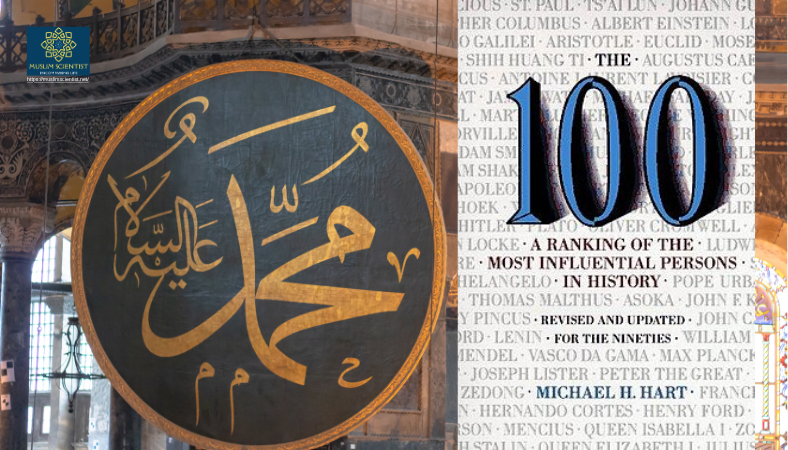
When American astrophysicist Michael H. Hart published The 100: A Ranking of the Most Influential Persons in History in 1978, few expected his top choice. The number one spot went not to a Western scientist, a European monarch, or a classical philosopher. It went to the Prophet Muhammad (PBUH) .
Hart, a Princeton-educated scientist and a Jew by birth, ranked the Prophet above Isaac Newton, Jesus Christ, and Albert Einstein . This choice surprised many Western readers. However, Hart defended his decision with rigorous historical logic. He examined not “greatness” or moral virtue, but measurable influence—the extent to which a person’s actions changed the course of human history .
Why Muhammad PBUH Topped the List
Hart presented two principal arguments for ranking Muhammad first .
First, Muhammad’s PBUH role in Islam was uniquely personal and comprehensive. Jesus, Hart noted, provided ethical teachings, but Saint Paul largely developed Christian theology and spread the faith. In contrast, Muhammad established both the theology and practices of Islam. He received the Qur’an, taught its meanings, and modeled its application in daily life. His influence on Islam exceeds the combined influence of Jesus and Paul on Christianity .
Second, Muhammad PBUH succeeded as both a religious and secular leader. Unlike Jesus, who did not establish a political state, Muhammad unified the Arabian Peninsula. He founded a community, governed a nation, and led military campaigns. This dual achievement remains unparalleled in human history .
Hart further observed that Muhammad PBUH rose from humble origins in Mecca—a backward region far from centers of civilization—to become an immensely effective political leader . The Arab conquests, he argued, would likely not have occurred without Muhammad’s singular leadership. By contrast, many historical events might have happened even without their famous leaders .
Michael Hart’s Top 10 Most Influential Persons in History (1992 Edition)
Source: Hart, Michael H. The 100: A Ranking of the Most Influential Persons in History, 1992 edition
The Global Reception and Impact
Hart’s ranking received mixed reactions. Western critics questioned his methodology and conclusions . However, the Muslim world embraced the book with enthusiasm. Muslim scholars and writers frequently cite Hart’s work to demonstrate that even objective Western analysis acknowledges the Prophet’s supreme influence .
In 1988, Egyptian President Hosni Mubarak honored Hart for his scholarly courage . The book has since sold over 500,000 copies and been translated into 15 languages . For many Muslims, Hart’s ranking provides powerful validation in an era of widespread Islamophobia and misrepresentation.
Hart’s Reasons for Ranking Muhammad PBUH #1
Hart’s Contested Language: A Critical Analysis
Not all Muslim scholars view Hart’s work as purely praiseworthy. A critical examination reveals that Hart used language that some consider problematic . He described the Prophet’s marriage to Khadijah as improving his “economic position,” and used the word “fled” to describe the Hijra to Medina .
Most significantly, Hart used the term “secular” to describe the Prophet’s political role. Yet in Islamic theology, the Prophet’s leadership was never secular—it was divinely guided. Hart also described the Prophet as the “author” of the Qur’an, contradicting Islamic belief that the Qur’an is the literal word of God .
Nevertheless, other scholars note that Hart’s overall intent was not malicious. His ranking reflects genuine historical influence, even if his terminology occasionally reflects Western secular assumptions .
Umar Ibn Al-Khattab: The Second Caliph’s Recognition
Hart’s book also included another Muslim figure: Umar ibn Al-Khattab (RA), the second Caliph of Islam. He ranked Umar as number 52 on the list—higher than Julius Caesar and Charlemagne .
Hart praised Umar’s brilliant leadership during the Islamic conquests. Under Umar’s governance, Islamic territory expanded rapidly, yet he ordered armies not to force conversions . Hart noted that “the Arab conquest was more a nationalist war of conquest rather than a holy war,” highlighting Umar’s pragmatic statesmanship .
Umar’s inclusion demonstrates how the Prophet’s influence extended beyond his own lifetime. His training produced leaders who shaped civilization for centuries . Hart’s dual recognition of Muhammad and Umar underscores the lasting impact of early Islamic leadership.
The Secret Behind Supreme Success
Why did Muhammad PBUH achieve such unparalleled influence? Some Muslim scholars point to the Treaty of Hudaybiyyah as a turning point . This 628 CE peace treaty appeared to be a concession—even a defeat. Yet the Qur’an described it as a “clear victory” .
The treaty allowed Muslims to return to Mecca peacefully the following year. Within two years, the Prophet entered Mecca with 10,000 followers, and the city surrendered without bloodshed . This approach—prioritizing peace and reconciliation over confrontation—demonstrates wisdom and long-term vision.
Contemporary Relevance
Hart’s recognition remains relevant today. Muslim communities worldwide continue to cite his work as an antidote to negative portrayals of Islam . Yet some scholars encourage deeper reflection. Instead of merely taking pride in Hart’s ranking, they argue, Muslims should study the Prophet’s methods and apply them in their own lives .
Conclusion
Michael Hart’s The 100 offers a remarkable testament to the Prophet Muhammad’s lPBUH asting impact on human civilization. While Hart’s analysis has its limitations, his conclusion remains powerful: Muhammad PBUH was the most influential human being in history. For Muslims, this is not just a point of pride—it is an invitation to understand and follow the example that produced such extraordinary historical influence.
Other Articles: