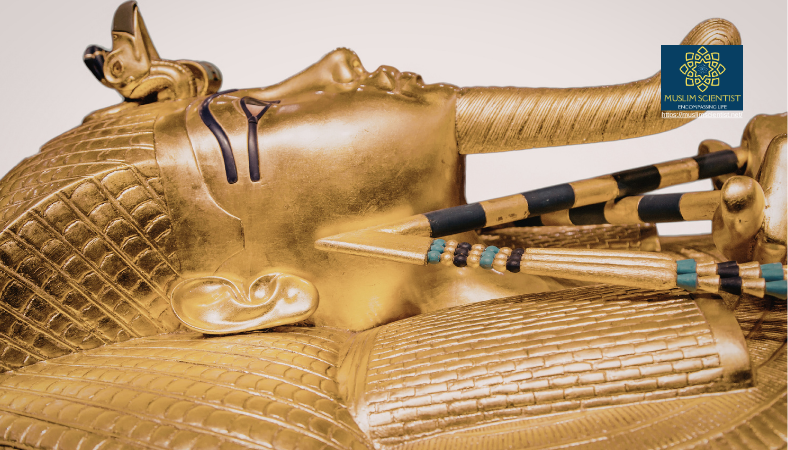
For centuries, the biblical story of Joseph and Moses has been read as a single, continuous narrative of Israelite enslavement and exodus from Egypt. The ruler of Egypt in both accounts was simply called “Pharaoh.” But the Quran, revealed more than a millennium after the events, makes a subtle yet profound distinction that aligns with modern historical discoveries: during Joseph’s time, the ruler is referred to as “the King” (al-malik), while during Moses’ time, he is called “Pharaoh” (Fir‘awn). This distinction, unnoticed by many, is now recognized by historians and Egyptologists as a reflection of a major political shift in ancient Egypt—one that the Bible had seemingly conflated.
This article explores this linguistic and historical correction, examining how the Quran’s narrative precision, long before the deciphering of hieroglyphs, challenges traditional readings and offers a remarkable case of textual coherence with historical reality.
The Biblical Narrative: A Single Title for Two Eras
In the Book of Genesis and Exodus, the ruler of Egypt during Joseph’s rise to power and during Moses’ confrontation centuries later is uniformly referred to as “Pharaoh.” The term is used as a title, not a personal name. The narrative presents a continuity of Egyptian kingship without distinguishing between different dynasties or historical periods.
For example, Genesis 41 recounts Joseph’s interpretation of the dreams for “Pharaoh,” and Exodus describes the oppression of the Israelites under a new “Pharaoh who knew not Joseph.” The text does not signal any change in political structure or terminology. For centuries, readers assumed that Egypt had always been ruled by a king called Pharaoh.
However, modern Egyptology has revealed that this was not the case. The title “Pharaoh” (from Egyptian per-‘aa, meaning “great house”) was not used as a formal title for the king until the 18th Dynasty, around the 15th century BCE—well after the time traditionally associated with Joseph, who is often placed in the Middle Kingdom or the Second Intermediate Period (circa 19th–16th centuries BCE).
The Quranic Distinction: King vs. Pharaoh
The Quran, revealed in the 7th century CE, narrates the same two pivotal moments but employs two distinct titles. In Surah Yusuf (Chapter 12), the ruler of Egypt is called al-malik (the King). Not once is he referred to as Pharaoh. In Surah Al-Qasas (Chapter 28) and other chapters dealing with Moses, the ruler is consistently called Fir‘awn (Pharaoh).
| Prophet | Quranic Title for the Ruler | Surah |
|---|---|---|
| Yusuf (Joseph) | Al-Malik (The King) | Surah Yusuf (12) |
| Musa (Moses) | Fir‘awn (Pharaoh) | Surah Al-Qasas (28), Surah Al-A‘raf (7), etc. |
This distinction is not incidental. It reflects a nuanced understanding of Egyptian political history. Egyptologists now confirm that the term per-‘aa (Pharaoh) emerged as a royal title during the New Kingdom, beginning with the 18th Dynasty. Prior to that, rulers were referred to simply as nswt (king) or by their personal names.
Thus, if Joseph lived during the Middle Kingdom or the Hyksos period—as many scholars suggest—the ruler would indeed have been called a king, not a pharaoh. And if Moses lived during the New Kingdom (likely the 19th Dynasty), the ruler would have been called Pharaoh. The Quran’s differentiation aligns perfectly with this historical timeline.
Historical Context: The Shift in Egyptian Rule
To understand the significance of this, we must look at the major transitions in ancient Egypt:
| Period | Dynasty | Ruler’s Title | Biblical/Quranic Figure |
|---|---|---|---|
| Middle Kingdom / Second Intermediate Period | 12th–17th Dynasties (c. 1991–1550 BCE) | Nswt (King) or Hqꜣ (Ruler) | Often associated with Joseph |
| New Kingdom | 18th–20th Dynasties (c. 1550–1077 BCE) | Per-‘aa (Pharaoh) | Associated with Moses and the Exodus |
The rise of the title “Pharaoh” coincided with Egypt’s imperial age, when the country became a dominant power in the Near East. The rulers of the 18th Dynasty, such as Thutmose III and Ramesses II, wielded unprecedented authority. The Quran’s use of Fir‘awn for Moses’ time captures this era of absolute monarchy, while its use of al-malik for Joseph’s time reflects a period when Egypt was either a fragmented land or ruled by foreign dynasties (the Hyksos), where the term “king” was more appropriate.
A Correction Beyond Historical Accuracy
What makes the Quran’s distinction remarkable is that it was revealed at a time when no one could have known this historical nuance. Hieroglyphs had not been deciphered (this would only happen in the 19th century with the Rosetta Stone), and the Bible—the most widely circulated scripture in the region—made no such distinction. The Quran’s text, therefore, offers an internal consistency that challenges the notion of a human author simply borrowing from biblical sources.
Moreover, the Quran’s narrative is not merely about titles. It embeds these figures in their proper historical contexts. In the story of Joseph, the King is depicted as a powerful but accessible ruler who consults his advisors and personally engages with a prisoner (Joseph). This fits the governance style of a king in a court setting. In the story of Moses, Pharaoh is depicted as a tyrant who claims divinity and operates through a vast administrative apparatus, characteristic of the New Kingdom pharaohs.
Implications for Interfaith Understanding
This correction is not about denigrating the Bible, but about highlighting the Quran’s unique claim to precision. For Muslims, it serves as evidence of the Quran’s divine origin. For others, it is a fascinating case of ancient scripture aligning with modern historical knowledge.
In interfaith dialogue, such insights can foster mutual respect. They show that the Quran does not simply repeat biblical stories but often reframes them with deliberate theological and historical nuance. The distinction between King and Pharaoh is one of many examples where the Quran adjusts narrative details to convey deeper meanings—here, the evolution of political power and the nature of prophetic struggle across different historical contexts.
Conclusion
The Quran’s differentiation between the ruler in Joseph’s time (al-malik) and the ruler in Moses’ time (Fir‘awn) is a striking example of textual precision that has been validated by modern Egyptology. It corrects a conflation present in the biblical narrative and situates the prophetic stories within their proper historical frameworks. For believers, it is a sign of divine authorship; for scholars, it is a testament to the complex interplay between scripture and history.
As we continue to explore the ancient world through archaeology and textual analysis, such details remind us that sacred texts often contain layers of meaning that only later discoveries can fully illuminate.
Reference: here
Other Articles