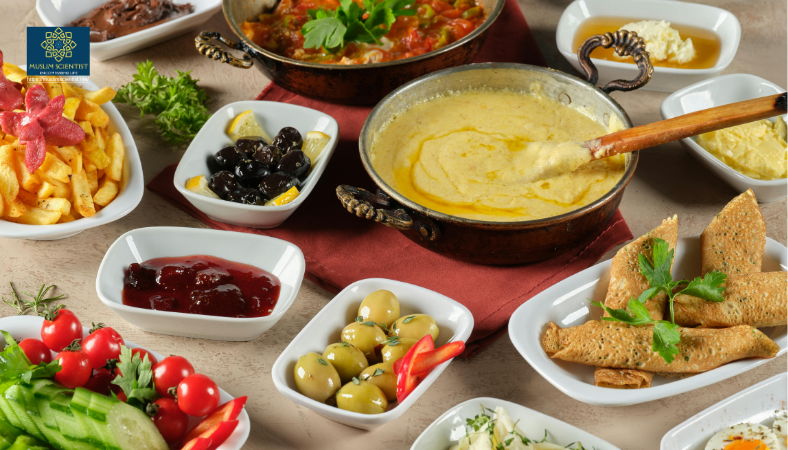
A major scientific review on dietary inflammatory indices aligns with Quranic principles of holistic health, moderation, and the body as a sacred trust (amanah).
The Prophet Muhammad (peace be upon him) said: “The son of Adam does not fill any vessel worse than his stomach. It is sufficient for the son of Adam to eat a few mouthfuls to straighten his back. But if he must (eat more), then one third for his food, one third for his drink, and one third for his breath” (Tirmidhi). This profound teaching captures the essence of Islamic nutrition: moderation, mindfulness, and the recognition that food is a tool for health, not a source of excess.
A groundbreaking new review published in Frontiers in Nutrition traces the evolution of dietary inflammatory assessment from abstract nutrient scores to practical, food-based indices. It confirms that a pro-inflammatory diet is a primary driver of metabolic syndrome, type 2 diabetes, and even Alzheimer’s disease (increasingly understood as “Type 3 Diabetes,” a form of brain insulin resistance). For the Muslim, this is not merely a scientific finding. It is a confirmation of divine wisdom. The Qur’an and Sunnah have long provided a framework for eating that directly counteracts the chronic inflammation driving modern disease.
The Body as a Trust (Amanah) and the Prohibition of Harm (La Darar)
The Islamic worldview holds that the human body is not our property. It is a trust (amanah) from Allah. We are caretakers, not owners. We will be questioned about how we used—and abused—our bodies.
The review describes a “malignant cascade” from a pro-inflammatory diet to disease. It begins in the gut, where processed foods and unhealthy fats disrupt gut bacteria, leading to a “leaky gut” and systemic inflammation. This inflammation then triggers insulin resistance, damages the blood-brain barrier, and ultimately leads to brain insulin resistance and Alzheimer’s.
This is a direct form of harm. The Prophet (peace be upon him) said: “There should be neither harming nor reciprocating harm” (Ibn Majah). A diet that is pro-inflammatory is not a neutral choice. It is a choice that causes harm—to your metabolism, to your heart, and to your brain.
The review’s model of the “gut-metabolism-brain axis” shows that food choices have a direct biological pathway to chronic disease. An Islamic perspective would add a spiritual dimension: neglecting this pathway is a betrayal of the trust of the body.
The Prohibition of Waste (Israf) and the Call for Balance
The Qur’an explicitly forbids waste: “Indeed, the wasteful are brothers of the devils” (Qur’an 17:27). And: “Eat and drink, but be not excessive. Indeed, He likes not those who commit excess” (Qur’an 7:31).
The review shows that a pro-inflammatory diet is characterized by excess: excess saturated fats, refined sugars, and processed foods. It is a diet of waste—not just of resources, but of health. The “empty calories” of a pro-inflammatory diet provide energy without nutrition, filling the stomach while starving the body of the phytonutrients and fiber it needs to regulate inflammation.
The Prophet’s teaching on filling the stomach is a direct antidote. By leaving one-third of the stomach for food, one-third for water, and one-third for air, we are training ourselves to avoid excess. This is not a mystical practice; it is a practical tool to prevent overconsumption of pro-inflammatory foods.
The Concept of Tayyib: Beyond Halal to Pure and Good
The Qur’an commands believers to eat not only what is halal (lawful) but also what is tayyib (pure, wholesome, good). Allah says: “O you who have believed, eat from the good things which We have provided for you” (Qur’an 2:172).
Tayyib is a holistic concept. It includes purity, safety, and wholesomeness. The review’s emphasis on the Food Inflammation Index (FII) aligns with this. It moves beyond abstract categories (like “all vegetables are good”) to a more refined understanding. For example, the FII distinguishes between high-water vegetables (like cucumber) and dark, cruciferous vegetables (like broccoli), which are rich in flavonoids that lower inflammation.
An Islamic approach to nutrition would embrace this nuance. It is not enough to eat halal chicken if it is processed and pro-inflammatory. It is not enough to eat vegetables if they are cooked in hydrogenated oils. The concept of tayyib calls us to the best quality, the most wholesome, the most pure. It calls us to an anti-inflammatory, nutrient-dense, whole-foods diet.
The Prophetic Diet: A Model of Anti-Inflammatory Eating
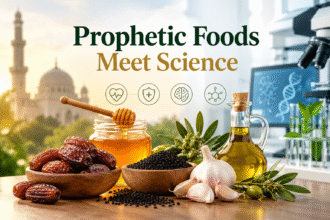
While the Prophet (peace be upon him) did not have access to modern nutritional science, his dietary practices align remarkably with the review’s findings. He ate simple, whole foods: barley bread, dates, milk, honey, grapes, melons, cucumbers, and meat occasionally. He avoided excess and never ate to fullness.
The review’s framework would rate the Prophet’s diet as highly anti-inflammatory:
- Whole Grains: Barley is a whole grain rich in fiber, which feeds beneficial gut bacteria and reduces inflammation.
- Dates and Honey: Natural sweeteners with antioxidant and anti-inflammatory properties, unlike refined sugars which are highly pro-inflammatory.
- Fruits and Vegetables: Rich in flavonoids, polyphenols, and vitamin C, all of which lower inflammatory markers like CRP and IL-6.
- Moderate Meat Consumption: The Prophet ate meat occasionally, not daily. This is consistent with evidence that high red meat consumption is pro-inflammatory, while occasional consumption can be part of a healthy diet.
The Sunnah of Intermittent Fasting
The Prophet (peace be upon him) regularly fasted on Mondays and Thursdays, as well as the “white days” (13th, 14th, and 15th of each lunar month). Modern science now confirms that intermittent fasting has powerful anti-inflammatory effects.
The review’s mechanism of chronic inflammation involves the over-activation of the NLRP3 inflammasome and the NF-κB pathway. Intermittent fasting has been shown to suppress these pathways, reduce oxidative stress, and improve insulin sensitivity. It also promotes autophagy, the cellular cleanup process that removes damaged mitochondria and protein aggregates.
The Sunnah of fasting is not just spiritual discipline. It is a physiological intervention that directly counters the inflammatory cascade described in the review.
Practical Takeaways for Muslims
- Make Intention (Niyyah): Before you eat, make the intention that you are nourishing your body as a trust from Allah, that you are avoiding the harm of inflammation, and that you are building strength to worship Him. This transforms eating into an act of worship.
- Follow the One-Third Rule: The Prophet (peace be upon him) taught us to fill only one-third of our stomach with food. Use a smaller plate. Eat slowly. Stop before you are full.
- Prioritize Tayyib Foods: Focus on whole, unprocessed foods: vegetables, fruits, whole grains, legumes, nuts, seeds, and fatty fish (which are rich in anti-inflammatory omega-3s). Avoid processed meats, refined grains, added sugars, and hydrogenated oils.
- Incorporate Anti-Inflammatory Spices: The review highlights the potency of spices like turmeric (curcumin) and ginger. The Prophet (peace be upon him) praised black seed (habbatussauda) as a cure for every disease except death. Make these a regular part of your cooking.
- Revive the Sunnah of Fasting: Fast on Mondays and Thursdays, and the white days. This is a powerful, evidence-based tool to reset your metabolism, reduce inflammation, and activate cellular repair.
- Heal Your Gut: The review shows that inflammation begins in the gut. Eat fiber-rich foods (vegetables, legumes, whole grains) to feed beneficial gut bacteria. Eat fermented foods (yogurt, kefir, kimchi) to introduce probiotics.
- Make Dua for Health: The Prophet (peace be upon him) taught specific supplications for health. Say: “O Allah, I ask You for health and well-being in this life and the next” (Abu Dawud). Combine prayer with action.
A Final Reflection: The Trust of the Body
Allah says: “We offered the trust (amanah) to the heavens and the earth and the mountains, but they refused to bear it and were afraid of it. But man bore it” (Qur’an 33:72).
Your body is that trust. Every meal is an act of stewardship. A pro-inflammatory diet is a betrayal of that trust. An anti-inflammatory, whole-foods diet is a fulfillment of it.
The review’s findings are a gift. They provide a scientific roadmap for the Prophetic way of eating. They confirm that the simple, balanced, whole-foods diet of the Prophet (peace be upon him) is the most powerful tool we have to fight chronic inflammation, metabolic syndrome, and even Alzheimer’s disease.
The path to a healthy body and a sharp mind is not found in expensive supplements or extreme fad diets. It is found in the Sunnah. It is found in the first third of the stomach, in the whole grains and leafy greens, in the dates and olive oil, in the regular fasts, and in the grateful intention before every meal.
May Allah grant us the wisdom to honor the trust of our bodies, the discipline to follow the Sunnah, and the health to worship Him for many years to come. Ameen.
Reference: here
Other Articles: