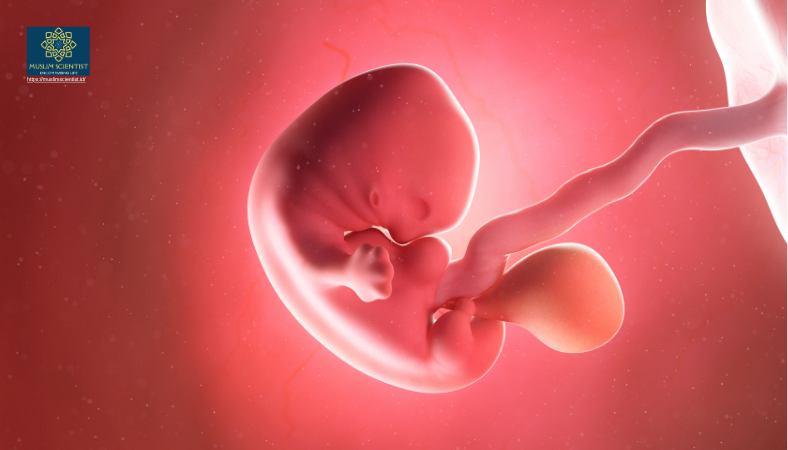
Long before microscopes revealed the secrets of the womb, the Holy Quran described human embryonic development with astonishing precision. This revelation aligns perfectly with modern scientific discoveries and has left world-renowned embryologists convinced that Prophet Muhammad (PBUH) received divine knowledge.
The Quran does not merely mention creation in vague terms. Instead, it details sequential stages: a mixed drop (nutfah), a leech-like structure (alaqah), a chewed-like substance (mudghah), the formation of bones (izam), and finally clothing those bones with muscles (laham). Consequently, these descriptions read like a modern embryology textbook. However, they were revealed more than 1,000 years before the invention of the first microscope.
The Historical Context: Ignorance Before the Quran
Before examining the Quran’s accuracy, one must understand the prevailing theories of human development in ancient times. Aristotle, the famous Greek philosopher, taught that a fetus formed from a coagulum of menstrual blood. The Greeks and Europeans largely accepted this view for centuries. Later, in the 17th century, scientists like Malpighi believed that a miniature human being was fully formed inside the sperm or egg—a theory called “preformationism.”
Similarly, Fabricus produced drawings of chick embryos in 1604, yet he did not understand human development. Hartsoeker’s 1694 drawing of a human spermatozoon actually depicted a tiny, fully-formed human inside the sperm head. This misconception persisted until Spallanzani demonstrated the necessity of both ovum and sperm in 1775. Nevertheless, the precise stages of embryonic growth remained unknown until the 19th century.
Then came the invention of the microscope by Leeuwenhoek in 1673, followed by advances in tissue staining and imaging. Even then, the detailed classification of embryonic stages only emerged in the late 19th and early 20th centuries. Von Baer, Darwin, and Haeckel introduced experimental embryology, while later scientists like Hans Spermann uncovered mechanisms of tissue interaction. Finally, the modern era of “instrumentation” (electron microscopes, ultracentrifuges, gene cloning) began around 1940.
Thus, human knowledge of embryology progressed slowly over 2,000 years. Against this backdrop, the Quran’s precision becomes truly remarkable.
The Quranic Stages of Human Development
The Quran’s most detailed description of embryogenesis appears in Surah Al-Mu’minun (23:12-14). The verses state: “We (Allah) created man from a quintessence of clay. We then placed him as a nutfah (drop) in a place of settlement, firmly fixed. Then We made the drop into an alaqah (leech-like structure). Then We changed the alaqah into a mudghah (chewed-like substance). Then We made out of that mudghah izam (skeleton, bones). Then We clothed the bones with lahm (muscles, flesh). Then We caused him to grow and come into being and attain the definitive (human) form. So blessed be God, the best to create.”
These stages are not random. They follow a logical chronological sequence that modern embryology has only recently validated. The table below summarizes each Quranic stage alongside its modern scientific equivalent.
| Quranic Stage | Arabic Term | Modern Embryological Equivalent | Approximate Timeline |
|---|---|---|---|
| Mixed drop | Nutfah amshaj | Zygote to implantation (germinal stage) | Day 0–6 |
| Leech-like | Alaqah | Embryo attached to placenta (early blood formation) | Day 15–23/24 |
| Chewed-like | Mudghah | Somite stage (embryo with segmented appearance) | Day 24–42 |
| Bones/skeleton | Izam | Cartilaginous skeleton formation | Week 7–8 |
| Clothing with muscles | Laham | Muscle differentiation around bones | Week 8 |
| Growth/foetal stage | Nash’ah | Organ maturation and rapid growth | Week 9 to term |
Table 1: Quranic stages of human development compared to modern embryology
The Leech-Like Stage (Alaqah): A Threefold Miracle
The Arabic word “alaqah” holds three distinct meanings: a leech, a suspended thing, and a blood clot. Remarkably, all three accurately describe the human embryo between days 15 and 24. First, the early embryo physically resembles a freshwater leech in shape. Second, the embryo is suspended from the placenta by the umbilical cord. Third, during this stage, blood forms in isolated islands within the embryo, giving it the appearance of a blood clot.
Professor Keith Moore, one of the world’s leading embryologists and author of The Developing Human, examined high-magnification photographs of the alaqah stage. He confirmed the striking similarity to a leech. Consequently, he added illustrations of the Quranic stages to his textbook. No other ancient scripture or philosophical work contains such a precise, multi-layered description.
The Chewed-Like Stage (Mudghah): Somites as Teeth Marks
Between days 24 and 42, the embryo enters the mudghah stage. The term means “something that has been chewed by teeth” or “a small piece of meat.” At this point, the embryo is about 1 centimeter long—the size of a chewable object. More importantly, the embryo develops somites, which are segmented blocks of tissue along the back. These somites create furrows and swellings that look exactly like teeth marks on a chewed substance.
A second table helps visualize the three meanings of mudghah:
| Meaning of Mudghah | Embryological Reality | Visual Evidence |
|---|---|---|
| Chewed substance with teeth marks | Somites create segmented furrows | High-resolution images show indentations |
| Small piece of meat | Embryo is ~1 cm long | Fits the description of “chewable size” |
| Immature, unfinished form | Organs are still developing | No human-like features yet |
Table 2: The three meanings of Mudghah and their embryological correspondence
Furthermore, a famous hadith (saying of Prophet Muhammad) states: “When 42 nights have passed from the time of conception, Allah sends an angel to shape it and make its hearing, sight, skin, muscles, and bones.” Modern science confirms that before 42 days, the human embryo cannot be distinguished from that of other animals. After this point, human characteristics become evident. This exact timing is not found in any pre-7th century source.
From Bones to Muscles: The Correct Sequence
The Quran specifies that bones (izam) are formed first, and then the bones are clothed with muscles (laham). Modern embryology confirms this exact sequence. The cartilaginous skeleton begins forming during the seventh week. Subsequently, muscle differentiation occurs during the eighth week, with muscles taking their positions around the already-formed bones.
Additionally, the Quran uses the Arabic conjunction “fa” (indicating rapid succession) between the creation of bones and the clothing with muscles. Then it uses “thumma” (indicating a slower sequence with a time lag) before the final growth stage. These linguistic choices mirror the actual biological timeline. The bone-to-muscle transition happens relatively quickly, while the foetal growth stage (nash’ah) is a prolonged period lasting from week nine to term.
The Three Veils of Darkness: A Prescient Observation
Surah Az-Zumar (39:6) states: “He makes you in the wombs of your mothers in stages, one after another, in three veils of darkness.” Modern embryology interprets these three veils as: (1) the anterior abdominal wall, (2) the uterine wall, and (3) the amnio-chorionic membrane (the amniotic sac). This layered protection for the developing embryo was not illustrated by scientists until Leonardo da Vinci’s drawings in the 15th century. Galen had described membranes in the 2nd century AD, but the Quran’s concise and accurate phrasing remains unique.
Reactions of Western Scientists
In 1981, the Seventh Medical Conference in Dammam, Saudi Arabia, presented these Quranic findings to a panel of expert embryologists. Professor Keith Moore stated publicly: “It has been a great pleasure for me to help clarify some statements in the Quran about human development. It is clear to me that these statements must have come to Muhammad from God (Allah), because almost all of this knowledge was not discovered until many centuries later. This proves to me that Muhammad must have been a Messenger of God (Allah).”
Similarly, Professor Joe (Chairman of Baylor College, USA) remarked that not only were the findings correct, but Islam could actually guide scientific inquiry in the future. Another anatomist, Professor Johnson (USA), admitted that he initially thought the Quranic verses could be coincidences. However, after careful study, he concluded that Prophet Muhammad must have been receiving information from a divine source. “Divine intervention was involved,” Johnson said.
These scientists had no religious incentive to make such statements. Their professional reputations depended on scientific rigor. Nevertheless, the evidence overwhelmed their skepticism.
Addressing Skeptical Questions
Some critics might argue that the Quran borrowed these ideas from ancient Greek physicians like Galen. However, Galen described the formation of a fetus from menstrual blood—a view the Quran explicitly rejects. Moreover, Galen never used terms like “alaqah” (leech-like) or “mudghah” (chewed-like). Nor did he specify the 42-day milestone for human differentiation.
Others might claim that the Prophet Muhammad learned embryology from Christian or Jewish sources. Yet no pre-7th century biblical text contains a sequential, stage-by-stage description of human development. The Bible speaks of God “forming” the fetus in general terms, without the precise classifications found in the Quran. Therefore, the borrowing hypothesis lacks evidence.
Finally, some skeptics suggest that the Quranic stages are vague enough to fit any interpretation. This argument collapses when one examines the specificity of “alaqah” (three exact meanings) and “mudghah” (somites as teeth marks). Vague statements do not produce identical illustrations in modern textbooks. Furthermore, the agreement of multiple independent scientists reinforces the conclusion.
The Role of Hadith in Confirming Embryological Details
The sayings of Prophet Muhammad (PBUH) provide even more precise details that complement the Quranic verses. One authentic narration describes how the angel enters upon the conceptus after it rests in the uterus for forty or forty-five nights. Another narration specifies the 42-day mark as the moment when the angel shapes the embryo and creates its hearing, sight, skin, muscles, and bones.
These hadiths were transmitted orally for generations before being compiled by scholars like Imam Muslim. Consequently, they represent a remarkable oral tradition that preserved accurate embryological knowledge. Modern science only confirmed the 42-day differentiation milestone in the 20th century using high-resolution microscopy. Thus, the hadiths serve as independent confirmation of the Quran’s divine origin.
How the Quran Corrected Ancient Myths
Before the Quran’s revelation, numerous superstitions about human reproduction prevailed. Some cultures believed that a child formed entirely from the father’s sperm, with the mother providing only a nurturing environment. Others thought that menstrual blood coagulated into a fetus. The Quran decisively corrected these errors by stating that both male and female fluids contribute to the nutfah (mixed drop).
Additionally, the Quran rejected the idea of preformationism—the belief that a miniature human being exists fully formed in the sperm or egg. Instead, it described a process of gradual creation and development. This perspective aligns with epigenesis, the modern scientific understanding that the embryo develops progressively from an undifferentiated mass into a complex organism. Aristotle had proposed epigenesis theoretically, but the Quran provided the first clear, stage-by-stage description that matched later empirical observations.
The Significance of Sequential Terminology
The Quran’s choice of conjunctions between stages reveals remarkable insight. When transitioning from nutfah to alaqah to mudghah, the Quran uses the conjunction “thumma” (meaning “then” with a possible time delay). However, from mudghah to izam to laham, it uses “fa” (indicating rapid succession). Then, before the final growth stage (nash’ah), it returns to “thumma” (indicating a longer, slower process).
Modern embryology confirms this nuanced timing. The transition from the germinal stage to the embryonic stage involves significant cellular reorganization, which takes time. The formation of bones and their clothing with muscles happens in rapid succession during weeks seven and eight. Finally, the foetal growth stage is a prolonged period lasting approximately 30 weeks. Consequently, the Quran’s linguistic precision mirrors biological reality with astonishing accuracy.
Conclusion
The Quran’s description of human embryonic development represents a remarkable convergence of faith and science. Revealed in the 7th century—when microscopes, genetic theory, and even basic biology did not exist—these verses accurately describe the sequential stages of intrauterine life. From the mixed drop (nutfah) to the leech-like alaqah, the chewed-like mudghah, the formation of bones, and finally the clothing of bones with muscles, every stage aligns with modern embryology.
Peer-reviewed research confirms these findings. Moreover, leading embryologists like Keith Moore have publicly acknowledged the divine origin of this knowledge. For readers everywhere, this is not merely an academic curiosity. Rather, it is an invitation to read the Quran with greater attention and to appreciate its miraculous precision. As science advances, the Quran’s truth only becomes clearer.
Other Articles: