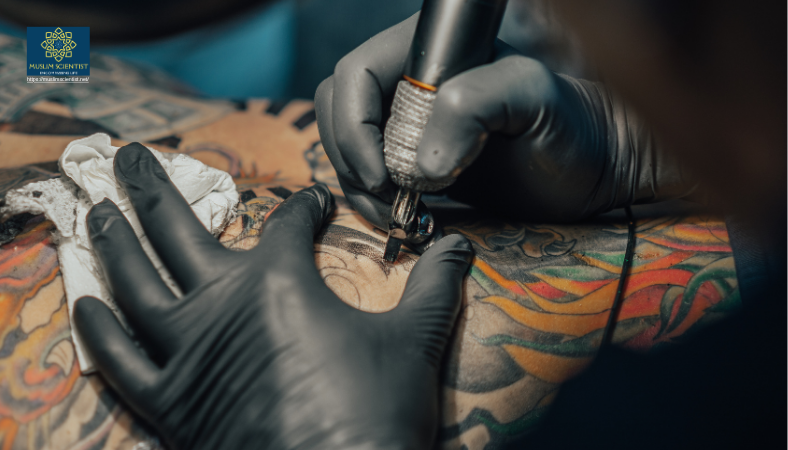
A Danish twin study has just provided powerful scientific evidence for what Islamic teachings have advised for over 1,400 years: permanent tattooing carries serious risks. The study, published in BMC Public Health, found that tattoo ink exposure is associated with a significantly increased risk of lymphoma and skin cancers—with large tattoos nearly tripling the risk of lymphoma.
For Muslims, this is not merely a health alert. It is a moment to reflect on the profound wisdom behind Allah’s commands. The prohibition of permanent tattoos in Islam is not an arbitrary restriction on beauty or self-expression. It is a protection—for your body, your health, and your soul.
Let us examine the scientific findings, then explore the Islamic rulings and the deeper wisdom they contain.
The Scientific Findings: A Quick Review
The Danish twin study is the most rigorous investigation of tattoo risks to date. By studying twins, researchers could control for genetics and shared environment. Their key findings:
- Any tattoo: Increased risk of skin cancer by 62-291% and basal cell carcinoma by 183%.
- Large tattoos (larger than a palm): Increased risk of lymphoma by 173% and skin cancer by 137%.
- Biological mechanism: Ink particles travel to lymph nodes, cause chronic inflammation, and many inks contain known carcinogens like carbon black and polycyclic aromatic hydrocarbons (PAHs).
The study’s authors concluded: “We are concerned that tattoo ink has severe public health consequences.” This is not a fringe opinion. It is a peer-reviewed finding published in a major scientific journal.
The Islamic Ruling: Clear and Unambiguous
The prohibition of permanent tattoos in Islam is well-established and agreed upon by all major schools of Islamic jurisprudence. The evidence comes from the Qur’an and the authentic Sunnah (teachings of the Prophet Muhammad, peace be upon him).
The Qur’anic Foundation: Allah says in Surah An-Nisa (4:119), describing the plots of Satan: “And I will mislead them, and I will arouse in them [sinful] desires, and I will command them so they will slit the ears of cattle, and I will command them so they will change the creation of Allah.” The scholars interpret “changing the creation of Allah” to include permanent alterations to the body such as tattoos.
The Prophetic Prohibition: The most direct evidence comes from the hadith recorded by Imam Al-Bukhari and Imam Muslim. The Prophet Muhammad (peace be upon him) cursed “the women who do tattoos and those who have them done.” The use of the word “cursed” (la’ana) indicates a major sin, not a minor one. The Prophet did not curse things lightly. This prohibition applies to both the one applying the tattoo and the one receiving it.
Why the Prohibition? The scholars give several reasons, all of which align with the new scientific findings:
- Harm to the Body: Anything that causes proven physical harm is forbidden (haram). The new study provides strong evidence of harm.
- Altering Allah’s Creation: The human body is a trust (amanah) from Allah. We do not own it; we are caretakers of it. Permanent alterations are seen as ingratitude and an attempt to “improve” on Allah’s design.
- Imitation of the Unbelievers: At the time of revelation, tattooing was a practice associated with pagan cultures. Muslims are commanded to be distinct.
- Impurity: The tattooing process involves breaking the skin and introducing foreign substances. The blood and the ink can be considered impure (najis), affecting the validity of prayer (wudu and ghusl) if the ink forms a barrier over the skin.
The Wisdom Confirmed: Protection from Harm
The new study adds powerful, empirical evidence to the first and most important reason: harm to the body. Islamic law is built on the principle of jalb al-masalih wa dar’ al-mafasid—seeking benefits and preventing harms. The Prophet (peace be upon him) said: “There should be neither harming nor reciprocating harm.”
The study demonstrates three distinct pathways of harm:
1. Physical Harm (Cancer Risk): The direct increase in lymphoma and skin cancer risk is a clear mafsadah (harm). A risk increase of 173% for lymphoma from a large tattoo is not trivial. Islamic jurisprudence states that preventing a certain harm takes precedence over achieving a speculative benefit. The “benefit” of a tattoo is purely aesthetic and cultural. The harm is potentially fatal. The ruling is clear.
2. Long-Term Unknown Harm (Ink Migration): The study notes that ink particles travel to lymph nodes and may reach other organs, including the liver. We do not yet know the full long-term consequences of having synthetic pigments permanently lodged in our lymphatic system. Islam prohibits consuming or introducing into the body anything that is impure or harmful, even if the harm is not yet fully understood. The precautionary principle (al-yaqeen la yazul bi al-shakk—certainty is not removed by doubt) applies here. If there is a reasonable doubt of serious harm, it must be avoided.
3. Chronic Inflammation: The body’s continuous immune response to the ink causes chronic inflammation. Modern medicine recognizes chronic inflammation as a root cause of numerous diseases beyond cancer, including autoimmune disorders and cardiovascular disease. The Prophet (peace be upon him) taught that the body has a right over us. Subjecting it to decades of unnecessary inflammation is a violation of that right.
Addressing Common Misconceptions
Some Muslims have attempted to justify tattoos by making distinctions that do not exist in the authentic sources.
Misconception 1: “It’s not permanent anymore with laser removal.” Laser removal does not make the initial act permissible. The prohibition applies to the act of tattooing itself. Furthermore, laser removal carries its own risks (scarring, ink particles breaking into smaller, more mobile fragments). The study notes that laser removal “is also an issue” because smaller particles have “greater migration potential.”
Misconception 2: “Only women are cursed in the hadith.” The hadith specifically mentions women because tattooing was predominantly a women’s practice in pre-Islamic Arabia. However, scholars unanimously agree that the prohibition applies to both men and women, as the underlying reasons (harm, altering creation) apply to both.
Misconception 3: “Medical tattoos are different.” Medical tattoos (e.g., for radiation therapy markings or nipple reconstruction after mastectomy) are generally considered permissible under the principle of necessity (darurah). They are treatments, not adornments. This exception proves the rule: cosmetic, non-essential permanent body modification is not allowed.
Misconception 4: “The ink is not a barrier to wudu.” This is a modern debate. However, the broader point remains: even if the ink is porous, the act of getting tattooed is itself prohibited. The impurity concern is secondary to the primary prohibition.
What About Existing Tattoos? Repentance and Removal
For a Muslim who has a tattoo from before they accepted Islam or before they learned the ruling, the door of repentance (tawbah) is always open. Allah says: “Say, ‘O My servants who have transgressed against themselves [by sinning], do not despair of the mercy of Allah. Indeed, Allah forgives all sins.'” (Qur’an 39:53).
Repentance requires:
- Stopping the sin (no new tattoos).
- Regretting what has passed.
- Resolving not to return to it.
Regarding removal: If laser removal is safe, affordable, and does not cause greater harm than the tattoo itself, it is recommended. If removal would cause scarring, significant pain, or financial hardship, the tattoo can be left as a reminder of Allah’s forgiveness. The sin was the act of getting it, not the continued presence of the ink.
A Deeper Reflection: Contentment with Allah’s Creation
Beyond the specific health risks, the prohibition of tattoos points to a deeper spiritual teaching: contentment (rida) with Allah’s creation.
The modern tattoo culture is often driven by dissatisfaction with one’s body—a desire to “improve” or “personalize” what Allah has already perfectly designed for you. This can be a form of ingratitude. The Qur’an asks: “Do you not see that Allah has subjected to you whatever is on the earth and the ships that run through the sea by His command? He restrains the sky from falling upon the earth unless by His permission. Indeed Allah is to people Kind and Merciful.” (Qur’an 22:65). If Allah has given you this body as a gift, why seek to permanently alter it?
The Prophet (peace be upon him) said: “Allah is Beautiful and loves beauty.” (Sahih Muslim). There are lawful ways to adorn oneself and express beauty: through clothing, jewelry, temporary adornments (like henna), and good grooming. Permanent tattoos are not a necessary or even a recommended form of beauty. They are a harmful excess.
A Final Call to Faith and Health
This new scientific study is a gift. It provides empirical, peer-reviewed evidence that the Islamic prohibition on tattoos was never about arbitrary control or cultural conservatism. It was, and is, about protection.
- Protection from cancer.
- Protection from chronic inflammation.
- Protection from unknown long-term effects.
- Protection from the spiritual harm of dissatisfaction with Allah’s creation.
For the Muslim considering a tattoo: pause. Reflect on the evidence. This is not just a matter of differing scholarly opinions. This is a matter of proven physical risk. Your body is an amanah. You will be asked about it on the Day of Judgment. Do not harm it permanently for a fleeting fashion.
For the Muslim with tattoos: turn to Allah in sincere repentance. He is Al-Ghafur (The All-Forgiving) and Ar-Rahim (The Most Merciful). Do not despair. And do not get another one.
For all of humanity: the Danish twin study is a warning. The popularity of tattooing is a recent experiment, and the results are coming in. The ink is permanent. The risks are real. The wisdom of the Creator, conveyed through His final Messenger, has been confirmed by the research of His creation. May we all be guided to what is best for our bodies and our souls.
Reference: here
Other Articles: