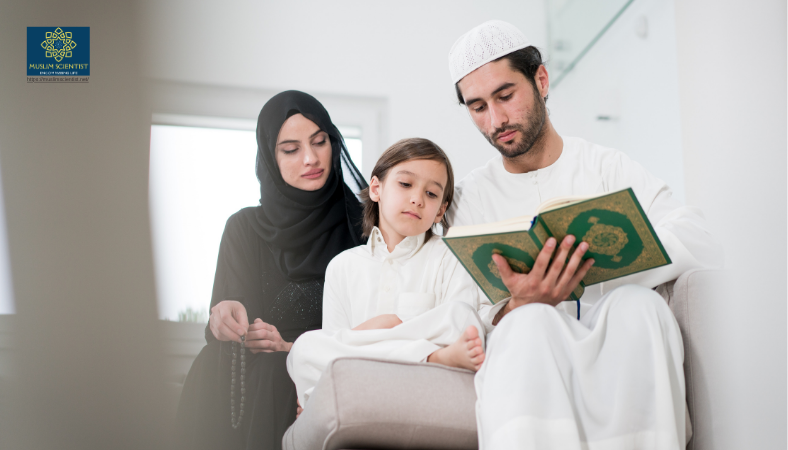
For 1,400 years, Muslim parents have relied on the Qur’an and the example of Prophet Muhammad ﷺ to raise their children. They teach kindness. They instill discipline. They nurture faith. But until now, Western psychology had no framework to measure or validate this ancient wisdom.
That has finally changed.
A study published in Religions (2026) has developed and validated the Islamic Parenting Style Scale (IPSS) —the first scientifically rigorous tool based entirely on Qur’anic teachings and Hadith. The research, conducted with 818 parents across Pakistan’s Khyber Pakhtunkhwa province, confirms what Muslim families have known for centuries: Islamic parenting is not authoritarian or permissive. It is a unique, balanced, and highly effective three-dimensional model.
And the data shows it works.
The Crisis That Demanded a Solution
Parenting is arguably the most important job in the world. Yet modern Muslim parents face unprecedented challenges: digital addiction, moral confusion, identity crises, and the erosion of traditional family structures. Many turn to Western parenting books—authoritarian, authoritative, permissive, uninvolved—only to find that these categories do not fit their values.
Why? Because Western models separate psychology from spirituality. They focus on outcomes like academic success and self-esteem but ignore the soul.
The Qur’an, however, is clear: “O you who have believed, protect yourselves and your families from a Fire whose fuel is people and stones” (Qur’an 66:6). Parenting is not just about producing successful adults. It is a sacred trust, a form of worship, and a direct responsibility to Allah.
Dr. Muhammad Naeem and his team from the University of Peshawar recognized a critical gap. Pakistan, with over 99% Muslim population, had no culturally relevant scale to assess Islamic parenting. Western scales were unsuitable because they do not account for tawhid (oneness of Allah), akhira (accountability in the afterlife), or the prophetic model of compassion and guidance.
So they built one from scratch—directly from the Qur’an and Sunnah.
The Three Pillars of Islamic Parenting
After analyzing 190 initial items, consulting religious scholars and psychometricians, and testing the scale on hundreds of parents, the researchers identified three distinct factors that together form the Islamic parenting style.
1. Cognitive and Reflective Domain (IPSCR) – 18 items
This domain focuses on developing a child’s mind, faith, and moral reasoning. Parents who score high in this area actively teach their children about Allah, the Prophet ﷺ, the afterlife, and the difference between right and wrong.
- Example item: “I tell my children about the rewards and punishments of the Hereafter.”
- Example item: “I explain to my children the awareness of Allah’s presence through different examples.”
This directly reflects the Qur’anic command to “reflect” (Qur’an 3:190) and the prophetic tradition of teaching through dialogue, as Luqman did with his son (Qur’an 31:13-19).
2. Compassionate Behavior Domain (IPSCB) – 13 items
This domain measures the warmth, love, empathy, and emotional security parents provide. It includes care and affection, responsiveness to needs, freedom of choice within Islamic bounds, equal treatment of all children, and forgiveness.
- Example item: “I respect my children.”
- Example item: “I protect my children from feelings of inferiority by giving them the courage to make their own decisions.”
The Prophet ﷺ was the embodiment of compassion. He said: “He is not one of us who does not show mercy to our young ones.” Aisha (RA) described him as having the best character. This domain captures that prophetic warmth.
3. Guidance and Supervision Domain (IPSGS) – 15 items
This domain covers discipline, monitoring, role modeling, and character development. It includes prohibiting bad character traits (razail), disciplining with wisdom (not harshness), inculcating confidence and brevity, and using appropriate rewards and consequences.
- Example item: “I forbid my children from extravagance.”
- Example item: “I monitor my children’s conversations.”
Crucially, this is not authoritarian control. Islamic guidance is rooted in love and accountability to Allah. The Qur’an describes Prophet Muhammad as “an excellent example” (33:21)—parents are meant to model, not just command.
Table 1: Islamic Parenting vs. Western Parenting Models
| Dimension | Authoritarian Parenting | Permissive Parenting | Authoritative Parenting | Islamic Parenting (IPSS) |
|---|---|---|---|---|
| Control/Discipline | High, rigid, punitive | Low, inconsistent | High, consistent, explained | High, consistent, rooted in accountability to Allah |
| Warmth/Responsiveness | Low | High | High | High, as prophetic mercy (rahmah) |
| Child’s Autonomy | Very limited | Unlimited within reason | Encouraged with guidance | Guided freedom within Islamic boundaries |
| Spiritual Foundation | Absent or separate | Absent or separate | Absent or separate | Central (tawhid, akhira, worship) |
| Purpose of Parenting | Obedience | Happiness | Competence | Tarbiyah (holistic upbringing) + Allah’s pleasure |
The Scale That Works: Psychometric Validation
The researchers didn’t just guess—they tested. Rigorously.
- Sample size: 818 parents (and a separate sample of 500 for confirmatory analysis)
- Gender ratio: 1:1 (equal mothers and fathers)
- Age range: 30–65 years
- Children’s ages: 5–18 years
- Geographic coverage: Multiple districts across Khyber Pakhtunkhwa, Pakistan
The results are impressive:
- Cronbach’s alpha (total scale): 0.92 (excellent internal consistency)
- IPSCR subscale alpha: 0.93
- IPSGS subscale alpha: 0.91
- IPSCB subscale alpha: 0.88
Kaiser-Meyer-Olkin measure of sampling adequacy was 0.93, confirming the data is perfect for factor analysis. Bartlett’s test of sphericity was significant (p < 0.001), meaning the items are highly correlated and measure the same underlying construct.
After confirmatory factor analysis (CFA), the final scale was refined to 29 items (down from 46), with excellent model fit indices:
- GFI (Goodness of Fit Index): 0.90
- CFI (Comparative Fit Index): 0.91
- TLI (Tucker-Lewis Index): 0.90
- RMSEA (Root Mean Square Error of Approximation): 0.06 (below 0.08 indicates good fit)
- SRMR (Standardized Root Mean Square Residual): 0.03 (excellent)
These numbers mean the three-factor model—Cognitive/Reflective, Compassionate, and Guidance/Supervision—is statistically valid and reliable.
Table 2: Key Psychometric Properties of the Islamic Parenting Style Scale (IPSS)
| Statistic | Value | Interpretation |
|---|---|---|
| Total items (final) | 29 | Practical for research and clinical use |
| Cronbach’s α (total) | 0.92 | Excellent internal consistency |
| IPSCR α | 0.93 | Highly reliable cognitive/reflective domain |
| IPSGS α | 0.91 | Highly reliable guidance/supervision domain |
| IPSCB α | 0.88 | Reliable compassionate behavior domain |
| KMO measure | 0.93 | Perfect for factor analysis |
| Variance explained | 49% | Robust factor structure |
| CFI/TLI | 0.91 / 0.90 | Good model fit |
| RMSEA | 0.06 | Acceptable fit |
| Composite reliability (CR) | >0.07 for all factors | Convergent validity confirmed |
What This Means for Muslim Parents
The IPSS is not just an academic exercise. It is a practical mirror.
For the first time, Muslim parents can assess their own parenting style against an authentically Islamic benchmark. Are you high in compassionate behavior but low in guidance? Are you strong on cognitive teaching but weak on emotional warmth? The scale helps identify strengths and gaps.
For researchers, the IPSS opens new doors: studies linking Islamic parenting to child mental health, academic achievement, moral development, and resilience. For clinicians, it provides a culturally competent assessment tool. For educators, it offers a framework for parenting programs in mosques and Islamic schools.
Islamic Teaching: The Qur’anic and Prophetic Roots of the IPSS
The study is built entirely on Islamic sources. Here are the key foundations:
1. The Command to Protect Families (Qur’an 66:6)
“O you who have believed, protect yourselves and your families from a Fire whose fuel is people and stones.”
This verse establishes parenting as a religious obligation, not just a social role. The IPSS measures how parents fulfill this duty.
2. Luqman’s Advice to His Son (Qur’an 31:13-19)
Luqman gives his son comprehensive counsel: worship Allah alone, be grateful, establish prayer, enjoin good, forbid evil, be patient, avoid arrogance, walk moderately, and lower your voice. This passage directly inspired the IPSS’s cognitive/reflective and guidance domains.
3. The Prophet as an Excellent Example (Qur’an 33:21)
Muslims are commanded to follow the Prophet ﷺ. His parenting was marked by mercy (rahmah), patience, age-appropriate expectations, and individualized attention. He played with children, respected their emotions, and never struck them. The IPSS’s compassionate domain reflects this prophetic model.
4. The Hadith on Mercy
The Prophet ﷺ said: “He is not one of us who does not show mercy to our young ones and respect to our elders.” He also said: “The best of you are those with the best character.”
5. The Concept of Tarbiyah
Islamic parenting is not just tarbiyah (nurturing) but also ta’dib (disciplined education) and tazkiyah (purification of the soul). The IPSS integrates all three.
6. The Prohibition of Extravagance (Israf)
The Qur’an states: “Indeed, the wasteful are brothers of the devils” (17:27). The IPSS includes an item on forbidding extravagance, linking financial discipline to parenting.
7. The Responsibility of Role Modeling
The Prophet ﷺ was a living example. Parents cannot command what they do not practice. The IPSS measures parents’ own commitment to Islamic teachings.
The Bigger Picture: Why This Matters for Global Muslim Families
Muslims are the world’s fastest-growing religious group, projected to make up nearly 30% of the global population by 2050. Yet parenting research has largely ignored them. Western models dominate, and Muslim families are often measured against inappropriate standards.
The IPSS changes that. It affirms that Islamic parenting is not a deficit model to be fixed. It is a coherent, evidence-based, spiritually grounded system.
Dr. Naeem and his colleagues write: “The robust alignment of the IPSS model corroborates the theoretical framework of Islamic parenting, which encompasses cognitive/reflective behavior, compassionate behavior, and guidance/supervision.”
In other words, Islamic parenting is not a collection of random rules. It is a scientifically validated structure.
What Parents Can Do Right Now
You don’t need a PhD to benefit from this research. Here is a practical checklist based on the IPSS:
Cognitive/Reflective (Ask yourself):
- Do I regularly teach my children about Allah, the Prophet ﷺ, and the afterlife?
- Do I explain why something is haram or halal, not just forbid?
- Do I encourage my children to ask questions and reflect?
Compassionate (Ask yourself):
- Do I show physical and emotional affection to my children?
- Do I treat all my children equally, without favoritism?
- Do I forgive my children’s mistakes and teach rather than shame?
Guidance/Supervision (Ask yourself):
- Do I monitor my children’s friendships and media use?
- Do I model the behavior I want to see (prayer, honesty, patience)?
- Do I use age-appropriate discipline with both rewards and consequences?
The Bottom Line
Parenting is the hardest job you will ever love. And for Muslim parents, it is also an act of worship. The new Islamic Parenting Style Scale validates what the Qur’an and Sunnah have taught for centuries: that raising children with cognition, compassion, and guidance produces confident, moral, faithful adults.
The Prophet ﷺ said: “Each of you is a shepherd and each of you is responsible for his flock.”
Now, finally, science has caught up to that truth.
Reference: here
Other Articles: