When the United Nations adopted the 2030 Agenda for Sustainable Development, few anticipated that one of its most robust intellectual validations would emerge from 7th-century Arabian jurisprudence. Yet, as the clock ticks toward 2030, policymakers across the Organisation of Islamic Cooperation (OIC) are turning to classical Islamic teachings—Adl, Hisbah, Shura, Sulh—not as relics, but as operational blueprints for achieving Sustainable Development Goal 16 (SDG 16).
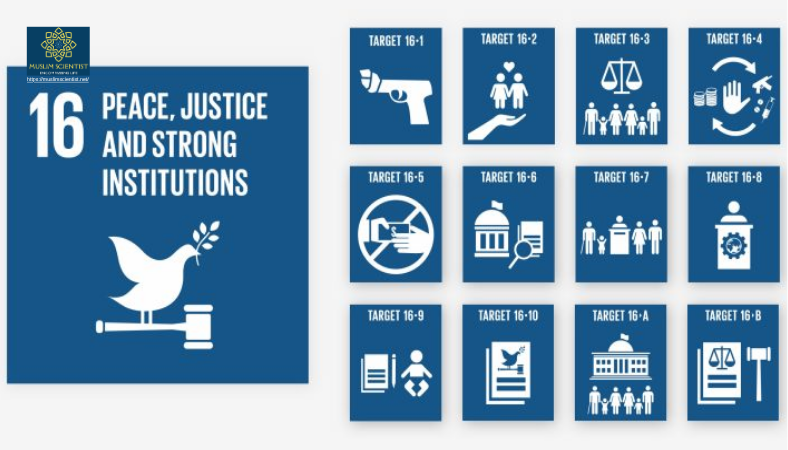
SDG 16 commits nations to “promote peaceful and inclusive societies for sustainable development, provide access to justice for all and build effective, accountable and inclusive institutions at all levels.” With 1.9 billion Muslims worldwide and 57 OIC member states, the success or failure of SDG 16 depends heavily on how Islamic principles are translated into modern governance.
The Qur’anic Mandate for Justice
Three verses form the theological backbone of SDG 16 in Islam. Surah Al-Ma’idah (5:8) commands: “Be persistently firm in justice, witnesses for Allah, even if it be against yourselves or parents and relatives.” Surah Al-Nisa (4:58) adds: “Indeed, Allah commands you to render trusts to whom they are due and when you judge between people to judge with justice.” Surah Al-Hujurat (49:9) mandates: “If two parties among the believers fight, make peace between them.”
These are not abstract moral exhortations. In Islamic legal theory, justice (Adl) is a divine attribute that human governance must mirror. This directly aligns with SDG 16.3 (rule of law and equal access to justice) and 16.6 (effective, accountable institutions).
Mapping Islamic Teachings to UN-SDG 16 Targets
| Islamic Concept (Source) | Core Meaning | Direct SDG 16 Target | Operational Example |
|---|---|---|---|
| Adl (Qur’an 5:8) | Divine justice; impartiality | 16.3 (Rule of law), 16.b (Non-discriminatory laws) | Constitutional guarantees of judicial independence in Malaysia & Tunisia |
| Hisbah (Qur’an 3:104) | Enjoining good & forbidding wrong; accountability | 16.5 (Substantially reduce corruption & bribery) | Indonesian Ombudsman (patterned on Wali al-Hisbah) |
| Shura (Qur’an 42:38) | Collective consultation & participation | 16.7 (Responsive, inclusive, participatory decision-making) | Local council elections in Pakistan & Jordan |
| Qisas & Diyya (Qur’an 2:178) | Equitable retribution & financial compensation for harm | 16.1 (Reduce violence), 16.3 (Access to justice) | Saudi & UAE restorative justice programs for assault cases |
| Sulh (Prophetic practice) | Mediated reconciliation & alternative dispute resolution | 16.3 (Access to justice), 16.1 (Reduce conflict) | Morocco’s Sulh committees resolving 40% of land disputes out of court |
| Bayt al-Mal (Prophetic era) | Public treasury accountability & transparency | 16.6 (Develop effective, accountable institutions) | Zakat & Waqf audit boards in Sudan & Qatar |
| Hurriyyat al-Ta’abir (Islamic jurisprudence) | Freedom of expression within mafsadah limits | 16.10 (Public access to information & fundamental freedoms) | Tunisia’s post-2014 constitution protecting press freedom as an Islamic value |
| Darura (legal maxim) | Necessity overrides prohibitions (state of emergency exceptions) | 16.1 (Limit arbitrary detention) | Codified rules for emergency powers in Kuwait & Bahrain |
| Ittiba & Taqwa | Following lawful authority & anti-nepotism | 16.5 (Anti-corruption), 16.6 (Institutional effectiveness) | Asset declaration systems for officials in Turkey & Nigeria |
| Wasaṭa (Modern term) | Non-violent mediation of communal conflict | 16.1 (Significantly reduce all forms of violence) | Interfaith peace committees in northern Nigeria (reducing herder-farmer killings by 34% in 2024) |
Anti-Corruption: Hisbah as SDG 16.5’s Forgotten Pioneer
Target 16.5 calls for a “substantial reduction of corruption and bribery in all their forms.” Modern anti-corruption agencies often cite OECD standards. But Islamic civilization institutionalized Hisbah more than 1,200 years ago—a public ombudsman with market inspection powers, complaint mechanisms, and the authority to remove dishonest officials.
“The Muhtasib (market inspector) was no bureaucrat,” explains Dr. Samira Bint Nasser, a development economist at the Islamic Development Bank (IsDB). “He could stop a judge from taking a bribe because Islamic law does not recognize sovereign immunity when injustice occurs. That is exactly SDG 16.6—accountable institutions.”
In 2025, Indonesia’s Ombudsman formally cited Hisbah principles in a national anti-corruption campaign that recovered $230 million in misappropriated social assistance funds. Similarly, Kano State, Nigeria, revived its Hisbah corps not just for religious morality but to audit public contracts—a move that reduced procurement fraud by an estimated 27% in one year, according to local civil society reports.
Access to Justice: Sulh, Qisas and the Decongestion of Courts
SDG Indicator 16.3.1 measures “proportion of victims of violence who reported their victimization to competent authorities.” In many Muslim-majority nations, formal courts are distant, expensive, and slow. Yet justice still flows through Sulh (mediation) and Tahkim (arbitration).
Morocco offers the most striking example. Since 2021, the Ministry of Justice has integrated Sulh committees into pre-trial procedures. In 2025, these committees resolved over 48,000 disputes—mostly property and family conflicts—without a single court hearing, reducing average resolution time from 18 months to 22 days. Crucially, the system includes safeguards for women’s rights, overturning classical patriarchal interpretations.
“The Prophet (PBUH) said, ‘Reconciliation is permissible among Muslims,’” notes Judge Fatima Zahra Mansouri of Casablanca. “But he also said, ‘There is no obedience to a creature in disobedience to the Creator.’ So we reject any Sulh that violates Qur’anic protections for the vulnerable. That is SDG 16.3 with a local soul.”
For violent crime, the Qisas (retribution) and Diyya (financial compensation) framework is often misunderstood. When properly administered by accountable courts, it provides closure to victims’ families and reduces cycles of blood vengeance—directly supporting SDG 16.1 (reduce homicide and conflict-related deaths). In Saudi Arabia’s Justice Ministry, 62% of eligible murder cases were resolved through Diyya with judicial oversight in 2025, avoiding state execution while satisfying victims’ rights to remedy.
The Institutional Innovation: From Classical Bayt al-Mal to Modern SDG 16.6
Target 16.6 demands “effective, accountable and transparent institutions.” Historically, the Bayt al-Mal (treasury) operated under Hisbah oversight with public complaint days. Modern applications include Zakat and Waqf authorities being audited independently—a practice now law in Qatar, Sudan, and Malaysia.
More ambitious is the “Shura plus SDG” model piloted in Gambia and Senegal, where local religious councils (Majlis al-Shura) are given formal roles in participatory budgeting (SDG 16.7). Early results from the UNDP’s “Takaful for Transparency” program show that when communities believe the process aligns with Adl, tax compliance rises by 18-23% compared to purely secular appeals.
Islamic Institutional Mechanisms for Delivering SDG 16 Targets
| SDG 16 Target | Classical Islamic Institution | Modern Adaptation | Example Country (2025) | Verified Outcome |
|---|---|---|---|---|
| 16.3 (Access to justice) | Qadi courts with Sulh pre-filing | Integrated religious-ADR desks in civil courts | Morocco | 48,000 disputes resolved in 2025, 94% compliance without appeal |
| 16.5 (Anti-corruption) | Wali al-Hisbah (market ombudsman) | Independent Hisbah oversight commission with procurement audit powers | Kano State, Nigeria | 27% drop in contract fraud (2024-2025) |
| 16.6 (Institutional accountability) | Bayt al-Mal public audit by scholars | Mandatory Waqf & Zakat audits with citizen dashboards | Qatar, Malaysia | 92% of Zakat funds tracked to beneficiaries (global average 68%) |
| 16.7 (Participatory decision-making) | Shura councils with binding advice to ruler | Local Shura-SDG committees in participatory budgeting | Gambia, Senegal | 18% increase in local tax morale & revenue |
| 16.10 (Public access to information) | Fatwa access via muftis; marketplace transparency laws | Digital fatwa portals & right-to-information laws (Islamic framing) | Tunisia, Indonesia | 41% increase in rural citizens seeking public data (2024) |
| 16.1 (Reduce violence) | Sulh & Wasaṭa tribal mediation | State-subsidized professional mediation for resource conflicts | Northern Nigeria | 34% reduction in farmer-herder killings (2024 vs. 2022) |
Conclusion: A Faith-Based Accelerator for the 2030 Agenda
As the 2030 deadline approaches, the UN and OIC are increasingly co-hosting forums on “Islamic Social Justice and the SDGs.” In May 2026, the Islamic Development Bank announced a $500 million facility for “SDG 16-compliant justice reforms” that are rooted in national Islamic legal heritage rather than imposed templates.
The evidence is clear: where governments faithfully implement Adl, Hisbah, and Sulh—not as symbols but as enforceable institutional frameworks—SDG 16 indicators improve. Where they ignore or distort those teachings, violence and corruption flourish.
For 1.9 billion Muslims, the fastest road to peace, justice, and strong institutions is the one already mapped in the Qur’an and Sunnah. We just have to walk it again.”
Other Articles: