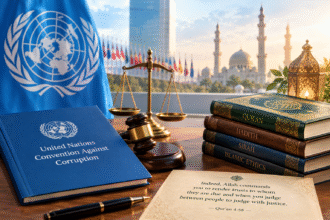
For over fourteen centuries, Islam has provided a comprehensive framework for economic activity – one that prohibits interest (riba), encourages profit-sharing, and mandates ethical conduct. Today, a new systematic review of 68 scientific studies published in Cogent Economics & Finance (Taylor & Francis, 2025) confirms what Muslims have long believed: Islamic banking is not just religiously permissible; it is economically powerful.
The study, “Impact of Islamic banking on economic growth: a systematic review of SCOPUS-indexed studies (2009-2024),” analyzed evidence from Malaysia, Indonesia, Pakistan, Saudi Arabia, Turkey, Nigeria, and dozens of other countries. The findings demonstrate that Islamic banking significantly contributes to economic growth, financial stability, poverty reduction, and sustainable development.
This is not coincidence. This is the fulfillment of divine wisdom.
The Core Findings: Science Confirms Revelation
The review found that Islamic banking has a consistently positive impact on economic growth across multiple regions. But beyond the numbers, the mechanisms behind this success are deeply rooted in Islamic teachings.
1. Prohibition of Riba (Interest) Leads to Stability
Allah says in the Qur’an:
“Allah has permitted trade and forbidden riba (interest).” (Surah Al-Baqarah 2:275)
Conventional banking relies on debt-based, interest-bearing transactions. This system encourages excessive leverage, speculation, and risk-taking – factors that led to the 2008 global financial crisis. Islamic banking, by prohibiting riba, forces transactions to be asset-backed and equity-based. The review confirms that this model is more resilient during economic crises. Islamic banks showed greater stability during the 2008 crisis and the COVID-19 pandemic compared to conventional banks.
The scientific evidence aligns perfectly with the Quranic prohibition. What Allah forbade is not arbitrary; it is because riba leads to systemic harm.
2. Profit-Sharing (Mudharabah) and Risk-Sharing (Musharakah) Drive Real Growth
The Prophet Muhammad (PBUH) was a merchant. He engaged in trade, partnerships, and profit-sharing. Islamic banking resurrects these prophetic practices through Mudharabah (profit-sharing) and Musharakah (joint venture) contracts.
Unlike conventional loans that demand fixed returns regardless of business performance, Islamic financing ties the bank’s return to the actual success of the enterprise. The review found that this creates a “bi-directional relationship” between Islamic banking and GDP. In Indonesia and Malaysia, Islamic banking both drives and responds to economic growth. It is deeply integrated into the real economy – exactly as Islamic economics intends.
3. Zakat and Microfinance: Poverty Reduction as Worship
Zakat (obligatory alms) is the third pillar of Islam. The Qur’an repeatedly pairs prayer (salah) with zakat, emphasizing its centrality to the faith. The review found that Islamic financial tools, including zakat and Islamic microfinance (using contracts like Qard Hasan – benevolent loans), significantly reduce poverty in countries like Nigeria and Indonesia.
In Indonesia, Islamic banking facilitates capital redistribution, directly reducing poverty at the district level. In Nigeria, zakat and microfinance empower low-income families. This is not charity; it is the systematic implementation of an Islamic economic obligation.
How Islamic Banking Mechanisms Align with Quranic Commands
| Islamic Banking Mechanism | Quranic/Hadith Basis | Scientific Finding (from Review) |
|---|---|---|
| Prohibition of Riba | “Allah has permitted trade and forbidden riba.” (2:275) | Islamic banks are more resilient during financial crises (2008, COVID-19). |
| Profit-Sharing (Mudharabah) | Practice of Prophet ﷺ as a merchant and partner | Bi-directional relationship with GDP; actively drives real economic growth. |
| Risk-Sharing (Musharakah) | “Allah will provide relief from the hardships of this world…” (65:2-3) | Reduces systemic risk; lower insolvency risk than conventional banks. |
| Asset-Backed Financing | “Do not sell what you do not possess.” (Hadith) | Links finance to real economic activity, reducing speculation and volatility. |
| Zakat (Alms) | Third pillar of Islam; “Take from their wealth a charity…” (9:103) | Significant poverty reduction in Nigeria, Indonesia, and other countries. |
| Prohibition of Gharar (Excessive Uncertainty) | “The Prophet forbade the sale of what is not present.” (Hadith) | Reduces speculative bubbles and financial fraud. |
Regional Impact of Islamic Banking – An Islamic Perspective
| Region | Scientific Finding | Islamic Interpretation |
|---|---|---|
| Malaysia | Long-term growth contribution; Islamic deposits and financing boost GDP | Fulfillment of Surah Al-Baqarah 2:261 – “The example of those who spend their wealth in the way of Allah is like a grain that sprouts seven ears…” |
| Indonesia | Bi-directional relationship with GDP | Embodiment of the prophetic trade ethics – finance in service of the real economy |
| Pakistan | Positive long-term impact; Shariah products enhance growth | Evidence that prohibiting riba does not hinder growth – it enhances it |
| Saudi Arabia | Supports growth and stability, but policy uncertainty weakens effect | A reminder that even a Shariah-compliant system requires just governance (adl) |
| Nigeria | Bi-directional relationship; supports poverty reduction | Zakat and microfinance as a modern application of Islamic wealth redistribution |
| Global/OIC | Strong positive impact on financial deepening | Confirmation that Islamic finance is not regional but universal |
Islamic Banking vs. Conventional Banking: A Scientific Comparison
The review directly compared Islamic and conventional banks. The results offer profound lessons for Muslim-majority nations seeking economic development without compromising their values.
On Efficiency Before Crises: Conventional banks were more efficient. But after the 2008 crisis, Islamic banks showed improved efficiency while conventional banks declined. The Islamic model is designed for long-term stability, not short-term speculative gains.
On Profitability: Conventional banks are more profitable. But higher profit often comes with higher risk. Islamic banks prioritize ethical compliance and risk-sharing over maximizing returns – a trade-off that aligns with the Islamic prohibition of gharar (excessive uncertainty) and maysir (gambling).
On Economic Impact: Islamic banking actively drives economic growth (bi-directional relationship). Conventional banking merely reacts to growth (unidirectional). This is the most important finding. Islamic financing is not a passive follower; it is an active engine of development because it is tied to real productive activity.
The Islamic FinTech Frontier
The review highlights that integrating Islamic banking with financial technology (FinTech) – blockchain, AI-driven Shariah compliance, digital banking – can enhance accessibility, efficiency, and transparency. From an Islamic perspective, this is maslahah (public benefit). As long as these technologies avoid riba, gharar, and maysir, they are powerful tools for expanding financial inclusion and supporting small businesses (SMEs). The Prophet (PBUH) said: “The truthful, honest merchant is with the Prophets, the truthful, and the martyrs.” (Tirmidhi). Islamic FinTech can help more merchants achieve that rank.
Challenges from an Islamic Perspective
The review also identifies challenges: weak regulatory frameworks, liquidity management issues, and misalignment with macroeconomic goals. From an Islamic viewpoint, these are not failures of the Shariah. They are failures of implementation. Allah’s laws are perfect; human institutions are not. The solution is not to abandon Islamic banking but to strengthen governance, improve financial literacy, and align national policies with the maqasid al-shariah (higher objectives of Islamic law): protection of religion, life, intellect, lineage, and property.
Practical Implications for Muslim-Majority Nations
1. Islamic Banking is an Economic Necessity, Not Just a Religious Option: The evidence is clear. Countries that develop robust Islamic banking sectors (Malaysia, Indonesia, Saudi Arabia) see tangible economic benefits. Muslim-majority nations still relying primarily on conventional banking are missing a proven tool for inclusive, stable growth.
2. Regulators Must Strengthen Shariah Governance: Weak institutional frameworks weaken Islamic banking. Governments must invest in clear Shariah standards, independent Shariah advisory boards, and consistent enforcement.
3. Integrate Zakat and Waqf into National Poverty Strategies: The review confirms that zakat and Islamic microfinance reduce poverty. These are not merely charitable activities; they are systematic economic tools that should be integrated into national development plans.
4. Embrace Islamic FinTech as a Sunnah of Innovation: The Prophet (PBUH) encouraged beneficial innovation. Blockchain, AI, and digital banking – when Shariah-compliant – can revolutionize financial inclusion, especially for small businesses and rural communities.
5. Educate the Ummah on Islamic Economics: Low financial literacy is a barrier. Muslims need to understand that Islamic banking is not just about avoiding riba; it is about actively participating in a just, equitable, and productive economic system commanded by Allah.
Conclusion: A Divine System, Scientifically Verified
This systematic review of 68 studies spanning 15 years is a gift to the Muslim ummah. It provides empirical, peer-reviewed evidence that the economic principles revealed in the Qur’an and practiced by the Prophet Muhammad (PBUH) are not outdated relics. They are, in fact, superior models for modern economic development.
The prohibition of riba leads to stability. Profit-sharing leads to real growth. Zakat leads to poverty reduction. Asset-backed financing reduces speculation. Justice (adl) and ethics permeate every transaction.
“And do not consume one another’s wealth unjustly or send it [in bribery] to the rulers in order that [you might] consume a portion of the wealth of the people in sin, while you know [it is unlawful].” (Surah Al-Baqarah 2:188)
Islamic banking is the practical application of this divine command. And now, science has confirmed what faith has always known: It works.
For policymakers, investors, and every Muslim who has ever wondered if Islamic banking is truly viable – this review is your answer. The system of Allah is not only permissible. It is powerful.#
Reference: here
Other Articles: