A Market Growing Faster Than Its Research
Halal commerce has quietly become one of the world’s largest consumer categories. Muslims now make up roughly 23% of the global population, and researchers estimate that over half of them fall into the young consumer bracket, a demographic reality that signals decades of sustained purchasing power ahead. Meanwhile, businesses across food, travel, fashion, and finance continue racing to serve this expanding market.
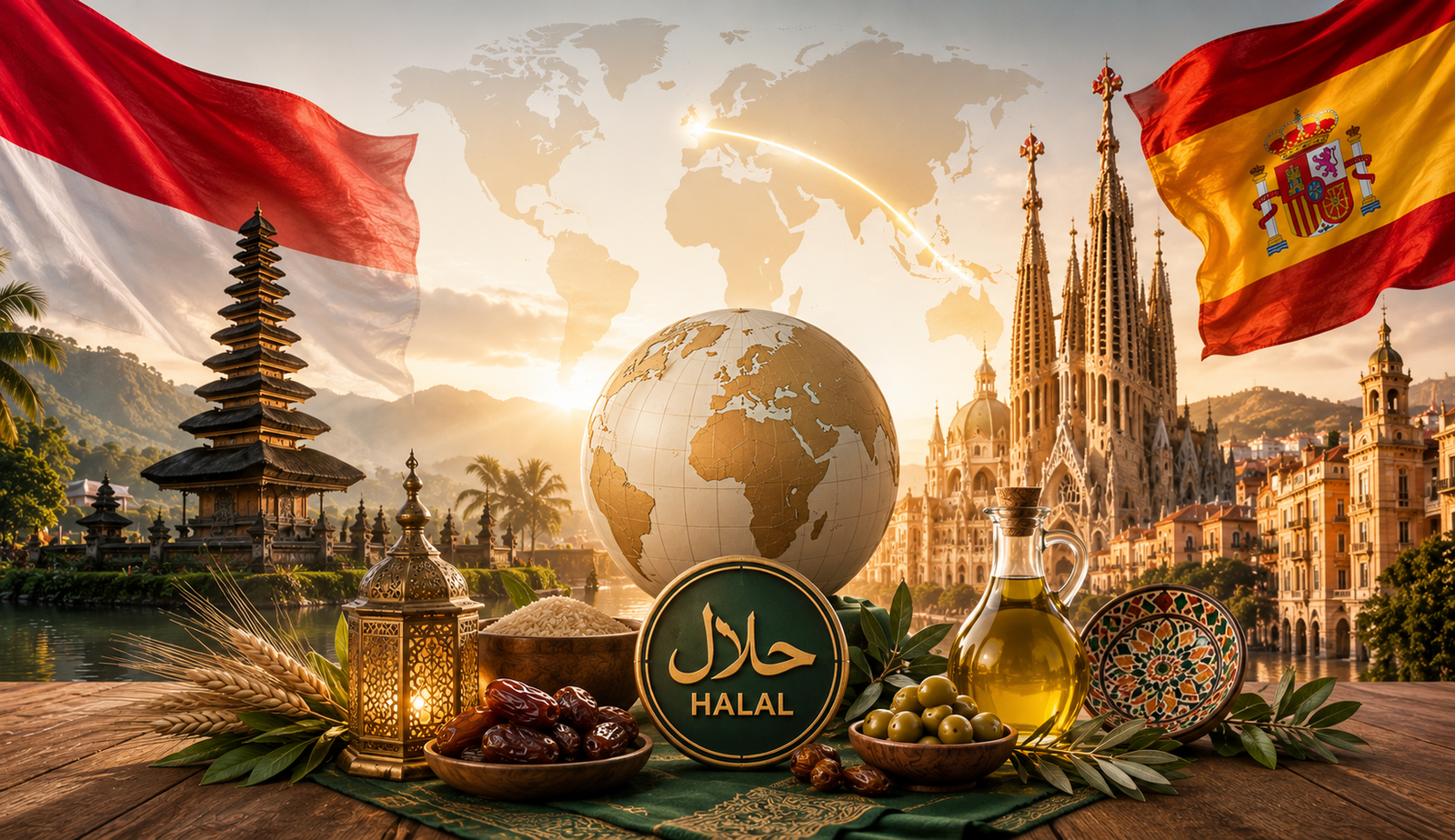
However, according to a recent academic opinion piece published in Frontiers in Psychology, the research meant to guide that expansion has not always kept pace. Authors from Telkom University in Indonesia and the University of Barcelona in Spain took a close look at existing halal consumer behavior literature in both countries, uncovering a revealing and somewhat surprising imbalance.
Why Indonesia and Spain Make an Unlikely Pair
At first glance, Indonesia and Spain seem like an odd comparison. Indonesia holds the title of the world’s largest Muslim-majority nation, with Muslims comprising more than 12.6% of the global Muslim population. Spain, by contrast, is a Catholic-majority European country whose Islamic history dates back roughly 1,200 years, to the era of Moorish rule beginning around 800 A.D.
Despite these differences, both countries share something increasingly relevant: real, measurable demand for halal products and experiences. Indonesia’s domestic market is obviously vast, given its population. Spain’s demand, meanwhile, comes largely through tourism and a growing local halal food supply chain, including the fact that a majority of lamb and beef sold nationally already meets Islamic slaughter requirements.
Therefore, examining both countries side by side offers researchers a useful natural experiment: how does halal research develop differently depending on whether a country is Muslim-majority or not?
Halal Research Highlights From Indonesia
| Study Focus | Key Finding | Published In | Year |
|---|---|---|---|
| Halal tourism industry potential | Halal tourism connects religious practice with real economic benefit for local communities and tourist sites | International Review of Management and Marketing | 2017 |
| Halal labeling and religiosity | Halal labels and personal religiosity both significantly influence food purchase decisions | International Journal of Business, Economics and Law | 2014 |
| Halal governance systems | Maps out current halal governance practices and remaining regulatory gaps in Indonesia | Journal of Islamic Monetary Economics and Finance | 2019 |
| Determinants of halal food consumption | Consumer attitudes, religious self-identity, and moral obligation all significantly predict halal food intentions | Journal of Islamic Marketing | 2019 |
What Indonesia’s Research Gets Right — and Misses
Indonesia’s academic community has produced a genuinely solid foundation of halal consumer research, particularly around food purchasing behavior. Studies consistently confirm that halal labeling, religious identity, and personal moral obligation all meaningfully shape what Indonesian Muslims choose to buy. This research aligns closely with Indonesia’s practical reality, where halal food consumption is deeply embedded in daily life for the majority-Muslim population.
Yet a clear gap emerges once tourism enters the conversation. Despite Indonesia’s obvious appeal to Muslim travelers, particularly visitors from the Middle East who reportedly spend an average of 12 days in the country, halal tourism remains comparatively understudied. One plausible explanation, according to the study’s authors, involves assumption rather than oversight: because Indonesia’s population is already majority-Muslim, researchers may simply not have prioritized tourism-specific halal research the way food consumption research has been prioritized.
This gap carries real consequences. Indonesia’s tourism sector could likely benefit from research specifically examining what Muslim international visitors expect, need, and value during their stay, beyond the food-purchasing habits of domestic consumers.
Spain’s Surprising Halal Demand
Spain’s story unfolds quite differently. Unlike Indonesia, Spain is not a Muslim-majority country, yet its halal market has grown substantially in recent years. According to the study, 62% of lamb and 56% of beef sold in Spain now comes from animals slaughtered according to Islamic law, figures that point toward genuine, sustained commercial demand rather than a passing trend.
Tourism numbers reinforce this picture. Spain welcomed more than five million Muslim tourist visits by 2019, many drawn to historic Islamic sites in Cordoba and Granada, remnants of the country’s centuries-long Moorish heritage. Spain has also expanded halal food exhibitions and hosted international halal industry events, signaling growing commercial investment in the sector.
Halal Research Highlights From Spain
| Study Focus | Key Finding | Published In | Year |
|---|---|---|---|
| Halal tourism, state of the field | Halal tourism research remains an early-stage academic field, even as real-world halal offerings expand rapidly | Tourism Review | 2019 |
| Halal tourism literature review | Halal tourism means designing services that meet Muslim travelers’ religious obligations | Journal of Islamic Marketing | 2019 |
| Spanish Muslims’ halal food purchase intention | Product awareness alone doesn’t drive purchase intention; consumer attitude and religious involvement matter more | International Food and Agribusiness Management Review | 2020 |
| Muslim tourists’ halal food purchase intention | Consumer attitude significantly mediates the link between halal credibility and purchase intention | Current Issues in Tourism | 2021 |
The Research Hasn’t Caught Up
Despite this clear commercial momentum, academic literature examining Spanish halal consumer behavior remains limited. Only a handful of major publications currently address the topic in depth, and most of those focus specifically on tourism rather than the broader consumer psychology driving everyday purchasing decisions.
This creates an unusual situation. Real-world demand for halal goods and experiences in Spain continues climbing, yet the underlying data helping businesses, policymakers, and tourism boards understand that demand remains thin. Notably, the study’s authors point out that halal tourism in Spain has remained relatively stagnant even while Muslim visitor numbers continue growing, suggesting untapped potential that better research could help unlock.
Furthermore, without deeper academic grounding, businesses risk making assumptions about Muslim consumers rather than working from evidence. Given that a growing share of Spain’s own non-Muslim population also seeks out halal-certified products specifically for their perceived quality and health benefits, misunderstanding this market carries a real opportunity cost.
A Global Pattern Worth Watching
This Indonesia-Spain comparison likely reflects a broader global pattern. Countries with large Muslim populations tend to generate research centered on domestic consumer behavior, since halal considerations naturally permeate everyday commercial life. Meanwhile, countries with smaller Muslim populations but growing halal markets, often driven by tourism or export demand, tend to produce research focused narrowly on that specific angle, leaving broader consumer psychology comparatively unexplored.
Consequently, neither research tradition alone paints a complete picture. Indonesia’s strength in consumer behavior research could meaningfully inform Spain’s thinner literature, while Spain’s tourism-specific insights could help Indonesia address its own understudied tourism sector. Collaboration, rather than parallel, siloed research efforts, appears to offer the more efficient path forward for both countries.
Why This Matters Beyond Academia
Although this piece centers on academic literature, its implications reach well beyond university departments. Tourism boards planning marketing campaigns, restaurant chains considering halal certification, and hospitality companies designing services for Muslim travelers all rely, whether they realize it or not, on the same body of research this study examines.
When that research base runs thin, businesses often default to assumptions or imported strategies from other markets, which may not accurately reflect local consumer expectations. Stronger, more collaborative academic groundwork could therefore translate directly into better-designed products, more effective marketing, and ultimately, stronger commercial outcomes across the halal sector.
Looking Toward Collaboration
The study’s authors close with a clear, practical recommendation: Indonesian and Spanish researchers should actively collaborate rather than continue developing separate, disconnected bodies of literature. Indonesian scholars, given their deeper experience studying halal consumer behavior domestically, could offer valuable frameworks and methodologies to Spanish researchers working to expand their own halal tourism and consumer studies.
Simultaneously, both countries could benefit from jointly expanding halal tourism research specifically, an area both share as a genuine, currently underdeveloped opportunity. Indonesia, despite its tourism potential, has not fully explored the topic. Spain, despite consistent Muslim visitor numbers, has seen halal tourism development stagnate.
A Market Too Big to Understudy
With the global Muslim population continuing to grow, and Pew Research projections suggesting Muslims could become the world’s largest religious group by 2070, the stakes for closing this research gap will only rise. Businesses, governments, and researchers alike stand to gain from treating halal consumer behavior and tourism as a genuinely global research priority, not a niche interest confined to Muslim-majority countries alone.
Ultimately, this comparison between Indonesia and Spain offers a useful lesson well beyond these two countries specifically. Wherever halal markets are growing, whether driven by domestic population or international tourism, research needs to grow alongside it. Otherwise, the gap between real-world demand and academic understanding will likely keep widening, leaving businesses and policymakers to navigate a major global market with an incomplete map.
Reference:
Other Articles: