Riyadh, Saudi Arabia – 1984. The Eighth Saudi Medical Conference was proceeding like any other major scientific gathering — until a moment that attendees would never forget.
On stage, a distinguished Thai professor of anatomy publicly declared the Islamic creed: “Laa Ilaaha Illallah, Muhammad Rasool Allah.” (There is no god but Allah, and Muhammad is His messenger.)
The man was Professor Dr. Tagata Tagasone, then Head of the Department of Anatomy and Embryology at the University of Chiang Mai, Thailand. Later, he would become Dean of the College of Medicine.
What caused a lifetime of scientific skepticism to collapse in a matter of minutes? A single verse from the Quran — chapter 4, verse 56 — that described something modern dermatology only fully understood in the last century.
The Verse That Reads Like a 21st-Century Textbook
The verse in question is from Surah An-Nisa’ (The Women) , verse 56:
“Those who reject Our signs, We shall soon cast into the Fire. As often as their skins are roasted through, We shall change them for fresh skins, so that they may taste the punishment. Indeed, Allah is Exalted in Power, Wise.” (Quran 4:56)
At first glance, this seems like a straightforward description of divine punishment. But Professor Tagasone saw something deeper — a scientific truth hidden in plain sight.
Why Must the Skin Be Renewed?
Let’s break down the science.
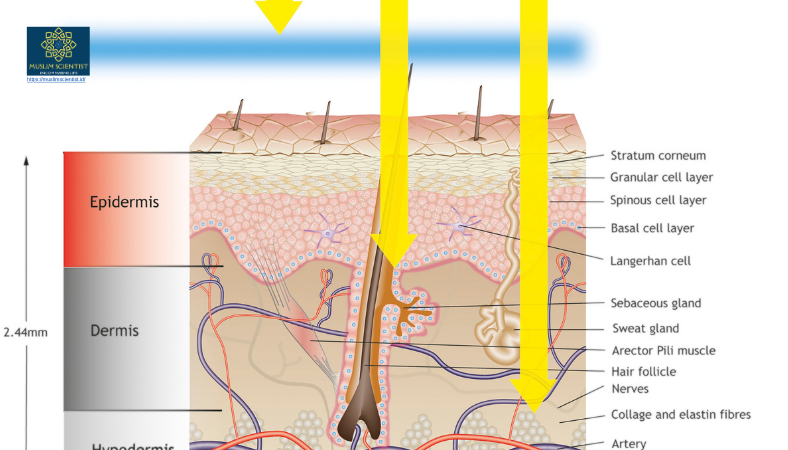
The human skin is not just a protective layer. It is the body’s largest sensory organ. It contains millions of nerve endings — specialized cells that detect heat, cold, touch, pressure, and pain. Without these nerve endings, you would not feel a burn, a cut, or even a gentle breeze.
Here is the crucial point: If the skin is completely destroyed by fire, those nerve endings are destroyed as well. A third-degree burn destroys the entire thickness of the skin, including all nerve endings. The result? The burned area becomes completely numb. It no longer feels pain.
So, for a person to experience the sensation of burning repeatedly, the skin must be restored — with all its nerve endings intact. If the skin were not replaced, the punishment would only be felt once. Then, numbness would set in.
The Quran, 1,400 years ago, described exactly this: the skin is roasted through, then replaced with fresh skin, so that the punishment continues to be felt.
This is not poetry. This is neuroanatomy — long before neuroanatomy existed.
Scientific Breakdown of Quran 4:56
| Quranic Statement | Scientific Interpretation | Discovery in Modern Medicine |
|---|---|---|
| “As often as their skins are roasted through” | Complete destruction of all layers of skin (third-degree burn) | Burn depth classification (19th-20th century) |
| “We shall change them for fresh skins” | Regeneration of skin with all sensory components | Skin grafting (late 19th century); understanding of skin renewal |
| “That they may taste the punishment” | Pain perception requires functional nerve endings in skin | Discovery of nociceptors (pain receptors) by Sherrington (1906) |
| “For Allah is Exalted in Power, Wise” | Divine origin of this knowledge | N/A |
The Conversation That Changed Everything
The events leading to Professor Tagasone’s conversion were meticulously documented. During the medical conference, Muslim researchers presented him with Quranic verses and prophetic traditions related to his field — anatomy and embryology.
Initially, Tagasone made a cautious claim. He said that Buddhist scriptures also contained accurate descriptions of embryonic development. The Muslim researchers were intrigued and asked him to show them those texts.
One year later, Professor Tagasone returned to King Abdul Aziz University as an external examiner. The researchers reminded him of his claim. This time, he apologized.
He admitted that he had made that statement without actually verifying it. When he returned to Thailand and checked the Buddhist scriptures, he found nothing — no accurate descriptions of embryology, no mention of skin regeneration or pain sensation.
At that point, the researchers presented him with a lecture written by Professor Keith Moore — one of the world’s most renowned embryologists, author of The Developing Human (a standard medical textbook). Professor Moore had written a detailed study on the compatibility of modern embryology with the Quran and Sunnah.
Tagasone knew Professor Moore’s reputation well. He studied the material. He was greatly astonished.
The Pivotal Question: Could This Come from a Human?
Then came the critical moment.
The researchers asked Professor Tagasone about modern discoveries in dermatology — specifically, the sensory characteristics of the skin. They asked:
“Do you agree that the sensation of a burn requires intact nerve endings in the skin?”
He answered: “Yes. If the burn is deep, the skin loses sensitivity.”
Then they recited Quran 4:56 to him — the verse about burning the skin and replacing it so that the punishment continues to be felt.
They asked: “Do you agree that this is a reference to the importance of nerve endings in the skin for sensation — revealed 1,400 years ago?”
Professor Tagasone paused. Then he answered: “Yes, I agree.”
He added: “This knowledge about sensation was known long before? No. Actually, it means they knew many years ago that the receptor of pain sensation must be on the skin. So they put a new skin on.”
The researchers then asked the decisive question:
“Is it possible that these verses came to Prophet Muhammad (peace be upon him) from a human source?”
Professor Tagasone conceded: “They could have never come from any human source.”
He asked: “Then where did he receive it from?”
They answered: “From Allah — the Creator of the heavens and the earth.”
Timeline of Human Understanding of Skin Sensation vs. Quranic Revelation
| Date | Event / Discovery | Knowledge of Skin Pain Receptors? |
|---|---|---|
| 609–632 CE | Quran revealed to Prophet Muhammad (PBUH) – contains verse 4:56 | Described the need for skin renewal to feel repeated pain |
| c. 1000 CE | Ibn Sina (Avicenna) describes the five senses in The Canon of Medicine | Basic understanding of touch, but no knowledge of nerve endings |
| 1664 CE | Thomas Willis publishes Cerebri Anatome – early studies of nerves | Nerves identified, but specific pain receptors unknown |
| 1839 CE | Theodor Schwann establishes cell theory | Skin structure begins to be understood at cellular level |
| 1906 CE | Charles Sherrington identifies “nociceptors” (pain receptors) | First scientific identification of pain-specific nerve endings |
| 20th century | Burn depth classification (first, second, third degree) | Complete understanding of skin destruction and numbness |
| 1984 CE | Professor Tagasone converts after reading Quran 4:56 | Modern scientist confirms Quran’s 1,400-year-old accuracy |
The Question of Source: Muhammad (PBUH) – An Illiterate Man in the Desert
Let us place this in context.
Prophet Muhammad (peace be upon him) lived in 7th-century Arabia. He did not read or write. He was not a physician, anatomist, or biologist. There were no medical schools, no microscopes, no dissections, no textbooks on dermatology or neuroanatomy in the Arabian Peninsula.
The Greek physician Galen (129–216 CE) had written extensively on anatomy, but his works were largely unknown in Arabia at the time. And even Galen did not understand that pain perception requires specific nerve endings in the skin that must be intact. That understanding came 1,700 years after Galen, in the 20th century.
So, where did the information in Quran 4:56 come from?
The only logical conclusions are:
- A lucky guess – but the verse is not vague. It specifically links skin replacement with the continuation of pain sensation. That is a testable, falsifiable claim about human anatomy.
- Plagiarism from ancient sources – but no pre-7th-century text contains this specific understanding of skin and pain. Professor Tagasone himself admitted that Buddhist scriptures contained nothing relevant.
- Divine revelation – The Creator, who designed the human skin and its nerve endings, revealed this fact to His Prophet.
Professor Tagasone’s New Life
After this realization, Professor Tagasone publicly recited the Shahadah. He did not convert out of emotion or social pressure. He converted because a scientific mind followed the evidence — and the evidence led to the Quran.
He then asked: “Who is Allah?”
The researchers replied: “He is the Creator of all that exists. If you find wisdom in creation, it comes from the All-Wise. If you find knowledge in the universe, it comes from the All-Knowing. If you find perfection and mercy, it comes from the All-Merciful.”
Professor Tagasone accepted Islam.
His story remains one of the most powerful examples of how the Quran’s scientific accuracy has challenged — and continues to challenge — even the most trained scientific minds.
What This Means for the Modern Reader
Today, we live in an age where many people assume science and religion are at war. The story of Professor Tagasone suggests otherwise.
When science is truly objective — when it follows the evidence without prejudice — it does not contradict revelation. It confirms it. The same Quran that spoke accurately about embryology, the expansion of the universe, and the water cycle also spoke accurately about the skin’s role in pain perception.
For the Muslim, this is a reminder that the Quran is the word of the Creator — not a 7th-century human text.
For the seeker of truth, this is an invitation to read the Quran with an open mind.
For the skeptic, this is a challenge: find a single error in the Quran’s descriptions of the natural world — if you can.
As the Quran itself says, in Surah Sad (38:87-88):
“This is no less than a reminder to all the worlds. And you shall certainly know the truth of it after a while.”
Postscript: A Legacy of Faith and Science
Professor Tagata Tagasone’s conversion was not an isolated incident. Many other scientists — including Professor Keith Moore (Canada), Professor Tejatat Tejasen (Thailand), and Dr. Maurice Bucaille (France) — have studied the Quran and concluded that its scientific content could not have come from any human source.
These are not uneducated men. They are professors, deans, and heads of departments at world-renowned universities. Their testimonies stand as a bridge between faith and reason.
The verse that burned away Professor Tagasone’s doubt continues to burn away the doubts of countless others. The skin, it turns out, is not just a covering. It is a sign — for those who reflect.
Reference: here
Other Articles: