In an era of empire and Christian piety, William Henry Quilliam converted to Islam and founded a Liverpool institution that would become the birthplace of British Islam. His story is one of courage, conviction, and a legacy nearly lost to time.
A Pious Methodist Who Found a New Faith
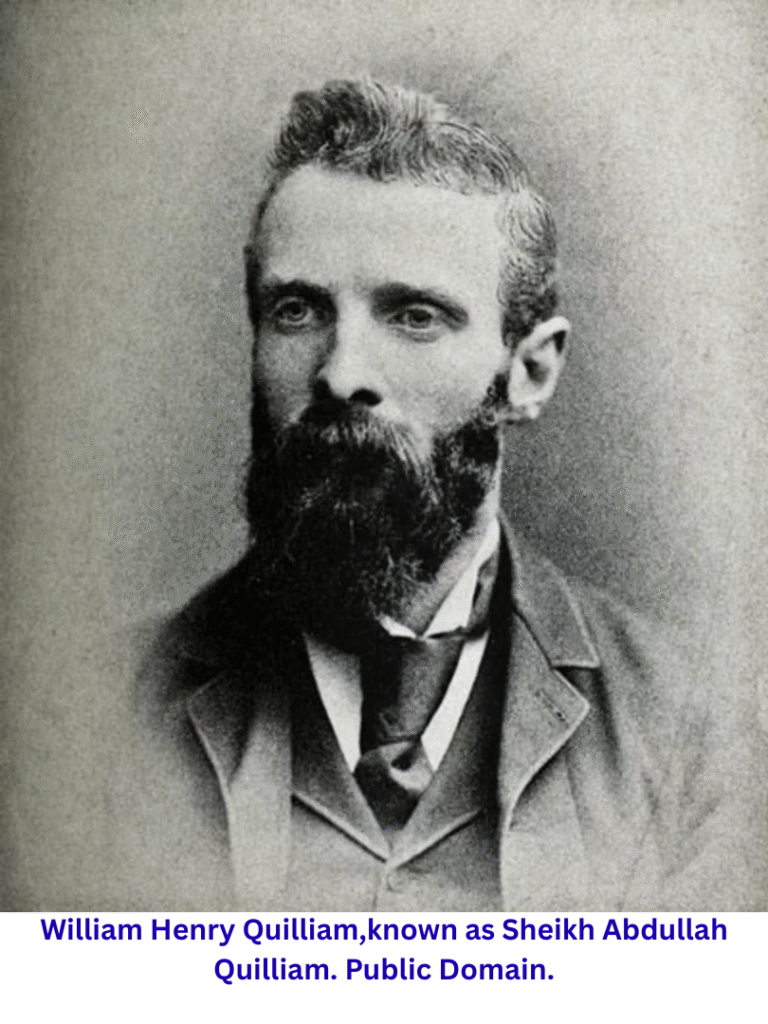
William Henry Quilliam was born in Liverpool on 10 April 1856, into a wealthy family of watchmakers. Raised as a Wesleyan Methodist, he was a “regular attendee” at the Fairfield Wesleyan Chapel and even taught Sunday School at the United Methodist Free Church. He was also a passionate advocate of the Temperance Movement, which opposed alcohol consumption—a conviction that would later resonate with Islamic teachings .
However, the Liverpool of Quilliam’s youth was deeply divided. Sectarian violence between Catholics and Protestants was common, and Quilliam grew increasingly disenchanted with the religion of his birth. Social injustice and inequality troubled him, and he felt that Christianity had failed to address these deep problems . This disillusionment would eventually lead him to seek answers elsewhere.
A Voyage That Changed Everything
In 1887, Quilliam travelled to Morocco to recover from an illness. During the ferry crossing, he observed a group of Muslim pilgrims praying on the deck, completely unperturbed by the rough seas. He later recalled, “They were not at all troubled by the force of the strong wind or by the swaying of the ship. I was deeply touched by the look on their faces and their expressions, which displayed complete trust and sincerity” .
After arriving in Tangier, he studied the Quran and found the faith “reasonable and logical.” He converted to Islam at the age of 31, taking the name Abdullah—even though converts are not obliged to change their names .
Building Britain’s First Mosque
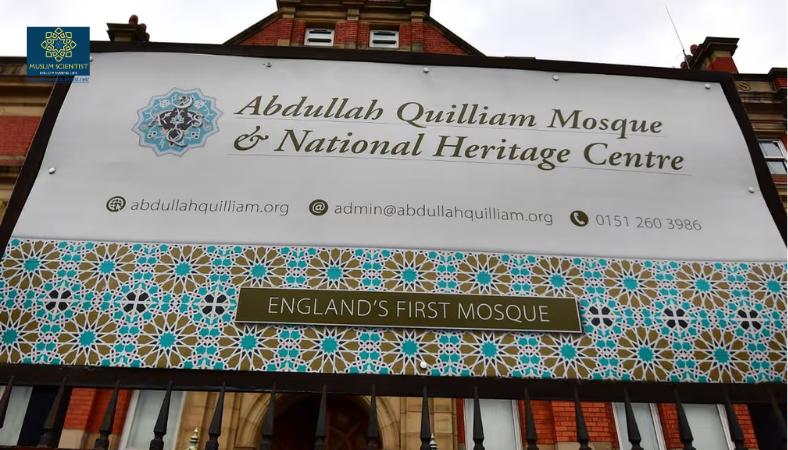
Returning to England, Quilliam set about spreading his new faith. On Christmas Day 1889, he opened the Liverpool Muslim Institute at 8-10 Brougham Terrace—the first functioning mosque in Britain . But this was no mere chapel. The institute was a full community hub, featuring:
- A mosque for daily prayers
- A boarding school for boys and a day school for girls
- An orphanage (Medina House) for non-Muslim parents who agreed to their children being raised as Muslims
- A museum, science laboratory, and library
- A printing press for publishing Islamic literature
The mosque was purchased with donations from Nasrullah Khan, Crown Prince of Afghanistan . By 1891, it was officially registered as a mosque. At its peak, it served around 150 worshippers, including Muslims from the Indian subcontinent, the Middle East, and Africa who had come to Liverpool as traders and seamen .
By 1893, Quilliam’s team was publishing The Crescent, a weekly newspaper, and The Islamic World, a monthly journal. These reached readers in over 20 countries, with subscriptions coming from as far away as India and Malaysia . His pamphlet The Faith of Islam was so popular that Queen Victoria ordered copies for herself and then six more for her grandchildren, suggesting a degree of royal interest in his work .
A Recognised Leader—and a Target
Quilliam’s influence was not limited to Liverpool. In 1894, the Ottoman Sultan Abdul Hamid II appointed him as Sheikh-ul-Islam of the British Isles—the only person ever to hold that title in Britain. He was also appointed Vice Consul of Persia by the Shah .
However, official recognition did not protect him from hostility at home. His public renunciation of Christianity sparked fierce backlash. Brougham Terrace became a target for vandals who threw bricks, offal, and even horse manure at the building. Some Christian priests and newspapers incited the attacks, but Quilliam stood firm, using newspapers and petitions to defend his community .
Despite the hostility, Quilliam maintained his profile. He was known locally for his work with the underprivileged, advocating trade unionism and divorce law reform. He was described by the Liverpool Weekly Courier as the “unofficial Attorney-General of Liverpool” . When foreign dignitaries arrived through Liverpool’s port, Quilliam, dressed in his robes and turban, would accompany the Lord Mayor to greet them. On one occasion, as he entered the Great Hall, foreign troops rose and offered him the Islamic cry, “Allah Akbar” .
Key Milestones in Quilliam’s Life
| Year | Event |
|---|---|
| 1856 | Born in Liverpool to a wealthy Methodist family |
| 1887 | Visits Morocco, converts to Islam, changes name to Abdullah |
| 1889 | Opens the Liverpool Muslim Institute—Britain’s first mosque |
| 1891 | Mosque officially registered |
| 1893 | Begins publishing The Crescent |
| 1894 | Appointed Sheikh-ul-Islam of the British Isles |
| 1908 | Struck off as solicitor, flees Liverpool |
| 1932 | Dies in London, buried in Woking |
The Fall and the Legacy
In 1908, Quilliam’s legal career came to an abrupt end. He was struck off the Roll of Solicitors after a failed attempt to entrap an allegedly adulterous husband for a female client—a “honey-trap” scheme that was not uncommon at the time but nevertheless resulted in his downfall . To protect his Muslim community from the scandal, he fled Liverpool, initially travelling to Constantinople. He later returned to Britain under the alias Henri Marcel Leon (or Haroun Mustapha Leon) and lived on the Isle of Man for a time .
In his absence, his son disposed of the Brougham Terrace properties, and the mosque closed in 1910. The building was later used as a registry office for births, deaths, and marriages, where it ironically recorded the marriage of John Lennon and his first wife, Cynthia .
Quilliam died in London on 23 April 1932 and was buried in an unmarked grave in the Muslim section of Brookwood Cemetery, Woking—not far from the graves of Abdullah Yusuf Ali and Marmaduke Pickthall, both of whom would later translate the Quran into English .
His Enduring Impact
Revival of a Forgotten Legacy
For decades, Quilliam’s contribution was almost entirely forgotten. However, in 1996, the Abdullah Quilliam Society was formed with the aim of restoring the mosque and preserving his legacy . In 1997, his granddaughter, Patricia Gordon, unveiled a plaque at the site, and the building was later granted Grade II listed status . After extensive refurbishment—costing over £1.5 million—the mosque was reopened in 2014 and continues to serve Liverpool’s Muslim community .
Today, Quilliam is increasingly recognised as a pioneering figure in British Islam, an “iconic exemplar of what it means to be British and Muslim” . Mumin Khan, chief executive of the Abdullah Quilliam Mosque, told The National that Quilliam “showed the beauty of Islam” by serving the poor and needy, “doing exactly what our Prophet would have done—serving humanity, serving the poor, serving the needy” .
Reference: here
Other Articles: