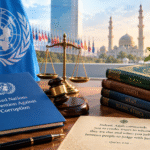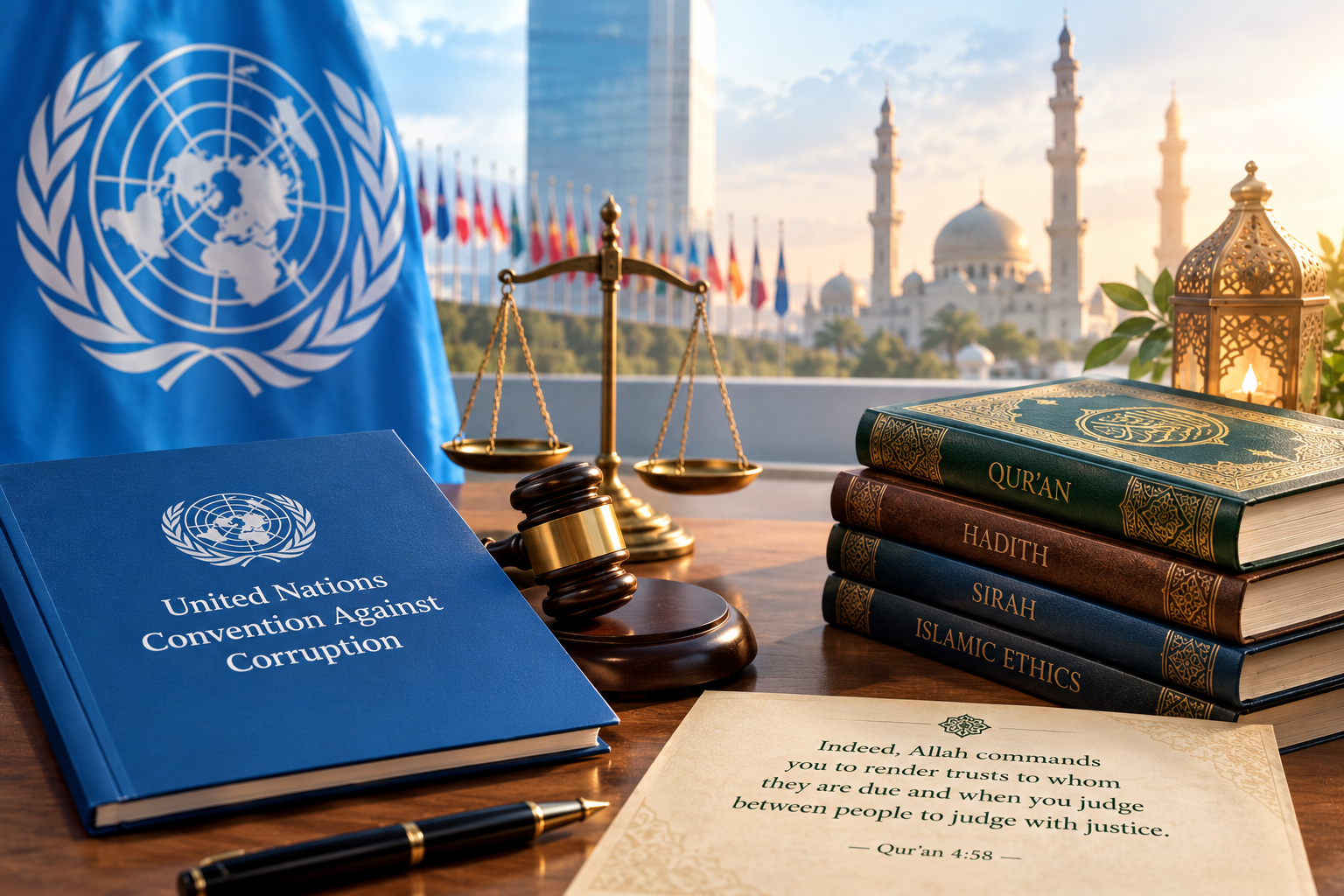
When diplomats gathered in New York in 2003 to sign the United Nations Convention against Corruption (UNCAC), they created the world’s first legally binding global treaty to fight graft . What many ordinary people may not realize is that long before modern international law took aim at bribery and embezzlement, Islamic teachings had already laid down remarkably strict and detailed prohibitions against the very same abuses.
For the average citizen—whether in Jakarta, Kuala Lumpur, Cairo, or London—the overlap between these two frameworks offers a powerful message: the fight against corruption is not a foreign imposition, but a shared moral imperative rooted in both global governance and faith.
What Is the UN Convention against Corruption?
The UNCAC is often described as the most comprehensive anti-corruption tool ever created. Adopted by the UN General Assembly in 2003 and entering into force in December 2005, it is the only legally binding universal instrument against corruption . As of recent years, the vast majority of UN member states—over 180 countries—are parties to the convention .
In simple terms, the convention asks countries to do four main things:
First, prevent corruption before it happens. This includes setting up anti-corruption bodies, promoting transparency in public hiring, and ensuring that judges and prosecutors act with integrity .
Second, criminalize corrupt acts. Countries must make it a crime to bribe public officials (both domestic and foreign), to embezzle public funds, to trade in influence, and to launder the proceeds of corruption .
Third, cooperate internationally. Because corrupt money often crosses borders, the convention requires countries to help each other investigate, extradite suspects, and share evidence .
Fourth, recover stolen assets. This is perhaps the most practical chapter for ordinary citizens. When a corrupt leader stashes stolen money in a foreign bank, the convention provides a framework to trace and return those assets to the country they were taken from .
The Islamic View: Corruption as a Betrayal of Trust
Now, let us look at what Islamic scripture says about the same behaviors. The vocabulary may be different, but the verdict is strikingly similar.
In Islam, corruption is not merely a legal violation—it is a moral and spiritual disease. The Quran explicitly forbids consuming wealth unjustly and using bribes to influence judges: “And do not consume one another’s wealth unjustly or send it [in bribery] to the rulers in order that [they might aid] you [to] consume a portion of the wealth of the people in sin, while you know [it is unlawful]” (Surah al-Baqarah, 2:188) .
The Prophet Muhammad (peace be upon him) went even further, cursing not only the one who takes a bribe but also the one who gives it and the intermediary who facilitates it . This three-way condemnation is crucial: it means that in Islamic ethics, there is no such thing as a “victimless” bribe. The giver, the taker, and the go-between are all implicated.
Perhaps the most powerful Islamic concept in this context is amanah, or trust. Public office, in Islamic teaching, is not a privilege to be exploited but a sacred trust to be fulfilled. The Quran commands: “Verily, Allah commands that you should render back the trusts to those to whom they are due; and that when you judge between people, you judge with justice” (Surah An-Nisa, 4:58) . When a official accepts a bribe, they are not just breaking a law—they are betraying a trust given by God.
Where the Two Frameworks Converge
What is remarkable is how closely the UNCAC’s technical provisions mirror Islamic ethical priorities.
This table shows that the core behaviors the UNCAC seeks to eliminate are the same behaviors Islamic law has condemned for centuries. The difference is largely one of mechanism: the UNCAC provides the international legal machinery, while Islam provides the moral and spiritual motivation.
A Closer Look at Asset Recovery: The “Stolen Wealth” Problem
One of the most tangible parts of the UNCAC for ordinary people is its focus on asset recovery. When millions of dollars are stolen from a health budget or an education fund and hidden in a foreign bank account, it is the poor who suffer most. The convention’s chapter on asset recovery gives countries a legal pathway to demand that money back .
Islamic teaching reinforces this from a different angle. A khutbah (sermon) text from the Federal Territory Islamic Religious Department in Malaysia notes that wealth obtained through haram (forbidden) means “does not bring comfort and happiness in life, but will bring misery and disaster in this world and the hereafter” . In other words, even if a corrupt official manages to keep their stolen money in this life, Islamic theology insists that it will never bring true peace.
| Dimension | UNCAC Approach | Islamic Approach |
|---|---|---|
| Focus | Returning assets to the victim state | Purifying wealth; avoiding haram earnings |
| Mechanism | International legal cooperation, freezing orders | Individual accountability before God; repentance and restitution |
| Ultimate Goal | Restoring public resources | Restoring justice and spiritual integrity |
Why This Matters for Ordinary Citizens
For the person on the street, the language of international treaties and religious jurisprudence can feel remote. But the practical implications are immediate.
When a customs officer demands an extra payment to clear goods, that is a bribe—prohibited by the UNCAC and forbidden in Islam. When a company wins a government contract because the director is the minister’s cousin, that is nepotism—condemned by both frameworks. When billions disappear from a state-owned enterprise and end up in luxury properties abroad, that is embezzlement and money-laundering—crimes that the UNCAC obligates countries to prosecute and that Islamic law regards as a betrayal of the ummah (community).
The convergence also matters for Muslim-majority countries. Many of them—including Indonesia, Malaysia, Saudi Arabia, the United Arab Emirates, and Iran—are parties to the UNCAC . This means their governments have voluntarily committed to international standards that align with their own religious heritage. Citizens can use this alignment to hold leaders accountable: “You signed the convention, and your religion teaches the same thing—so why is corruption still tolerated?”
Challenges and Criticisms
It would be naive to suggest that either framework has solved the problem. Corruption remains rampant in many countries that have ratified the UNCAC, and Muslim-majority societies are not immune to graft despite clear scriptural prohibitions. The gap between principle and practice is real.
Some critics note that the UNCAC lacks strong enforcement mechanisms. It relies on peer review and voluntary compliance, and powerful countries have sometimes shielded their own officials from scrutiny . Similarly, Islamic teachings on corruption are only effective if they are taught, preached, and internalized—something that is not always the case when religious institutions themselves become politicized or compromised.
Yet the value of having both frameworks lies in the overlap. When a religious leader condemns bribery from the pulpit and a government prosecutor cites the UNCAC in court, the message is reinforced from two directions. For ordinary people, this dual legitimacy can be a source of courage: the corrupt official cannot claim that anti-corruption efforts are merely a “Western” or “foreign” agenda.
Conclusion: A Shared Language of Accountability
The United Nations Convention against Corruption and Islamic teaching speak different languages—one of treaties and mutual legal assistance, the other of Quranic verses and prophetic traditions. But they describe the same enemy and demand the same remedy: transparency, accountability, and justice.
For the common person, the takeaway is simple. Corruption is not just illegal under international law; in Islam, it is a betrayal of trust that corrupts the soul and poisons society. The UNCAC gives governments a roadmap to build institutions that resist graft. Islamic teaching gives individuals a moral compass to refuse it.
When both are taken seriously, they form a powerful alliance—one that religious leaders, civil society, and ordinary citizens can use to demand a fairer society. The challenge is not a lack of standards. It is the will to live up to them.
Reference: UNITED NATIONS CONVENTION AGAINST CORRUPTION