Can a financial system built on religious rules help end poverty and protect the environment? A new review of 65 studies says it can. Earlier studies treated Islamic law, Islamic finance, and the United Nations Sustainable Development Goals (SDGs) as separate topics. This review ties the three together. Moreover, the authors find that the aims of Islamic law and the UN’s 17 goals point in the same direction, because both seek a better life for people today and for future generations. However, they add a warning: governments, regulators, and other institutions must back Islamic finance if it is to deliver results. This article explains the findings in plain language.
Why Islamic Finance Matters
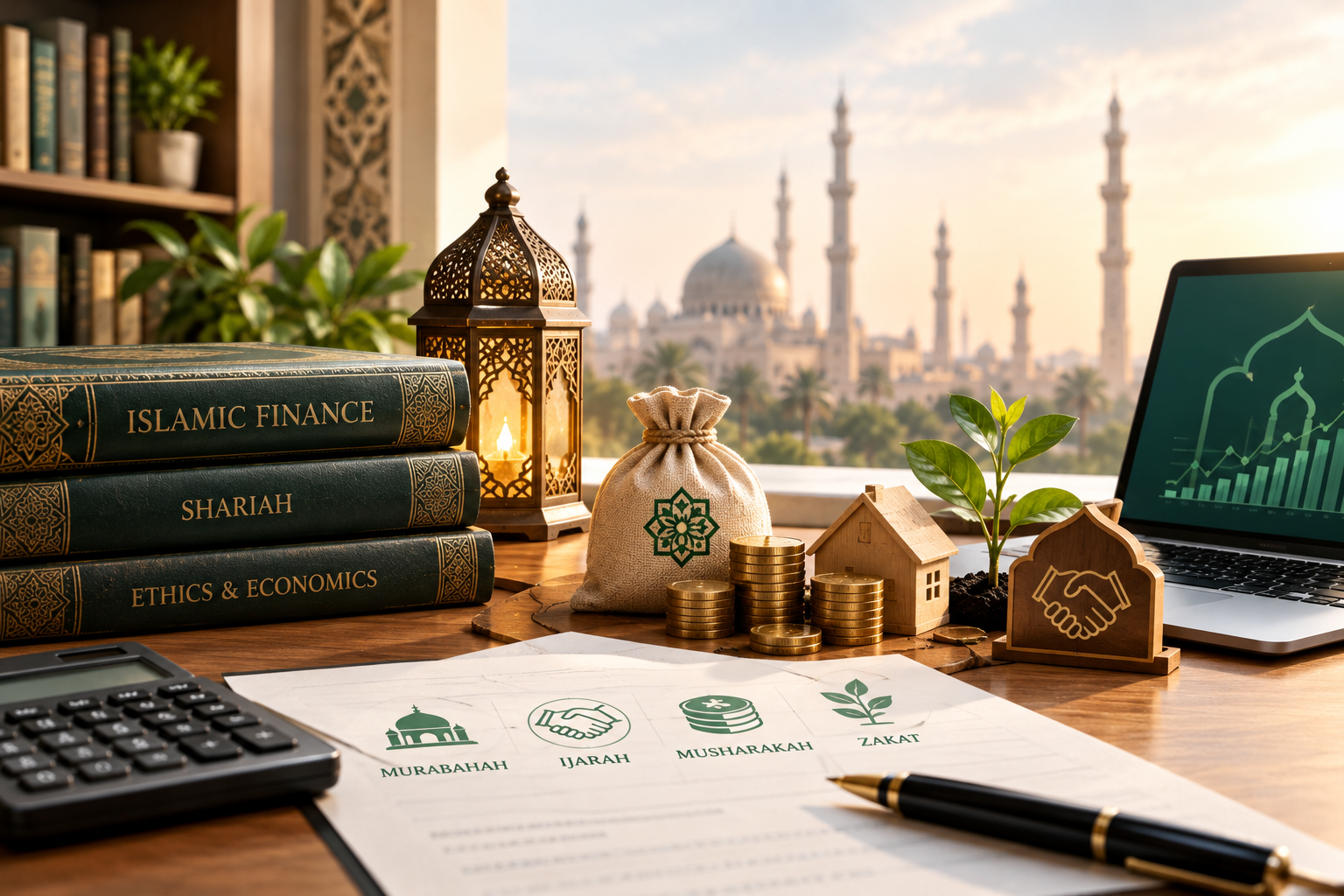
Islamic finance follows Shariah, or Islamic law. For example, it avoids interest and usury. Instead, it uses profit- and loss-sharing deals, such as mudarabah and musharaka contracts, in which the bank and the customer share both gains and risks. The sector began to grow in the 1970s and now operates in many countries. Furthermore, many countries with large Muslim populations face high poverty and low SDG scores, so they need large investments in infrastructure and services. Several earlier studies suggest Islamic finance could help. Still, the authors note that some customers see it as purely religious, and some critics doubt its role in sustainable development. In addition, past research stayed scattered, and none of it linked all three topics. Therefore, this review sets out to show that Islamic finance serves more than religious needs.
How the Review Worked
The team searched the Scopus database on 22 February 2022, using the terms Islamic, finance, sustainable, and development. First, the search returned 97 publications. Next, the authors kept English-language journals, books, and book chapters, and they dropped duplicates and unfinished versions. They also set aside papers that merely used Muslim-majority countries as a sample without discussing Islamic finance. After reading the full texts, they removed two more papers as off-topic. In the end, 65 publications from 2008 to 2022 remained. Among them were 52 research articles, 10 book chapters, 2 review articles, and 1 conference paper. Publication peaked in 2019 and 2020, with 19 and 18 papers. Meanwhile, Malaysian researchers wrote the most studies, 27 in the paper’s table. Finally, the team grouped the findings into themes and matched each one to the goals of Islamic law and to the SDGs.
The Money Behind the Movement
Islamic finance is big business. According to figures the authors cite from Refinitiv, global Islamic financial assets grew from USD 1,975 billion in 2014 to USD 3,374 billion in 2020. The pandemic slowed growth slightly, yet the sector still expanded by roughly 14% in 2020. Looking ahead, Refinitiv projects USD 4,940 billion by 2025, based on average growth of 8% a year. Banking dominates the market, as the table below shows. Sukuk, which are Islamic bonds, come second. In other words, most of the money sits in ordinary banking, so the sector’s choices can shape real communities.
Where Islamic Financial Assets Sat at the End of 2020
| Segment | Value (USD billion) | Share of total |
|---|---|---|
| Islamic banking | 2,349 | 70% |
| Sukuk (Islamic bonds) | 631 | 19% |
| Shariah funds | 178 | 5% |
| Islamic financial institutions (labelled “IFIs” in the paper) | 154 | 4% |
| Takaful (Islamic mutual insurance) | 62 | 2% |
| Total | 3,374 | 100% |
Source: Harahap, Risfandy, and Futri (2023), citing Refinitiv (2021).
Two Sets of Goals, One Direction
The authors use a framework from the scholar Al-Ghazali called Maqasid al-Shariah, which means the purposes of Islamic law. It lists five things to protect: faith, life, intellect, posterity (future generations), and property. For instance, protecting life covers health, freedom, and equality, while protecting posterity includes education and a clean environment. Property protection covers fair wealth distribution and poverty reduction. Meanwhile, the UN launched its 17 SDGs in 2015, and its main aim is to end poverty and ensure equality worldwide. As a result, the two systems overlap strongly. The authors argue that both treat wealth as a tool for the development of all people, not just of one owner. Consequently, they see Islamic finance as a natural partner for the SDGs.
What the Studies Found: Helping People First
The most discussed theme, with 13 of the 65 papers, covered philanthropy, social responsibility, and ethics. For example, one study in Kedah, Malaysia, found that zakat, the mandatory yearly charity, supports poverty relief and better health. Similarly, another found that zakat contributions had a positive effect on the financial performance of Islamic banks. Waqf, or charitable endowment, also stood out. According to the review, sustainable waqf properties meet community needs and improve the social standing of Muslims. In Indonesia, digital waqf platforms raise funds more effectively and may help cut poverty. In addition, studies from Nigeria suggest that sukuk, waqf, and zakat could pay for higher education. Finally, one paper found that adding ESG or SDG goals to Shariah fund decisions did not hurt returns.
Tools at a Glance
The table below sums up the main tools the review discusses. Each one links to goals such as poverty reduction, education, or gender equality. However, the authors stress that most evidence comes from individual studies, so results vary by country.
Islamic Finance Tools and What Studies Found
| Tool | What it is | What studies found | Goals it supports (examples) |
|---|---|---|---|
| Zakat | Mandatory yearly charity | Helps poor people earn their own income; linked to poverty relief in Kedah | Poverty, health |
| Waqf | Charitable endowment | Builds lasting properties for social needs; digital platforms may raise more funds | Poverty, welfare, nutrition |
| Sukuk | Islamic bonds | Support human welfare; can fund waqf assets and education; blockchain may add transparency | Growth, infrastructure, education |
| Islamic microfinance | Small loans and partnerships | Helps reduce poverty; women-only credit windows boost female clients | Poverty, gender equality |
| Green banking and green trusts | Eco-friendly banking and investment pools | Bankers’ green habits help green banking grow; an unleveraged green investment trust can pool funds for projects | Climate and environment |
Source: Harahap, Risfandy, and Futri (2023), summarizing the reviewed studies.
Technology and Green Banking
Technology offers new options. For example, combining sukuk with blockchain could make cash flows more transparent and help investors decide. Nevertheless, the authors caution that legal, regulatory, and Shariah risks remain. In addition, one study suggests that crowdfunding could revive waqf in Thailand. On the environmental side, the review highlights five green habits among Islamic bankers: conservation, sustainable work, avoiding harm, influencing others, and taking initiative. Each habit helps green banking grow. However, one study of banks in the United Arab Emirates found that Islamic banks disclosed less about sustainability than conventional ones. Therefore, Islamic finance does not automatically outperform on green issues, and the authors do not claim it does.
Rules, Compliance, and Governance
Following Shariah matters, according to the review. Studies suggest that Shariah-compliant firms finance themselves more carefully and stay more financially sustainable. Likewise, firms that adopt strong Islamic corporate governance improve their social and environmental results. The authors also warn against hilah, the practice of bending religious rules through legal tricks. Meanwhile, the review finds a legal gap in several countries. Conventional law often clashes with the needs of Islamic finance, and courts may lack the expertise to handle disputes. For example, studies from Nigeria and the United Arab Emirates call for reform, and one paper recommends special agencies for Shariah-related statements. As a result, the authors urge governments to update laws so that Islamic finance can work smoothly.
Customers, Women, and Skills
People also shape the sector. Studies in Malaysia show that attitudes, social norms, and trust drive depositors’ choice of Islamic banks. Therefore, education campaigns about products and values could attract new customers. Interestingly, a study in the United States found that local residents liked the idea of profit and loss sharing, even in a Muslim-minority setting. In addition, the review highlights women. Women-only credit windows and trained female staff can widen access to small loans and support the fifth SDG, gender equality. Meanwhile, universities and industry partners are building courses to train Islamic finance talent. Overall, these findings suggest that growth depends as much on skills and trust as on products.
Limits and Open Questions
The review has limits. The team searched only one database, Scopus, and counted only English-language work. Moreover, the studies it covers differ widely in method and quality, and many are conceptual rather than tested with data. Some regional figures in the paper do not add up cleanly, so readers should treat them as rough guides. In addition, not every finding is positive. One study argued that Islamic consumer credit looks much like conventional debt, and others found gaps in court support. Consequently, the authors call for more tests of how Islamic finance affects development, especially through single-country surveys of poverty and social impact.
What This Means for You
The message is clear and practical. Islamic finance can serve broad social goals, not only religious ones, but it needs good rules and honest practice. First, banks should keep Shariah compliance strong, because the review links it to stability. Second, policymakers should update laws and support courts so that disputes get fair handling. Finally, researchers should test these claims with fresh data. For everyday readers, the lesson is simple: ask what a financial product does for communities as well as for customers. Moreover, a system that shares risk and funds real needs may help more people reach the goals the world has set for 2030.