Summary
Geopolitical Risk and ASEAN Markets: What a New Study Reveals About Conventional vs. Islamic Indices
A 2025 study by Zaheer Anwer and Fiaz Ahmad of Sunway Business School examines how geopolitical risk affects stock returns in five ASEAN economies. The research covers January 2019 to March 2024, a period marked by COVID-19, the Russia-Ukraine war, and ongoing trade tensions.
The study analyses both conventional and Shariah-compliant indices from Indonesia, Malaysia, Thailand, the Philippines, and Vietnam. It asks whether Islamic investments offer protection during geopolitical crises.
Several findings emerge. First, geopolitical risk does affect ASEAN5 returns. When risk rises, returns tend to fall. Second, effects vary across countries. Economies with greater trade exposure feel the impact more acutely.
Third, conventional and Islamic indices show broadly similar responses. Both decline when geopolitical risk spikes. Islamic indices do not offer systematic protection.
Fourth, the relationship is not static. It changes over time, suggesting context matters. Fifth, there is limited evidence of safe haven properties. Islamic indices do not consistently protect against geopolitical risk.
Why don’t Islamic indices provide shelter? Several explanations emerge. They remain equity investments, exposed to market risk. They are subsets of broader markets, representing filtered versions of the conventional universe. Geopolitical risk affects entire economies, rippling through all sectors. The screening process may not target sectors most affected by geopolitical shocks.
Country-level differences matter. Malaysia and Indonesia, with mature Islamic finance sectors, show patterns reflecting this integration. Thailand, the Philippines, and Vietnam show different dynamics.
For investors, several lessons emerge. Geopolitical risk is a real factor. Islamic investments do not automatically provide protection. Diversification remains essential. Monitoring developments matters.
For policymakers, the findings suggest continued attention to financial stability, continued development of Islamic finance, regional cooperation, and clear communication during periods of tension.
The study acknowledges limitations. It focuses on five countries. It uses indices rather than individual stocks. It covers a specific period. Future research could expand the sample, examine sector-level effects, and explore different types of geopolitical events.
The findings contribute to research on global risks and emerging markets. Islamic finance serves important purposes — providing faith-compliant options, promoting ethical principles, supporting financial inclusion. But it does not offer a magic shield against geopolitical risk. Diversification, not asset class selection, remains the primary tool for managing uncertainty.
For ASEAN economies, the study underscores the importance of resilience. Geopolitical risk is not going away. Countries that prepare through diversification, cooperation, and sound policy will weather the storms better.
A 2025 study from Sunway University examines how geopolitical tensions shape returns across five Southeast Asian economies — and whether Islamic-compliant investments offer any protection
A World on Edge: Why Geopolitical Risk Matters
Geopolitical risk has become impossible to ignore. Trade wars, territorial disputes, military conflicts, and political instability dominate headlines. For investors, these events create uncertainty. For markets, they create volatility.
A 2025 study by Zaheer Anwer and Fiaz Ahmad of Sunway Business School in Malaysia examines how geopolitical risk affects stock returns in five ASEAN economies. The research focuses on both conventional and Shariah-compliant indices, asking a critical question: do Islamic investments offer any shelter when the world grows tense?
The study covers the period from January 2019 to March 2024. This window captures several major disruptions — the COVID-19 pandemic, the Russia-Ukraine war, tensions in the South China Sea, and ongoing trade frictions between major powers. In other words, it captures a world in which geopolitical risk has become the norm rather than the exception.
What Is Geopolitical Risk?
Before diving into findings, it helps to understand what researchers mean by geopolitical risk. The term refers to the threat, realization, and escalation of adverse events tied to tensions between states or political actors. These events range from terrorist attacks and diplomatic breakdowns to full-scale military conflict.
Unlike market risk, which can be measured through price volatility, geopolitical risk originates outside financial systems. It emerges from the messy world of politics, diplomacy, and power competition. Yet its effects ripple through markets with remarkable speed.
Investors respond to geopolitical shocks in predictable ways. They sell risky assets. They move toward safe havens. They delay decisions. These behaviors create price swings that may have little to do with company fundamentals.
For emerging markets like those in ASEAN, geopolitical risk adds another layer of vulnerability. These economies depend heavily on trade, foreign investment, and global supply chains. When tensions rise, capital flows can reverse quickly.
The ASEAN5: A Region of Contrasts
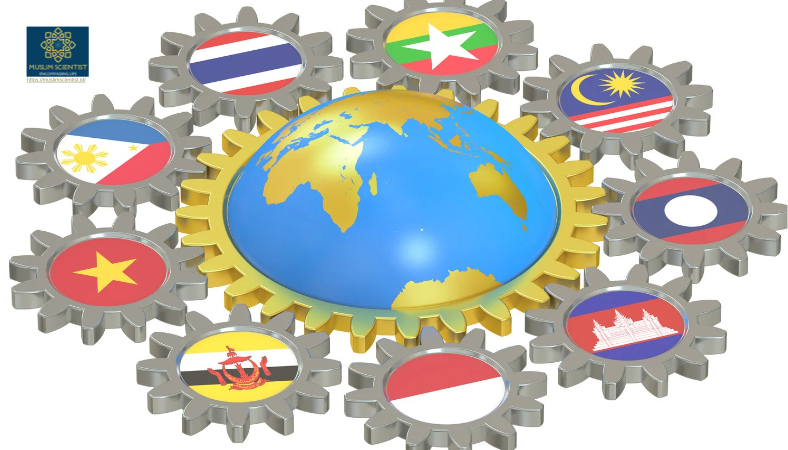
The study examines five ASEAN economies. These countries share membership in a regional bloc but differ significantly in size, development, and economic structure.
Indonesia leads the group with the largest population and economy. Malaysia and Thailand represent more mature industrial and financial markets. The Philippines and Vietnam contribute growing consumer markets and manufacturing hubs.
What unites them is a shared vulnerability to external shocks. All five rely on exports. All five attract foreign investment. All five are integrated into global supply chains. When geopolitical risk rises, all five feel the pressure.
The region also hosts significant Muslim populations. Malaysia and Indonesia are majority Muslim. This makes Islamic finance a natural component of the financial landscape. Shariah-compliant indices offer an alternative investment universe for those seeking faith-based opportunities.
Why Islamic Indices Might Be Different
Islamic finance rests on principles that differ from conventional finance. The prohibition of riba (interest), avoidance of excessive uncertainty, and exclusion of harmful industries all shape how Shariah-compliant investments are constructed.
These principles produce portfolios that look different from conventional ones. Islamic indices typically exclude financial institutions that rely on interest. They screen out alcohol, gambling, and tobacco companies. They avoid excessive leverage.
Some researchers argue these differences make Islamic investments more stable during crises. Less leverage means less vulnerability. Ethical screens mean exposure to different sectors. Risk-sharing principles mean a different approach to financial contracts.
Others disagree. They argue that Islamic indices are still subsets of broader markets. They remain exposed to the same macroeconomic forces. When panic strikes, investors sell everything — including Shariah-compliant assets.
The study tests these competing claims.
ASEAN5 Economies in the Study
| Country | Key Characteristics | Muslim Population | Financial Market Development |
|---|---|---|---|
| Indonesia | Largest economy, G20 member | Majority Muslim (~87%) | Emerging, growing |
| Malaysia | Advanced Islamic finance hub | Majority Muslim (~61%) | Mature, well-developed |
| Thailand | Industrial and tourism hub | Minority Muslim (~5%) | Mature |
| Philippines | Growing consumer market | Minority Muslim (~6%) | Developing |
| Vietnam | Manufacturing powerhouse | Small Muslim minority | Emerging |
The Study’s Key Research Questions
| Question | Focus |
|---|---|
| Does geopolitical risk affect ASEAN5 returns? | Direct impact assessment |
| Do conventional and Islamic indices respond differently? | Comparative analysis |
| Is there a safe haven effect? | Hedging potential |
| How do responses vary across countries? | Regional heterogeneity |
| What are the policy implications? | Investor and regulator guidance |
How the Study Works
The researchers use quantitative methods to trace relationships between geopolitical risk and market returns. They analyse daily data across the study period. They examine both short-term reactions and longer-term patterns.
The data includes conventional indices and Shariah-compliant indices from each of the five countries. This allows direct comparison — do Islamic investments behave differently when geopolitical risk spikes?
Geopolitical risk itself is measured using established indices. These capture news-based indicators of tension, conflict, and political instability. Higher values signal greater risk.
The methodology allows researchers to trace not just whether relationships exist, but how they evolve over time. Geopolitical risk is not constant. It rises and falls. The study tracks these movements.
What the Study Finds
Several patterns emerge from the analysis.
First, geopolitical risk does affect ASEAN5 market returns. When risk rises, returns tend to fall. This confirms what intuition suggests — political tensions create economic uncertainty.
Second, the effects vary across countries. Some economies are more sensitive than others. Countries with greater trade exposure, higher foreign investment, or proximity to conflict zones feel the impact more acutely.
Third, conventional and Islamic indices show broadly similar responses. Both decline when geopolitical risk spikes. Islamic indices do not offer systematic protection against geopolitical shocks.
Fourth, the relationship is not static. It changes over time. During certain periods, the link between risk and returns strengthens. During others, it weakens. This suggests that context matters — the same geopolitical event may have different effects depending on prevailing conditions.
Fifth, there is limited evidence of safe haven properties. Assets that protect investors during crises — gold, certain currencies, specific government bonds — have well-documented safe haven characteristics. Islamic indices do not consistently display these properties against geopolitical risk.
Why Islamic Indices Don’t Provide Shelter
The finding that Islamic indices respond similarly to conventional ones may surprise some observers. After all, Islamic finance is built on principles that emphasize stability and risk-sharing.
Several explanations emerge.
First, Islamic indices remain equity investments. They are exposed to market risk. When investors panic, they sell equities — regardless of whether those equities are Shariah-compliant.
Second, Islamic indices are subsets of broader markets. They represent a filtered version of the conventional universe. The filtering removes certain sectors but does not eliminate exposure to systematic risk.
Third, geopolitical risk affects entire economies. It disrupts trade, investment, and consumer confidence. These effects ripple through all sectors — including those that Islamic indices include.
Fourth, the screening process may not target the sectors most affected by geopolitical risk. Islamic indices exclude financials and sin stocks. But they still include manufacturing, technology, and commodities — all sensitive to geopolitical shocks.
Country-Level Differences
The study finds notable variation across the five countries.
Malaysia and Indonesia, with their more developed Islamic finance sectors, show patterns that reflect this maturity. Their Islamic indices are more integrated with global markets. They respond to geopolitical risk in ways similar to conventional indices.
Thailand, the Philippines, and Vietnam, with smaller Islamic finance sectors, show different dynamics. Their Islamic indices are less developed. The relationship between geopolitical risk and returns may be shaped by other factors.
These differences matter for investors. A one-size-fits-all approach does not work. The same geopolitical event may have different implications depending on which market you are watching.
Implications for Investors
The study offers several lessons for investors.
First, geopolitical risk is a real factor. Investors should incorporate it into their analysis. Ignoring political tensions leaves portfolios exposed.
Second, Islamic investments do not automatically provide protection. Investors seeking shelter during geopolitical crises should look elsewhere. Gold, certain currencies, and specific fixed-income instruments have better-documented safe haven properties.
Third, diversification remains essential. Exposure to multiple countries, sectors, and asset classes reduces vulnerability. No single market or instrument offers complete protection.
Fourth, monitoring geopolitical developments matters. Risk is not static. It evolves. Investors who track developments can adjust positions accordingly.
Implications for Policymakers
The findings also carry implications for regulators and policymakers.
First, financial stability requires attention to geopolitical risk. Central banks and regulators should monitor external tensions. They should assess how these tensions affect domestic markets.
Second, Islamic finance development should continue. The study does not suggest Islamic finance is ineffective. It simply finds that Islamic indices do not offer special protection against geopolitical risk. Islamic finance still serves important functions — providing faith-compliant investment options, promoting ethical finance, and supporting financial inclusion.
Third, regional cooperation matters. ASEAN countries share vulnerabilities. Coordinated responses to geopolitical shocks could reduce collective risk.
Fourth, communication is important. Clear messaging during periods of tension can reduce panic. Investors who understand the situation are less likely to make impulsive decisions.
What This Means for Ordinary People
Why should this study matter beyond financial circles?
Because geopolitical risk affects everyone. When tensions rise, economies slow. Jobs are lost. Prices rise. The effects reach households, not just trading floors.
For Muslim investors, the findings are clarifying. Islamic investments offer faith compliance, not crisis protection. Those seeking both should diversify across asset classes.
For anyone with savings or retirement accounts, the study offers a reminder. Global events matter. Political tensions in distant countries can affect local portfolios. Awareness and diversification are essential.
For citizens of ASEAN countries, the research highlights regional interdependence. What happens in one country affects others. Cooperation and coordination serve everyone’s interests.
The Bigger Picture
The study contributes to a growing body of research on how global risks affect emerging markets. It adds nuance to debates about Islamic finance and its potential benefits.
The findings are neither dismissive nor celebratory. Islamic finance serves important purposes. It provides faith-compliant investment options. It promotes ethical principles. It supports financial inclusion.
But it does not offer a magic shield against geopolitical risk. Investors seeking protection must look elsewhere. Diversification, not asset class selection, remains the primary tool for managing uncertainty.
For ASEAN economies, the study underscores the importance of resilience. Geopolitical risk is not going away. Trade tensions, territorial disputes, and great-power competition will continue to shape the global landscape. Countries that prepare — through diversification, cooperation, and sound policy — will weather the storms better.