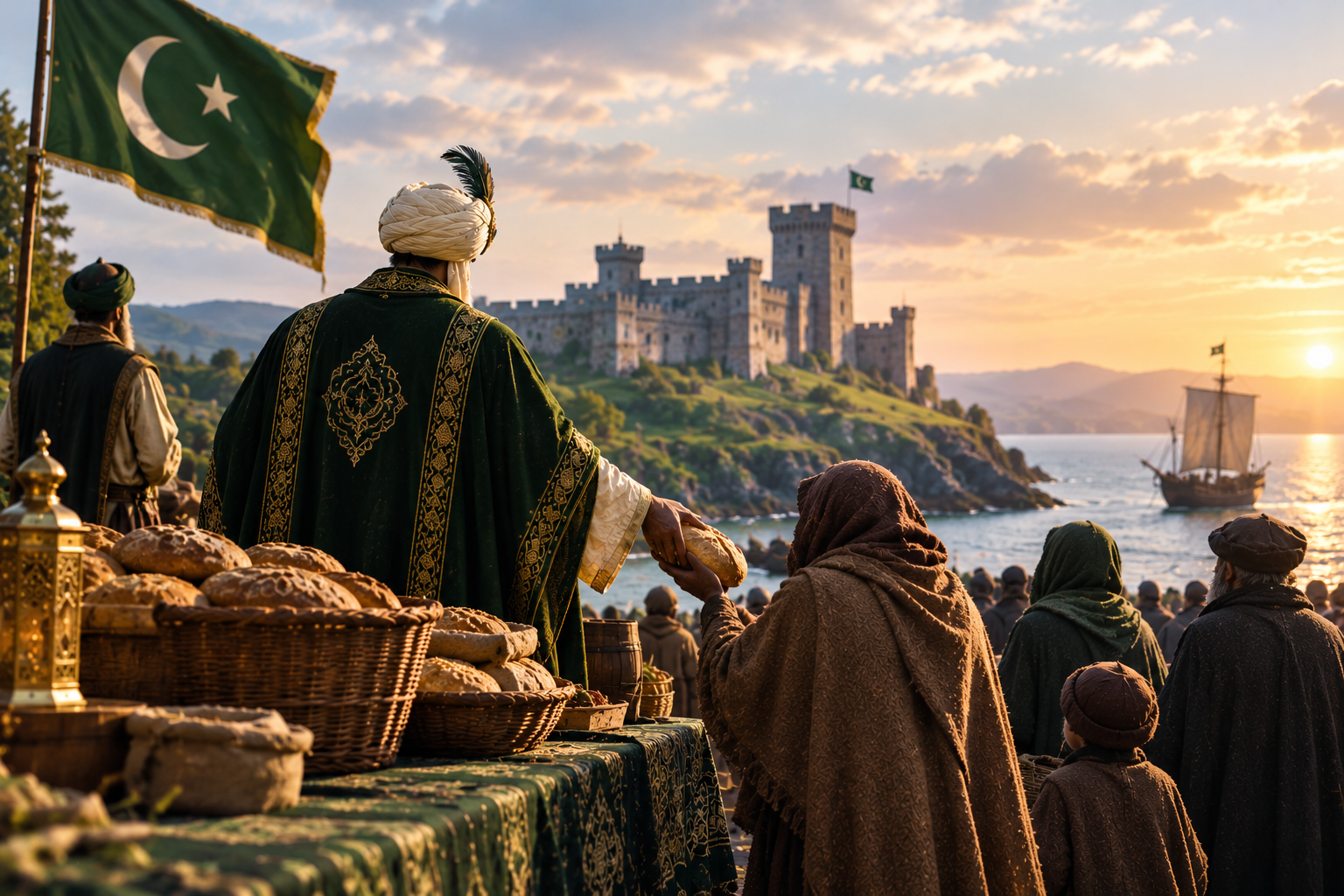
On the cobblestone quays of the River Boyne, a small plaque tells a story that many Irish schoolchildren still learn today. It honors a ruler from a distant empire who reached out when the world seemed indifferent. Nearly two centuries ago, Sultan Abdul Majid I of the Ottoman Empire sent ships filled with food and medicine to a starving island. Today, that act of kindness remains etched into the town’s coat of arms—a crescent and star beside the Irish harp .
This is not a new discovery. Yet for ordinary people across Europe and the Middle East, the story carries fresh weight. It speaks to a simple truth: compassion crosses borders, faiths, and politics. In an era when divisions often dominate headlines, the bond between a 19th-century Muslim ruler and the Catholic poor of Ireland offers a quiet counter-narrative.
A Famine That Broke a Nation
Ireland in the 1840s was a place of desperate hunger. A potato blight destroyed the staple crop that fed millions. British rule, then led by Queen Victoria’s government, offered relief that historians widely consider inadequate. Over one million people died. Another million fled, mostly to America .
The worst year was 1847, known as “Black ’47.” Crop yields had failed for three straight seasons. People in the hardest-hit west of Ireland ate seaweed, turnip tops, and sand eels—foods no English observer considered fit for animals . The British Treasury clung to laissez-faire policies. Soup kitchens opened and closed. Workhouses overflowed. Coffins were reused because wood ran short.
News of this catastrophe traveled slowly, but it did travel. In Istanbul, the Ottoman capital, a man heard the details from an unexpected source.
The Sultan’s Dentist and a Moral Duty
Sultan Abdul Majid I was 23 years old when the famine peaked. His dentist, an Irishman named Dr. (some accounts say a physician), told him what was happening in his homeland . The young sultan, head of a vast empire stretching from the Balkans to Arabia, decided to act.
He offered £10,000—a sum worth well over a million pounds today . That amount, however, created a diplomatic problem. Queen Victoria had donated £2,000 to Irish relief. British protocol held that no foreign ruler should appear more generous than the British monarch. London’s diplomats pressured the sultan to reduce his gift.
Reluctantly, Abdul Majid cut the cash donation to £1,000 . But he did not stop there.
Key Figures of the Ottoman Aid to Ireland (1847)
| Item | Detail |
|---|---|
| Ruler | Sultan Abdul Majid I (Ottoman Empire) |
| Initial offer | £10,000 |
| Amount sent after British pressure | £1,000 |
| Additional aid | 3 ships carrying food and medicine |
| Destination port | Drogheda, County Louth |
| Current symbolic legacy | Crescent and star on Drogheda’s coat of arms |
Ships That Slipped Past the Blockade
British naval authorities controlled Irish ports. They refused to let foreign vessels dock at Dublin or Cork, fearing political embarrassment and protocol breaches . The sultan’s agents found another way.
Three Ottoman ships sailed quietly toward the northeast coast. They unloaded their cargo at Drogheda, a port town about 30 miles north of Dublin . The exact contents—grain, medicine, clothing—were distributed by local committees. No grand ceremony marked the arrival. The British press barely mentioned it.
Local records, however, preserved the memory. Drogheda’s town leaders sent a formal letter of thanks to Istanbul. “We, as Irish nobles, dignitaries and people, submit our gratitude to the Ottoman Sultan for his generous assistance,” the letter reads. “Many people have been relaxed and got rid of death” .
That letter now sits in the Ottoman archives in Istanbul. A copy travelled back to Ireland in 1995, when Drogheda unveiled its memorial plaque.
Why This Story Matters Today
For ordinary readers, the tale offers more than historical curiosity. It challenges assumptions about religion and power. The Ottoman sultan was a Muslim caliph. The Irish were devout Catholics under Protestant British rule. Yet neither theology nor geopolitics stopped the aid.
A contemporary religious journal in Britain noted the significance at the time. “For the first time a Mohammedan sovereign manifests spontaneously a warm sympathy with a Christian nation,” it wrote. “May such sympathies be cultivated” .
Modern diplomats cite the episode as a foundation of Turkey-Ireland relations. In 2010, President Mary McAleese thanked Turkey during a state visit to Ankara. She noted that Drogheda’s football club, Drogheda United, still wears the crescent and star on its crest .
Famine and Aid at a Glance
| Category | Figure / Fact |
|---|---|
| Famine period | 1845–1852 |
| Irish deaths | Over 1 million |
| Irish emigration | Over 1 million (mainly to USA) |
| Worst year | 1847 (“Black ’47”) |
| Ottoman cash aid | £1,000 (plus ships of goods) |
| Value of initial offer today | ~£1.3 million / $1.3 million |
| Drogheda memorial unveiled | 1995 |
A Quiet Lesson in Humanity
Not every act of goodness makes headlines. The Ottoman ships did not end the famine. They did not overthrow British policy or change the course of history. What they did was feed some hungry people and leave a mark on a town’s identity that outlasted empires.
For common people in Ireland, Turkey, and beyond, the story resists easy moralizing. It simply shows that a young ruler, thousands of miles away, chose to listen. He heard a dentist’s account of suffering. He offered what he could. When politics blocked him, he found another route.
Drogheda’s plaque does not glorify the sultan. It does not condemn the British. It states a fact: in 1847, the people of Turkey showed generosity to the people of Ireland. That fact has survived for nearly two centuries. In a world that often forgets kindness, that survival is worth noting.
Reference