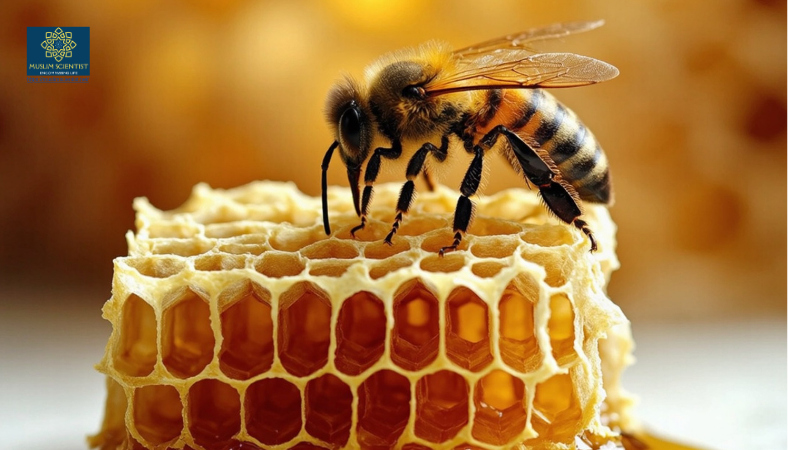
The humble honeybee, a creature weighing less than a gram, holds secrets that continue to astonish scientists and believers alike. Modern research has uncovered remarkable complexities in bee behaviour, communication, and the therapeutic properties of their products. Strikingly, these twenty-first-century discoveries align with divine revelations found in the Quran, specifically in Surah An-Nahl (Chapter 16, The Bee), which was revealed over 1,400 years ago .
Why would an entire chapter of the Quran bear the name of an insect? The answer lies in the profound significance Allah attributes to this remarkable creature. Surah An-Nahl (Chapter 16), titled “The Bee,” contains verses that describe divine inspiration bestowed upon this tiny being .
The Quran states: “And your Lord inspired the bee, saying: ‘Take you habitations in the mountains and in the trees and in what they erect. Then, eat of all fruits, and follow the ways of your Lord made easy (for you).’ There comes forth from their bellies, a drink of varying color wherein is healing for men. Verily, in this is indeed a sign for people who think” (Quran 16:68-69) .
Classical Islamic scholars like Ibn Kathir, al-Tabari, and al-Qurtubi interpreted “awha” (inspired) as Allah’s divine guidance that creates programmed instinct in bees, directing their behaviour without conscious thought . This interpretation has stood the test of time, with modern science confirming that bees follow sophisticated behavioural patterns that appear to be divinely coded.
The linguistic precision of these verses continues to inspire wonder. The Arabic command “ittakhizee” (build) employs the feminine imperative form, accurately reflecting that worker bees performing construction are exclusively female . The Quran mentions that honey comes from the “bellies” of bees, precisely where the honey crop stores nectar. Furthermore, the plural description of “their bellies” acknowledges the collective effort of the bee community .
Scientific Wonders of the Honeybee: Intelligence Beyond Measure
The Waggle Dance: Nature’s Communication System
For over 2,000 years, humans observed bees returning to their hives and performing mysterious movements without understanding their meaning. Aristotle documented this behaviour but could not explain its significance . Not until the 1940s did Karl von Frisch decode this intricate communication system, earning him a Nobel Prize for his groundbreaking work.
The “waggle dance” communicates the precise location of food sources. When a forager bee discovers nectar or pollen, she returns to the hive and performs a figure-eight pattern on the vertical honeycomb surface . The direction she faces during the straight “waggling run” indicates the food’s direction relative to the sun. If she waggles while facing straight upward (12 o’clock), the food lies directly toward the sun. If she moves 60 degrees to the left of 12 o’clock, the food sits 60 degrees left of the sun .
The speed of the dance encodes distance information. Closer food sources produce more frenzied dancing, with more circuits completed per unit time . This sophisticated communication system allows thousands of worker bees to coordinate their efforts efficiently.
Computational Power in a Tiny Brain
The honeybee’s brain weighs less than 10 milligrams, yet it performs computational feats that surpass modern supercomputers. Research indicates that a bee’s brain operates at approximately ten trillion operations per second, compared to a supercomputer’s 16 billion operations per second . Remarkably, the bee achieves this while consuming less than 10 microwatts of energy—over ten million bee brains could operate on the power needed for a single 100-watt light bulb .
In a fascinating experiment, ethologist James Gould observed bees anticipating his behaviour. After regularly moving food sources at a specific ratio, bees appeared at the new location before Gould arrived, having deduced his pattern . This demonstrated that bee brains create complex reality simulations and learn from past experiences.
Scientific Insights on Bees vs. Quranic Description
Healing from the Bellies: Honey’s Therapeutic Properties
Antibacterial and Wound-Healing Properties
Modern medical research has comprehensively validated honey’s antibacterial effects, just as the Quran proclaimed over fourteen centuries ago . Honey’s antibacterial activity stems from multiple mechanisms. Its high sugar concentration limits moisture availability for bacterial growth. Additionally, its acidity (pH 3.6-4.2) creates an environment hostile to many pathogens .
The antibacterial compounds in honey include hydrogen peroxide, which forms through enzymatic activity, and methylglyoxal, particularly potent in certain varieties . Most remarkably, honey has demonstrated efficacy against antibiotic-resistant strains, including MRSA (Methicillin-resistant Staphylococcus aureus), making it a valuable weapon against hospital-acquired infections .
Wound-healing applications extend beyond infection control. Honey stimulates the growth of new blood capillaries and fibroblasts, the cells that produce collagen for tissue repair. It also possesses anti-inflammatory properties that reduce swelling and improve circulation . The Prophet Muhammad (peace be upon him) reportedly advised using honey for abdominal complaints, a tradition now supported by evidence of honey’s gastrointestinal benefits .
Memory Enhancement and Cognitive Function
Islamic traditions have long associated honey consumption with improved memory. Scholars like al-Zuhri recommended honey for its positive effects on cognitive function . Contemporary laboratory research has provided supporting evidence for these claims.
Studies conducted on Tualang honey, a Malaysian variety, demonstrated enhanced spatial memory in test subjects. Both working memory (short-term) and reference memory (long-term) showed improvement. Particularly notable was the enhancement of working memory performance . These findings suggest potential applications in addressing memory-related conditions, including age-related cognitive decline and perhaps Alzheimer’s disease .
The antioxidant properties of honey contribute to these cognitive benefits. Antioxidants neutralise free radicals that can damage brain cells and accelerate neurodegeneration. Pinocembrin, a unique antioxidant found almost exclusively in honey, demonstrates neuroprotective potential .
The Ecological Importance of Bees
Pollination and Ecosystem Balance
Beyond producing honey, bees perform an indispensable ecological function through pollination. Approximately one-third of the food consumed globally depends on bee pollination. This includes fruits, vegetables, nuts, and many crops essential for human nutrition . The economic value of bee pollination services runs into billions of dollars annually.
Bees have co-evolved with flowering plants over millions of years, developing mutualistic relationships that benefit both species. Plants produce nectar and pollen to attract bees, while bees collect these resources for their colonies . This delicate balance ensures biodiversity and ecosystem stability.
Threats to Bee Populations
Bee populations worldwide face unprecedented threats. Pesticides, habitat destruction, climate change, and disease have contributed to alarming colony collapse rates. The loss of bees would have catastrophic consequences for global agriculture and food security.
Islamic teachings emphasise stewardship of the Earth and its creatures. The Quran describes all creation as signs of God’s presence, encouraging believers to reflect upon and protect the natural world. Similarly, the Prophet Muhammad taught that harming animals and destroying habitats displeases God .
Honey’s Therapeutic Benefits Supported by Research
The Bee as a Model for Ethical Medical Research
Learning from Nature’s Example
The bee community offers an inspiring model for ethical scientific research. Female bees work collectively, maintain social harmony, contribute to ecosystem health, and produce universal benefits through their labour . These characteristics parallel the qualities Islamic tradition values in human society.
Scholars have proposed developing an Islamic research enterprise based on the bee’s example. Such an approach would prioritise universal healing, environmental sustainability, and ethical responsibility . Researchers would draw inspiration from the Quran and prophetic traditions while incorporating contemporary scientific methodologies.
Principles-Based Approach to Healing
An Islamic medical-industrial complex modelled on the bee would emphasise several key principles. Treatments would be ḥalāl (permissible) and pure, avoiding anything that causes harm. Research would minimise environmental damage and consider the welfare of all creatures. Perhaps most importantly, medical discoveries would benefit all people without discrimination based on religion, culture, or ethnicity .
This framework aligns with the Quranic description of honey as “healing for men” (Syifaul linnas), emphasising universal human benefit rather than exclusive advantage. Just as bees produce honey that serves diverse communities, medical research should serve all humanity.
A Sign for Those Who Reflect
Divine Presence in Nature’s Detail
The remarkable discoveries about bees serve as powerful “signs” for those who contemplate creation. The Quran explicitly invites reflection upon the natural world, stating that the bee’s existence contains a “portent (Sign) for people who reflect” .
Honeybees possess either 16 pairs of chromosomes (females) or 16 single chromosomes (males), a fascinating numerical coincidence given that Surah An-Nahl is the 16th chapter of the Quran . Whether coincidence or design, such details fuel wonder and reflection.
The bee’s complexity, intelligence, and utility demonstrate the Creator’s wisdom and care. Even a creature many dismiss as insignificant possesses extraordinary capabilities that continue to surprise scientists and inspire believers.
Practical Applications for Daily Life
The scientific validation of honey’s healing properties encourages believers to integrate this natural remedy into daily health practices. The Prophet Muhammad’s recommendation of honey for ailments finds contemporary scientific support. We should consume honey for its health benefits while maintaining appropriate medical treatment for serious conditions.
Furthermore, the bee’s example encourages environmental stewardship. Protecting bee populations through sustainable agricultural practices, reducing pesticide use, and preserving natural habitats reflects Islamic values of caring for creation.
Conclusion: Ancient Revelation, Modern Confirmation
The honeybee, a creature of profound significance in Islamic tradition, continues to reveal its secrets to modern science. The Quran’s description of divine inspiration, hive-building behaviour, and honey’s healing properties has been remarkably confirmed through centuries of scientific investigation.
From the complex waggle dance that defies chance explanation to the antibacterial properties of honey that combat drug-resistant infections, the bee demonstrates the Creator’s wisdom. These discoveries strengthen faith while expanding knowledge.
As we face environmental challenges and health crises, the bee offers both practical solutions and spiritual lessons. By emulating the bee’s community-mindedness, industriousness, and dedication to universal benefit, we might build a more compassionate and sustainable world.
The Quran’s invitation to reflect upon the bee remains as relevant today as it was fourteen centuries ago. Modern science has only deepened our appreciation of this tiny creature’s significance, confirming that “in all of that is a great sign for all those who reflect” .
Other Articles: