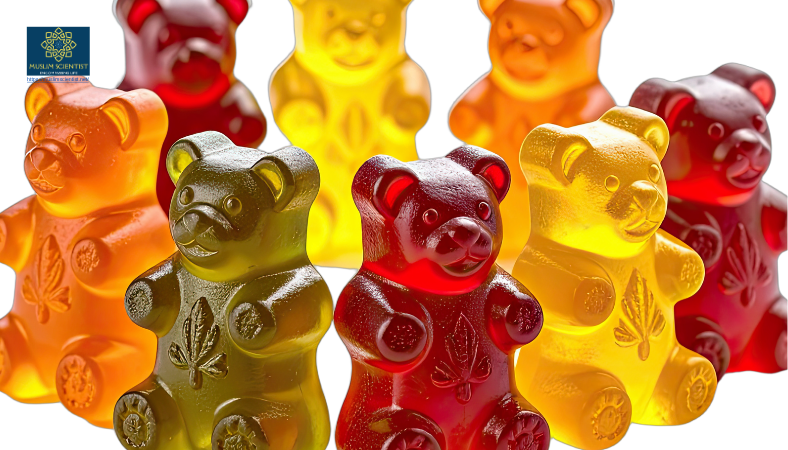
They are chewy, colorful, and taste like candy. But those gummy vitamins—for brain health, immunity, or just daily multivitamins—contain a hidden ingredient that millions of consumers cannot ignore: gelatin.
For the global halal market, valued at trillions of dollars, the source of that gelatin matters enormously. Porcine (pig) gelatin is the industry standard because it is cheap and consistent. But for Muslim consumers following Islamic dietary laws, porcine products are strictly forbidden.
A study from Universitas Gadjah Mada in Indonesia has delivered encouraging news for halal-conscious consumers and the food and pharmaceutical industries. Scientists have systematically compared gummy candies made from porcine, fish, and bovine (cow) gelatin. The findings show that fish and bovine gelatin can produce gummy candies with comparable quality to porcine gelatin—with important differences that manufacturers need to understand.
The Billion-Dollar Gummy Problem
Gummy candies have exploded in popularity—not just as sweets, but as a delivery form for vitamins, minerals, probiotics, and even brain health supplements. Women’s health supplements, multivitamins, and nutraceuticals containing DHA, cod liver oil, and herbal extracts are now routinely sold as gummies.
But gelatin, the polymer that gives gummies their characteristic chewy texture, has a hidden diversity. It can come from pigs (porcine), cows (bovine), or fish (marine). Porcine gelatin dominates the market because pig skins are abundant and the resulting gelatin has consistent properties.
However, this creates a significant barrier for Muslim consumers in Indonesia, Malaysia, the Middle East, and beyond who require halal certification. It also affects Jewish consumers seeking kosher products and vegetarians and vegans (though plant-based alternatives are a separate category).
The study, led by Dr. Marlyn Dian Laksitorini and her team at Universitas Gadjah Mada’s Faculty of Pharmacy, set out to answer a critical question: Can fish or bovine gelatin truly replace porcine gelatin without sacrificing product quality?
What the Scientists Did
The researchers prepared gummy candies using three types of gelatin: porcine (pig), fish, and bovine (cow). All other ingredients—sugar, pectin, citric acid, flavor, color—were kept identical. Only the gelatin source varied.
They then tested the gummies for six mechanical properties: hardness, cohesiveness, adhesiveness, gumminess, springiness, and stringiness. They also measured water activity (which affects microbial safety), color, protein content, and antioxidant activity.
Finally, to simulate real-world adulteration (accidental or intentional mixing of porcine gelatin into halal-labeled products), they mixed porcine gelatin into fish and bovine gelatin at 25% to 95% proportions.
The results offer both reassurance and a warning.
How Different Gelatins Compare in Gummy Candy
| Property | Porcine Gelatin | Fish Gelatin | Bovine Gelatin | Key Finding |
|---|---|---|---|---|
| Hardness | Highest | Similar to bovine | Lower than porcine | Porcine makes harder gummies |
| Adhesiveness | Lowest | Medium | 20x higher than porcine | Major difference |
| Stringiness | Medium | Medium | Higher (not significant) | Source matters |
| Gumminess | Comparable | Comparable | Comparable | ✅ Not a concern |
| Cohesiveness | Comparable | Comparable | Comparable | ✅ Not a concern |
| Springiness | Comparable | Comparable | Comparable | ✅ Not a concern |
Data source: Laksitorini et al., Pharmaceutical Sciences and Research, Vol 12 No 3, 2025
The study found that gumminess, cohesiveness, and springiness were comparable across all three gelatin sources. This is excellent news for manufacturers: the basic “chew” of the gummy can be matched regardless of gelatin origin.
However, adhesiveness and stringiness were highly sensitive to the gelatin source. Bovine gelatin produced gummies that were 20 times more adhesive than porcine gelatin. Adhesiveness is how much the gummy sticks to surfaces—like teeth, packaging, or manufacturing equipment. High adhesiveness is generally undesirable; it can cause gummies to stick together, tear during demolding, or cling unpleasantly to the mouth.
Fish gelatin fell in between: more adhesive than porcine but less adhesive than bovine.
The Water Activity Breakthrough for Bovine Gelatin
One of the most practical findings involves water activity. Water activity measures how much “free” water is available for bacteria and mold to grow. For microbial safety, food products should have a water activity below 0.85.
- Porcine gelatin gummies: 0.88 ± 0.003 (above the threshold)
- Fish gelatin gummies: 0.89 ± 0.003 (above the threshold)
- Bovine gelatin gummies: 0.82 ± 0.003 (below the threshold)
Bovine gelatin produced gummies that are inherently more resistant to bacterial growth—a significant advantage for shelf life and safety. The researchers attribute this to differences in amino acid composition; bovine gelatin appears to bind water differently, leaving less free water for microbes.
Water Activity and Safety Threshold
| Gelatin Source | Water Activity (Aw) | Safe for Long-Term Storage? (Aw < 0.85) |
|---|---|---|
| Bovine (Cow) | 0.82 ± 0.003 | ✅ YES |
| Porcine (Pig) | 0.88 ± 0.003 | ❌ NO |
| Fish | 0.89 ± 0.003 | ❌ NO |
Bovine gelatin meets the food safety threshold for bacterial growth; porcine and fish exceed it with this formulation.
The Adulteration Warning: When Halal Certification Is Compromised
The researchers then mimicked adulteration—adding porcine gelatin to fish or bovine gelatin at 25%, 50%, and higher proportions. This could happen accidentally (cross-contamination) or intentionally (fraudulent substitution of cheaper porcine gelatin in halal-labeled products).
For fish gelatin adulterated with porcine:
- Hardness, cohesiveness, gumminess, and springiness remained unchanged.
- But adhesiveness and stringiness dropped significantly with as little as 25% porcine addition.
This means that sensory tests (the “stickiness” and “pull length” of the gummy) could potentially detect adulteration—a useful finding for halal certification agencies.
For bovine gelatin adulterated with porcine:
- The pattern was different and more complex.
- Adding 25% porcine actually reduced hardness, gumminess, and springiness.
- Adding 50% porcine restored some properties to near-original levels.
The takeaway: Adulteration does not always produce simple, predictable changes. A product might feel fine to consumers even if it is adulterated. This underscores the importance of rigorous laboratory testing, not just sensory evaluation, for halal certification.
Antioxidant and Protein Content: No Surprises
The researchers also tested whether different gelatins had different antioxidant activities (ability to neutralize free radicals) or protein content.
Antioxidant activity: All three gelatins showed negligible antioxidant activity compared to vitamin C (ascorbic acid). At 20 mg/mL concentration:
- Ascorbic acid: 96.9% inhibition
- Gelatins: 0.36-0.41% inhibition
Gelatin is not an antioxidant supplement. That is fine—it is not supposed to be.
Protein content: All three gelatins were 91-93% protein by weight, with no significant differences. Gelatin is an excellent source of protein, but gummy candies typically contain only 10% gelatin, so the final protein content is around 17-20%—modest but not trivial.
What This Means for Halal-Conscious Consumers
For Muslims who diligently avoid porcine products, this study offers both reassurance and a practical caution.
The reassurance: Fish and bovine gelatin can produce gummy candies that are comparable to porcine gelatin in the most important mechanical properties (gumminess, cohesiveness, springiness). Manufacturers do not have to sacrifice quality to offer halal products.
The caution: Adhesiveness and stringiness are different. Bovine gelatin gummies are much more adhesive (20x). This could affect manufacturing (sticking to molds) and consumer experience (sticking to teeth). However, the study used a standard formulation; manufacturers can adjust other ingredients (oils, coatings, drying time) to compensate.
The adulteration risk: The study shows that adding porcine gelatin changes properties in detectable ways, but not always predictably. For halal certification bodies, this reinforces the need for DNA-based or spectroscopic testing, not just texture analysis.
What This Means for the Food and Pharmaceutical Industry
Dr. Laksitorini and her team are explicit in their recommendation: Changing gelatin source requires revalidation of the manufacturing process.
Excipient changes (even swapping one gelatin for another) can alter critical quality attributes. Companies cannot simply substitute bovine or fish gelatin into a formula designed for porcine gelatin and expect identical results. They must:
- Re-evaluate adhesiveness and stringiness, which are the most sensitive parameters.
- Adjust drying time, cooling process, or surface coatings to manage higher adhesiveness (for bovine gelatin).
- Validate microbial safety, noting that bovine gelatin achieves lower water activity (a potential advantage).
- Consider consumer testing, as texture differences may be noticeable.
The study is particularly timely as the global halal nutraceutical market expands. Indonesia, with the world’s largest Muslim population, is a major market. Manufacturers serving this market must take gelatin sourcing seriously.
The Bigger Picture: Halal, Kosher, and Plant-Based Alternatives
Gelatin is not the only gelling agent, but it remains the most popular because of its unique thermo-reversible gelation and clean flavor release. Plant-based alternatives (pectin, agar-agar, carrageenan, starch) exist but produce different textures.
This study focuses on gelatin-to-gelatin substitution, which is the most direct path to halal compliance. Fish and bovine gelatin are both permissible (halal) if sourced from animals slaughtered according to Islamic guidelines. (For bovine gelatin, this requires halal slaughter; for fish, no slaughter is required.)
The findings align with broader consumer trends: demand for transparency, ethical sourcing, and religious compliance is not going away. Companies that invest in halal-certified, high-quality alternative gelatins will have a competitive advantage.
Limitations of the Study
As with any scientific study, there are limitations to consider:
- The formulation was fixed. The researchers used one specific recipe (10% gelatin, 23% sugar, 2% pectin, etc.). Varying the formulation could change the relative performance of different gelatins.
- The study used synthetic colorant. This may have masked natural color differences between gelatins. Future studies should include a colorant-free control.
- Bloom strength differed. The gelatins had different bloom strengths (a measure of gel firmness): porcine (unspecified, but typical 250-300), fish (200), bovine (250). Ideally, bloom strength would be matched.
- Consumer sensory testing was not performed. The study measured mechanical properties but did not ask actual consumers which gummy they preferred.
The Bottom Line
For the average consumer, especially those seeking halal-certified products, this study is good news. Gummy candies and gummy vitamins can be made from fish or bovine gelatin without sacrificing chewiness or elasticity. Porcine gelatin is not irreplaceable.
For manufacturers, the message is one of due diligence. Substituting gelatin sources requires careful revalidation, particularly for adhesiveness and stringiness. But with proper process adjustments, halal-compliant gummies can meet and even exceed quality standards—bovine gelatin offers superior water activity, a genuine safety advantage.
And for the scientific community, this study opens new questions: Can formulation changes (adding oils, adjusting sugars) eliminate the adhesiveness difference? Can consumer testing confirm that the mechanical differences are perceptible or meaningful? And can rapid analytical methods detect adulteration in finished products?
The hidden ingredient in your gummy vitamins turns out to be much more interesting than it seems. For millions of halal-conscious consumers, that is a chewy, reassuring discovery.
Reference: here
Other Articles: