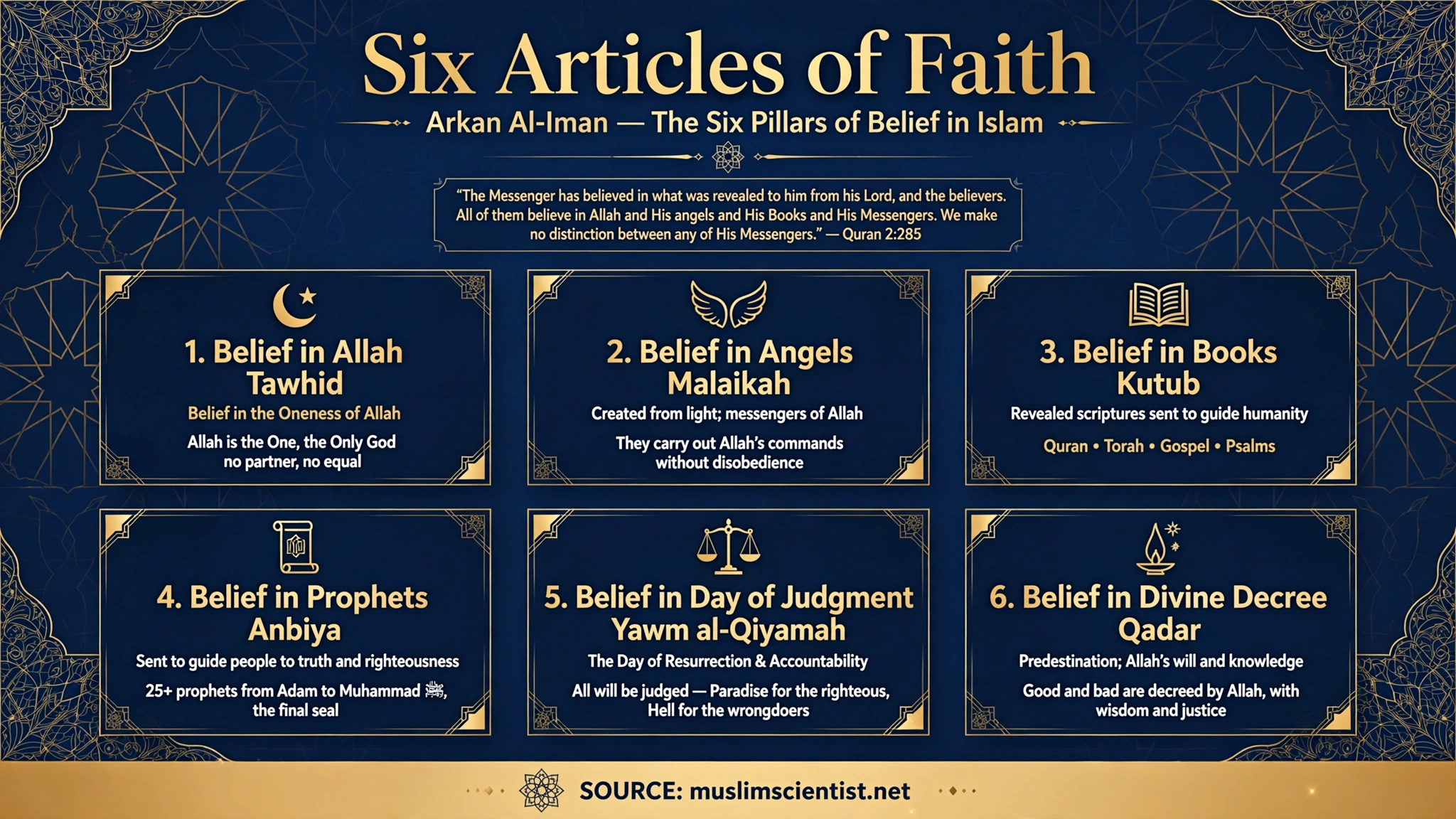
The Six Articles of Faith (Arkan al-Iman) form the foundation of Islamic belief. While the Five Pillars outline the practices of Islam, these six articles define what a Muslim must believe in their heart. Together, they provide a comprehensive framework for understanding God, existence, and humanity’s purpose.
Here is an explanation of each article:
1. Belief in Allah (Tawhid)
The first and most fundamental article is belief in the absolute oneness of God (Tawhid).
What it means: Muslims believe Allah is the sole Creator, Sustainer, and Ruler of the universe. He has no partners, no equals, and no offspring. He is unique in His essence, attributes, and actions. Nothing deserves worship except Him alone.
Key aspects:
- Allah is the Creator of everything that exists
- He alone provides sustenance and controls all affairs
- He is all-knowing, all-powerful, and all-merciful
- He has no physical form and cannot be depicted or visualized
- The purpose of creation is to worship Him alone
The Quran states: “And I did not create the jinn and mankind except to worship Me.” (Surah Al-Dhariyat 51:56)
This belief is the foundation upon which all other articles rest. It is the core message brought by every prophet throughout history .
2. Belief in Angels (Mala’ikah)
Muslims believe in the existence of angels, created by Allah from light.
What they are: Angels are pure, spiritual beings who have no free will and obey Allah’s commands perfectly. They do not eat, drink, sleep, or reproduce. They are neither male nor female and are not to be worshipped.
Their duties include:
- Jibreel (Gabriel): Delivering divine revelation to the prophets
- Mika’eel (Michael): Responsible for sending rain and sustenance
- Angel of Death: Taking human souls at the time of death
- Recording Angels (Raqeeb and Ateed): Recording every person’s deeds and words
- Israfeel: Blowing the trumpet on the Day of Judgment
- Guards of Paradise and Hell: Maintaining these abodes
The Quran mentions angels in approximately 54 places, emphasizing their role as obedient servants of God . Belief in angels is essential because they are part of the unseen world (al-ghayb) that Allah has informed us about .
3. Belief in the Revealed Books (Kutub)
Muslims believe that Allah revealed divine guidance through scriptures sent to various prophets throughout history.
The major revealed books include:
- Suhuf (Scrolls): Revealed to Prophet Ibrahim (Abraham)
- Tawrat (Torah): Revealed to Prophet Musa (Moses)
- Zabur (Psalms): Revealed to Prophet Dawud (David)
- Injeel (Gospel): Revealed to Prophet Isa (Jesus)
- The Quran: Revealed to Prophet Muhammad, the final and complete revelation
Key beliefs about these books:
- All were originally divine revelations from the same God
- All taught the same core message: worship One God alone
- The earlier scriptures have been subject to distortion and alteration over time
- The Quran is the final, perfectly preserved word of God
- The Quran confirms and completes all previous revelations
Muslims treat the Quran with utmost reverence, as it is believed to be the literal, unchanged word of Allah revealed in Arabic .
4. Belief in the Prophets (Rusul)
Muslims believe that Allah chose human beings as messengers to convey His guidance to humanity.
Key beliefs:
- Prophets are human beings, not divine. They do not share any aspect of divinity with God
- They are chosen by Allah and are sinless (protected from major sins)
- They perform miracles by God’s permission to prove their prophethood
- Allah sent prophets to every nation and people throughout history
- There have been approximately 124,000 prophets in total
- Only 25 are mentioned by name in the Quran
The major prophets include:
- Adam: The first human and first prophet
- Nuh (Noah): Preached against idolatry
- Ibrahim (Abraham): The friend of Allah and father of monotheism
- Musa (Moses): Delivered the Torah and led the Israelites
- Isa (Jesus): Born miraculously to Maryam, performed miracles, brought the Gospel
- Muhammad: The final prophet and “Seal of the Prophets”
The core message of all prophets was the same: “O my people, worship Allah; you have no deity other than Him.” (Quran 7:59)
5. Belief in the Day of Judgment (Yawm al-Qiyamah)
Muslims believe that physical death is not the end of existence. The Day of Judgment is when all of humanity will be resurrected and held accountable for their deeds.
Key beliefs:
- The entire universe will come to an end
- All the dead will be resurrected and brought before Allah
- Every individual will be questioned about their life on earth
- Deeds will be weighed on a divine scale
- No injustice will occur—every action, even an atom’s weight, will be accounted for
The Quran states: “So whoever does an atom’s weight of good will see it, and whoever does an atom’s weight of evil will see it.” (Quran 99:7-8)
The outcomes:
- Those with sincere faith and good deeds will enter Paradise (Jannah), a place of eternal bliss
- Those who rejected faith and committed evil will face punishment in Hell (Jahannam)
- Allah may forgive any sin except shirk (associating partners with Him) if a person repents before death
This belief serves as a powerful motivation for moral accountability and righteous living .
6. Belief in Divine Decree (Qadar)
The sixth article concerns Allah’s complete knowledge and control over all things, balanced with human free will.
This belief includes four key aspects:
- Allah’s Knowledge: Allah knows everything that has happened, is happening, and will happen. Nothing is hidden from Him
- The Preserved Tablet: Allah has recorded all that will occur in a divine book before creation
- Allah’s Will: Whatever Allah wills happens, and whatever He does not will does not happen. His will is absolute and all-encompassing
- Allah’s Creation: Allah is the Creator of all things, including the actions of His creation
Reconciling with free will:
This article raises the important question of human free will. Islamic scholars explain that while Allah knows and has decreed all things, human beings still possess genuine free will to choose between right and wrong . The knowledge of Allah about a person’s choices does not force them to make those choices—it simply reflects His eternal knowledge.
The Quran states: “Whoever wills, let him believe; and whoever wills, let him disbelieve.” (Quran 18:29)
This belief provides comfort to believers, knowing that nothing happens outside of Allah’s wisdom and control, even when circumstances are difficult or painful .
Summary
Together, these six articles form the complete creed of a Muslim:
| Article | Core Belief |
|---|---|
| 1. Allah | Absolute oneness of God, sole Creator and Sustainer |
| 2. Angels | Spiritual beings created from light, executing God’s commands |
| 3. Books | Divine scriptures revealed to guide humanity, culminating in the Quran |
| 4. Prophets | Chosen human messengers sent to every nation with the same message |
| 5. Day of Judgment | Resurrection and accountability for all deeds |
| 6. Divine Decree | Allah’s complete knowledge and will, balanced with human free will |
These articles are not merely intellectual concepts—they shape a Muslim’s worldview, provide purpose and meaning, and inform how one approaches life’s challenges and blessings. Together with the Five Pillars of practice, they constitute the complete foundation of Islamic faith and life.