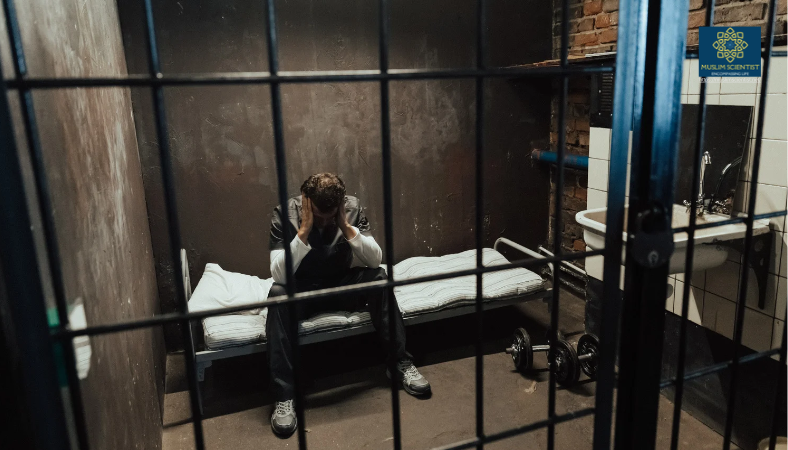
A striking demographic shift is unfolding inside the prison systems of England and Wales: while Muslims make up roughly 6.5 percent of the general population, they account for approximately 18 percent of the prison population. This disparity has sparked intense debate over why so many inmates—particularly new arrivals—appear to embrace Islam behind bars.
According to a recent analysis published by Religion Unplugged, the reasons range from genuine spiritual conversion to a more troubling phenomenon: coercive conversion driven by the need for physical safety in violent, overcrowded cellblocks.
The Safety-for-Loyalty Exchange
Shadow Justice Secretary Nick Timothy has suggested that coercive conversion is part of the answer. The analysis describes a prison environment where new inmates quickly “size up the local power structure” and discover that joining a dominant Muslim group can provide a built-in defense network against extortion and violence.
“Conversion operates less like a spiritual awakening and more like buying an insurance policy from the meanest guys in the exercise yard,” the article states.
British independent government reviews into prison extremism have documented how self-styled “emirs” run specific wings, demanding compliance from cellmates and imposing informal religious rules on non-believers.
Ian Acheson, who led an independent government review of Islamist extremism in U.K. prisons, told The Guardian that offenders convicted of less severe terrorism offenses often enter overcrowded, under-resourced jails where they are unlikely to receive treatment for their behavior—making joining a religious or ideological group a rational survival strategy.
A Transatlantic Phenomenon
The trend is not limited to the United Kingdom. Across the Atlantic, American federal and state facilities have also seen conversion rates climb steadily in recent decades, with tens of thousands of inmates taking their vows behind bars each year.
However, Muslim leaders in the U.S. say radicalization is rare. Rami Nsour, who runs a distance-learning program in Islamic education for inmates, noted: “The numbers don’t show [radicalization]. Does it exist? Yes. But it’s a rare instance in the same way are there people who are Christian extremists, who are radicalized in prison?”
A study published by the National Institute of Corrections, which included case studies from nine countries including the U.S. and U.K., found “limited empirical grounding to underpin these assertions” that vulnerable inmates form captive audiences for violent terrorist offenders.
Some converts, like Christopher Anderson of Philadelphia, credit finding Islam behind prison gates with helping them turn their lives around.
Demographic Anomalies Raise Questions
Roughly one in five Muslim prisoners in the United Kingdom is white—a figure dramatically out of proportion to the white Muslim population in the broader public. The analysis argues that “one needn’t be a bigoted conspiracy theorist to ask why this is the case.”
Radicalization: Rare but Real
While emphasizing that not every conversion is coerced or insincere, the analysis acknowledges that radicalization can and does occur. Chérif Kouachi, a perpetrator of France’s 2015 Charlie Hebdo shootings, met an al-Qaeda-linked extremist in prison with whom he maintained ties after release. Omar El-Hussein, who carried out the Copenhagen cultural center attacks, also spent time in the state corrections system, where authorities noticed behavioral changes and alerted Danish intelligence services.
Germany and Australia have faced similar dynamics in their maximum-security prisons, with extremist networks exploiting vulnerable inmates.
Legal and Architectural Challenges
Prison guards struggle to police this shift because religious rights carry heavy legal protections. Wardens cannot easily restrict group prayer or interfere with religious instruction without triggering lengthy civil rights lawsuits. Radical recruiters exploit this legal boundary, using mandatory group worship times to vet prospects and pass notes across cell blocks.
The physical architecture of older penitentiaries compounds the problem. Facilities built in the 19th and early 20th centuries feature open galleries, shared communal showers, and echoing corridors that make private surveillance nearly impossible.
The Gang-Extremism Nexus
Integrating gang politics with religious extremism produces what the analysis calls “a uniquely dangerous prisoner.” Standard gang members fight over drugs, territory, and internal rank. Ideological converts add “a layer of cosmic moral authority” to those basic criminal motives—making standard disciplinary measures like solitary confinement lose their deterrent power.
Corrections departments attempt to counter this through targeted counter-radicalization programs, hiring moderate chaplains and shuffling high-risk recruiters between facilities. But moving a charismatic organizer “simply exports the problem to a fresh prison population.”
A Call for Open Discussion
The analysis concludes with a warning: “A young offender enters the system for a minor drug offense or vehicle theft. He is drawn into a dominant prison faction simply to survive, then walks out not rehabilitated, but fully indoctrinated into a world of violence and extremism.”
“To tackle a problem, we must first be able to discuss it openly and honestly.”
Key Statistics at a Glance
| Metric | General Population | Prison Population |
|---|---|---|
| Muslim share (England & Wales) | ~6.5% | ~18% |
| White Muslims (UK) | Small fraction | ~1 in 5 Muslim prisoners |
| Annual U.S. inmate conversions | — | Tens of thousands |
Documented Cases of Prison Radicalization
| Individual | Country | Attack/Connection | Prison Radicalization Details |
|---|---|---|---|
| Chérif Kouachi | France | 2015 Charlie Hebdo shootings | Met al-Qaeda-linked extremist in prison; maintained ties post-release |
| Omar El-Hussein | Denmark | Copenhagen cultural center attacks | Behavior changes noticed in corrections system; intelligence alerted |
Expert Perspectives
| Expert | Role | Key Quote |
|---|---|---|
| Nick Timothy | Shadow Justice Secretary (UK) | Suggests coercive conversion is part of the explanation |
| Ian Acheson | Led independent UK government review | Vulnerable inmates join groups “to help them stay safe and form allies” |
| Rami Nsour | Runs Islamic education program for U.S. inmates | “The numbers don’t show [radicalization]… it’s a rare instance” |
| John Mac Ghlionn | Researcher and essayist (author of analysis) | “From Manchester to Melbourne, the rise of Islamic conversions and the spread of radicalism are—if not inseparable—certainly intertwined” |
Reference: Mac Ghlionn, J. (2026, November 3). Why Does Muslim Membership Surge Behind Bars? Religion Unplugged.