Written by Nafan Bilal, Student of LIPIA (Lembaga Ilmu Pengetahuan Islam dan Arab), Jakarta, Indonesia
Rome on the Brink of Destruction
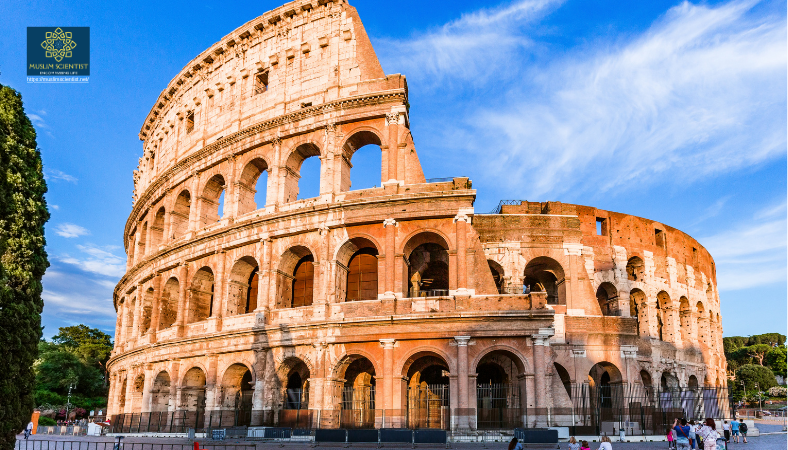
In the early 7th century CE, history records that the Eastern Roman Empire (Byzantium) was passing through one of the darkest periods in its history. Heraclius, who had just ascended the throne as emperor in 610 CE, had to face heavy pressure from the Sasanian Persian Empire. Rome’s situation grew worse when Persian forces succeeded in conquering Jerusalem, one of the holiest cities in Christian tradition, and carried off the True Cross in 614 CE. Not stopping there, in 618–619 CE, Egypt was also conquered by Persia. The Persian Empire became increasingly dominant in the war, while Rome’s territory shrank further. At that time, the Roman Empire appeared to be on the brink of destruction, while the victory of the Persian Empire seemed only a matter of time.
Timeline of Major Events (603–628 CE)
| Year | Event | Significance |
|---|---|---|
| 603 CE | Persian campaigns against Rome begin | Start of the Roman–Persian War |
| 610 CE | Heraclius ascends the throne | New Roman emperor takes power |
| 614 CE | Fall of Jerusalem; True Cross captured | Major Christian holy site lost |
| 618–619 CE | Persia conquers Egypt | Rome loses key territory and resources |
| 622 CE | Heraclius launches counteroffensive | Roman military turning point |
| 624–625 CE | Campaigns in Transcaucasia | Rome pressures Persian resources |
| 627 CE | Battle of Nineveh | Decisive Roman victory over Persia |
| 628 CE | Fall of Khosrow II; war ends | Persian Empire weakened; territories returned |
The Qur’an’s Prediction in the Midst of Crisis
However, in the midst of these events, a revelation came down from the barren desert of Makkah, bringing news that at that time seemed so difficult to believe. When Rome was on the brink of destruction, the Qur’an actually announced that the Romans would achieve victory within a few years. This news is found in ar-Rum: 2–6. The Qur’an states that after its defeat, Rome would achieve victory within “biḍʿ sinīn,” which according to Tafsir Ibn Kathir refers to a span of three to nine years. This statement is very interesting because it conveys a prediction that at that time seemed very difficult to happen in the future.
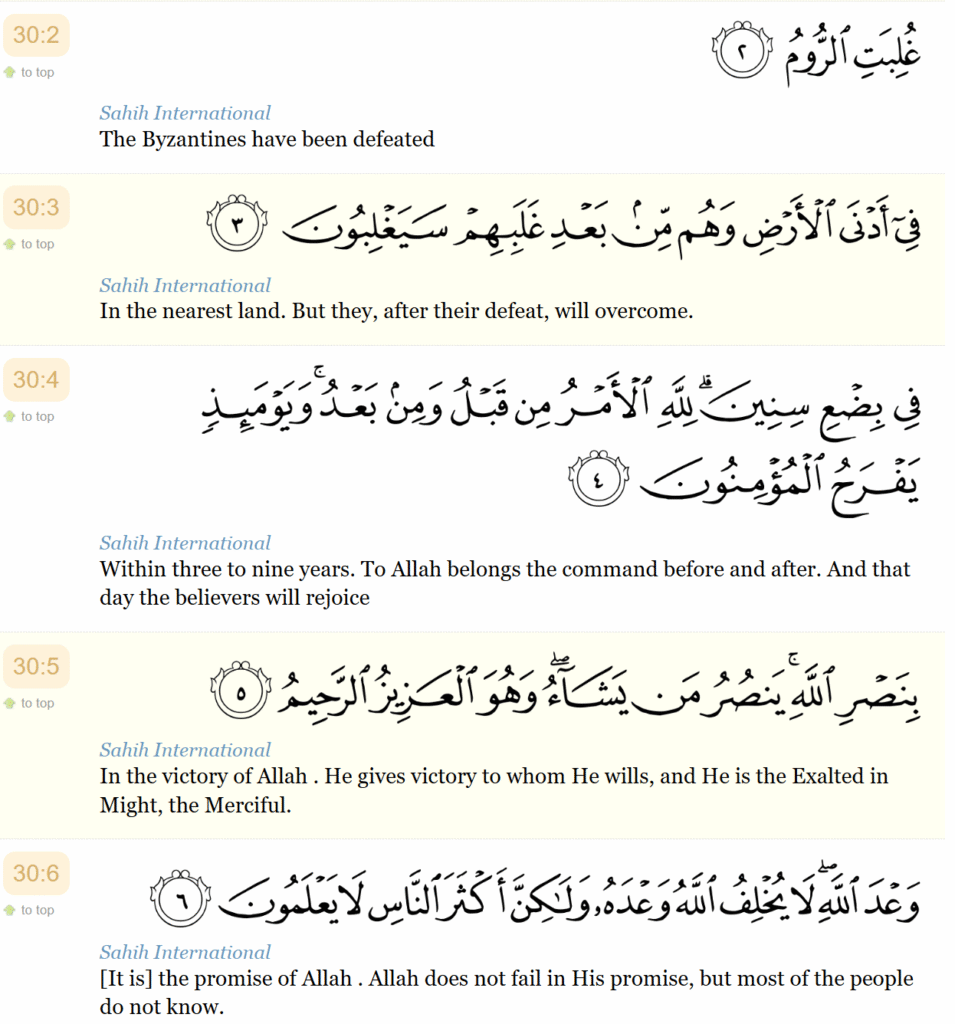
Interestingly, if we examine those verses carefully, the Qur’an does not merely state that Rome will win again one day. Rather, within it there is a series of information that can be compared with existing historical records. The Qur’an explains that the Romans had suffered a defeat, but they would regain victory within a few years. Not stopping there, Allah also emphasizes that His promise never fails. With this, the Qur’an not only provides a prediction, but asserts that it will certainly happen.
Abu Bakr, Quraysh, and the Wager
Jami’ at-Tirmidhi records an interesting story. It describes Makkah’s response to Rome’s defeat. When Persia succeeded in defeating Rome, the Muslims were sad and hoped that Rome could defeat Persia again because Rome was Ahlul Kitab (People of the Book). Conversely, the disbelievers of Quraysh rejoiced at Persia’s victory and hoped that they could defeat Rome. In the narration of Ibn Abbas, this is linked to the similarity between Persia and the polytheists in idol worship.
Amid that situation, the opening verses of Surah ar-Rum were revealed. The message affirmed that Rome would regain victory within a few years. Abu Bakr ash-Shiddiq then conveyed this news to the people of Makkah. Hearing that, a number of Quraysh disbelievers challenged Abu Bakr because they doubted that Rome could reverse the situation. The challenge then led to a wager regarding the Roman victory, which according to the narration took place before wagering was prohibited.
Abu Bakr then agreed to a time limit of six years with the Quraysh. He sought to see whether Rome would truly achieve victory. However, after six years, Rome had still not succeeded in defeating Persia. The Quraysh then took Abu Bakr’s stake, while Abu Bakr conveyed the matter to the Messenger of Allah. The Messenger of Allah said that ‘biḍʿ siniin’ spans three to nine years; six-year limit did not exceed the span. Abu Bakr then extended the time limit of the wager. In the following year, Rome finally succeeded in achieving victory over Persia, as foretold in the opening verses of Surah ar-Rum.
The story above shows that the news of the Roman victory not only formed part of the Muslims–Quraysh debate, but also connected to a history that continued. When the revelation came down, Rome remained in a pressed position after Persia delivered a major defeat to Rome. So, how could such a difficult situation finally be reversed? The answer can be found in the series of events that occurred in the following years.
The Rise and Victory of Rome
The change began to appear in 622 CE. At that time, Emperor Heraclius launched a military campaign to face the Persian Empire. After years of suffering defeats and losing important territories, Heraclius began to lead his troops into Persian-controlled territory. Encyclopaedia Iranica records that from 622 CE Heraclius began a series of military campaigns and several times succeeded in surprising and defeating Persian forces.
The Roman revival did not happen in a single battle, but Heraclius continued his military campaigns in the following years. World historian James Howard-Johnston from Oxford University explains that in 624–625 CE Heraclius led a series of military operations in Transcaucasia and succeeded in winning several battles, while also putting great pressure on Persian resources. Thus, the war situation that had previously greatly favored Persia slowly began to turn around.
This change continued to develop until reaching major victories in the following years. Therefore, we treat 622 CE as the Roman military turning point, not as the year in which we won the entire war immediately; from this year, the previously impossible revival began. Until finally, the peak of the success of the Roman counterattack occurred in the Battle of Nineveh in 627 CE, when Heraclius’s forces succeeded in decisively defeating the Persian forces. This defeat further weakened the Persian Empire and then followed the fall of Khosrow II in 628 CE.
The Correspondence of the Qur’an’s Prediction with History
If we compare the series of events above with the explanation of the Qur’an, we will find an interesting correspondence in the time span mentioned. In the opening verses of Surah ar-Rum, it states that Rome, which had suffered defeat, would regain victory within “biḍʿ sinīn.” The term “biḍʿ” in the narration mentioned earlier covers a span of three to nine years.
Historical records show that the situation truly reversed. After suffering a series of defeats and losing important territories, Rome under Emperor Heraclius began to launch a counterattack against Persia in 622 CE. The military campaign continued in the following years until Rome achieved a decisive victory in the Battle of Nineveh in 627 CE. This development then followed the fall of Khosrow II in 628 CE and the end of the war with the return of a number of territories previously controlled by Persia.
The Qur’an not only mentions that Rome would win again but also provides a time span, namely biḍʿ sinīn. When that victory finally occurred, the event became part of a series of history that corresponded with the Qur’an’s report regarding the return of Roman victory after their defeat.
Correspondence Between Qur’anic Prediction and Historical Events
| Aspect | Qur’anic Statement (ar-Rum 1–6) | Historical Record |
|---|---|---|
| Initial condition | Romans defeated in nearby land | Persia conquers Jerusalem (614), Egypt (618–619) |
| Prediction | Romans will win within “biḍʿ sinīn” (3–9 years) | Heraclius counteroffensive begins 622 CE |
| Turning point | Victory after defeat | Campaigns 622–625 CE; Battle of Nineveh 627 CE |
| Final outcome | Romans victorious; promise of Allah fulfilled | Persia defeated; Khosrow II falls (628 CE) |
| Timeframe | Within 3–9 years of revelation (~615–617 CE) | Victory achieved 622–628 CE (within span) |
Conclusion
The story of the Roman victory in Surah Ar-Rum demonstrates historically that the Qur’an announced future news at that time while Rome faced great pressure. When Persia was in a superior position and Rome had suffered a major defeat, the Qur’an instead announced that Rome would regain victory within “biḍʿ sinīn.” A few years later, history records the Roman military revival under Emperor Heraclius until finally achieving a decisive victory over Persia. This series of events shows an interesting correspondence between the Qur’an’s report and historical records.
This story also reminds us that Allah’s promise in the Qur’an is not something that we can regard as human conjecture. What at that time seemed difficult to happen ultimately truly came to pass. For a Muslim, this event becomes one of the proofs that strengthens the belief that the Qur’an is the revelation of Allah and that His promise is certainly true.
References:
Tafsir Ibn Kathir,
Jami’ al-Tirmidhi,
Commentary on Tafsir Ibn Kathir,
Tafsir al-Jalalayn
Encyclopaedia Iranica
James Howard-Johnston: The Last Great War of Antiquity