A study of 660 Muslim consumers in the UK and UAE reveals that halal is no longer just about meat. It is a powerful symbol of identity, a mark of quality, and a rapidly expanding market that religious authorities can no longer control alone.
The word “halal” simply means “permissible” in Arabic. For decades, it was primarily associated with meat slaughtered according to Islamic law. However, a new research article published in the journal Consumption and Society shows that the concept has exploded into a global phenomenon worth nearly $2 trillion. More importantly, it has become a central part of what it means to be Muslim in the modern world.
The study, led by researchers from Cardiff University, Huddersfield University, and Coventry University, surveyed 330 Muslim consumers in the United Kingdom (a minority-Muslim country) and 330 in the United Arab Emirates (a majority-Muslim country). Their goal was simple: to understand what consumers actually think about halal labels, certification, and the growing range of products marketed as Islamic.
What they found is a market in transformation. The old rules are fading. New consumer tribes are emerging. And the reasons people buy halal are becoming as diverse as the consumers themselves.
The $1.9 Trillion Question: What Does Halal Really Mean Today?
Globally, the halal food market is estimated to be worth US$1.9 trillion. It serves a global Muslim population of 1.84 billion people. Alongside India and China, it is often called the world’s “Third One Billion” market. However, this is not just about food. The study highlights a process called “halalisation.” This is the extension of halal principles to cosmetics, body products, clothing, leisure activities, and even finance.
For many, halal consumption has become central to being Muslim. As researcher François Gauthier argues, the emergence of “halal” is a major development that sheds light on other trends within Islam. The study’s authors wanted to see how this plays out on the ground. They asked consumers about their food choices, their trust in certification bodies, and their willingness to pay more for halal products.
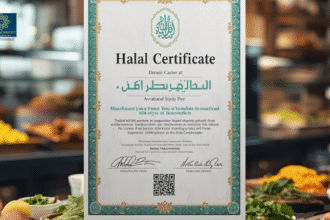
The answers revealed sharp differences between the UK and the UAE. They also revealed surprising similarities. In both countries, trust in halal certification is very high—92% in the UK and 99% in the UAE. However, trust in non-Muslim certifying bodies is much lower in the UK (70%) than in the UAE (96%). This suggests that in a minority context, halal is not just about food safety; it is about trust and identity.
A Tale of Two Countries: Minority vs. Majority Mindsets
The experience of being a Muslim consumer is radically different depending on where you live. In the UK, Muslims make up about 5.7% of the population. They consume around 20% of all lamb and a growing percentage of beef. The halal meat market is expanding rapidly, with major supermarkets like Tesco, Sainsbury’s, and Asda now offering a wide range of halal ready meals and international cuisine.
In this environment, halal labels serve a dual purpose. First, they act as “icons” of trust. They assure consumers that a product is permissible. Second, they act as “devices” for identity. The study found that 75% of UK consumers look for halal labels on food. Additionally, 42% check for halal labels on cosmetics. For younger Muslims, buying halal is a way to express a hybrid identity. The researchers call this group “Global Muslim-Western.” They want authentic halal slaughter, but they also want fine dining, international cuisine, and modern convenience.
Conversely, in the UAE, Muslims are the majority. Here, the halal status of food is largely taken for granted. Only 50% of consumers look for halal logos. Only 12% check cosmetics. The motivation for buying halal is different. It is less about religious identity and more about quality. The study found that in the UAE, it is mostly secular consumers who actively check for halal labels. They associate halal with hygiene, safety, and environmental sustainability.
The Stunning Debate: A Key Driver of Politicisation
One of the most controversial issues in the halal market is the practice of stunning animals before slaughter. In the UK, this issue has become highly politicised. Animal welfare groups and veterinary associations have campaigned for mandatory labelling of slaughter methods. This has created a public debate about religious rights and animal suffering.
The study found that this controversy has had a major impact on consumer behaviour. In the UK, more consumers prefer meat from animals that were not stunned. A separate survey by Fuseini and Knowles found that 70% of halal consumers in England prefer non-stunned meat. This has led to the rise of certifying bodies like the Halal Monitoring Committee (HMC), which promotes non-stunned meat as more “authentic.”
In the UAE, this debate is largely absent. The study shows that 53.94% of consumers in the UAE eat stunned poultry, compared to only 33.64% in the UK. Similarly, 64.85% of UAE consumers eat stunned bovine or ovine meat, compared to 33.94% in the UK. The vast majority of UAE respondents (95.15%) said they eat meat produced by “People of the Book” (Christians and Jews). In the UK, this figure was only 63.03%.
This difference highlights a key finding: the politicisation of halal consumption is geographically specific. In the UK, halal is a political statement. In the UAE, it is a practical matter of quality and availability.
Consumer Attitudes and Behaviours in the UK and UAE
| Question | UK (%) | UAE (%) |
|---|---|---|
| Check for halal logo on food | 75 | 50 |
| Check for halal logo on cosmetics | 42 | 12 |
| Trust halal certification | 92 | 99 |
| Trust non-Muslim certifying bodies | 70 | 96 |
| Accept non-halal additives in food | 47 | 73 |
| Accept GMOs as halal | 48 | 82 |
| Accept alcohol in food | 58 | 94 |
| Willing to pay a premium for halal | 66 | 84 |
The Rise of the “Haloodie”: Young, Brand-Conscious, and Hybrid
The study identifies a new and powerful consumer group: young, affluent Muslims in Western countries. The researchers call them “Global Muslim-Western.” This group is driving the segmentation of the halal market. They are not satisfied with a simple halal label on a piece of meat. They want a whole lifestyle.
This includes “haloodies”—Muslim foodies who seek out fine dining options where the absence of pork and alcohol is guaranteed. They are interested in organic-halal, sustainable-halal, and convenience-halal products. They are also interested in “streetwear” that combines Islamic values with Western fashion trends. Brands like Mecca Cola and the Razzane doll (a veiled alternative to Barbie) are examples of this trend.
This group challenges the traditional divide between religious and secular, Western and non-Western. Their consumption practices are central to their identity. They use halal labels to signal their religiosity and their modern lifestyle simultaneously. For them, brands are becoming more important than religious authorities in defining what is halal.
This trend is less visible in the UAE. There, the market is more secularised. Consumers want quality and environmental sustainability. They do not need halal labels to express their identity because their identity is already the majority. The study suggests that a specific form of secularism is emerging in the UAE. It is rooted in everyday life and consumption, not necessarily in liberal values.
Acceptability of Stunning in Halal Slaughter
| Practice | UK (%) | UAE (%) |
|---|---|---|
| Eat stunned poultry | 33.64 | 53.94 |
| Eat stunned bovine/ovine meat | 33.94 | 64.85 |
| Accept mechanically slaughtered poultry | 34.65 | 60.00 |
| Eat meat from “People of the Book” | 63.03 | 95.15 |
The Future of Halal: Quality, Sustainability, and Transparency
The study’s findings point to a clear future for the halal market. The demand for halal is growing, but it is also becoming more sophisticated. Consumers are no longer satisfied with a simple logo. They want to know how animals are reared and killed. They want to know about environmental sustainability and health. They want transparency.
In the UK, this means a greater demand for labelling that covers the whole production system. In the UAE, it means a focus on quality differentiation and environmental concerns. In both countries, the market is expanding and segmenting. Religious authorities cannot control this market alone. Supply chain actors, brands, and consumers are all shaping its future.
The researchers conclude that the “halalisation” of the market is growing but in a very uneven way. In the UAE, it happens in a context where Islamic values are endorsed by the government and major institutions. In the UK, it is associated with a segment of younger Muslims who are embedding their faith in Western consumer culture. This is not a sign of secularisation. It is a sign of a new, hybrid form of religious consumerism.
For common people, this means one thing: the next time you see a halal label, look closer. It is not just a mark of religious compliance. It is a window into a complex world of identity, politics, lifestyle, and global commerce.