A Book That Refused to Be Silenced
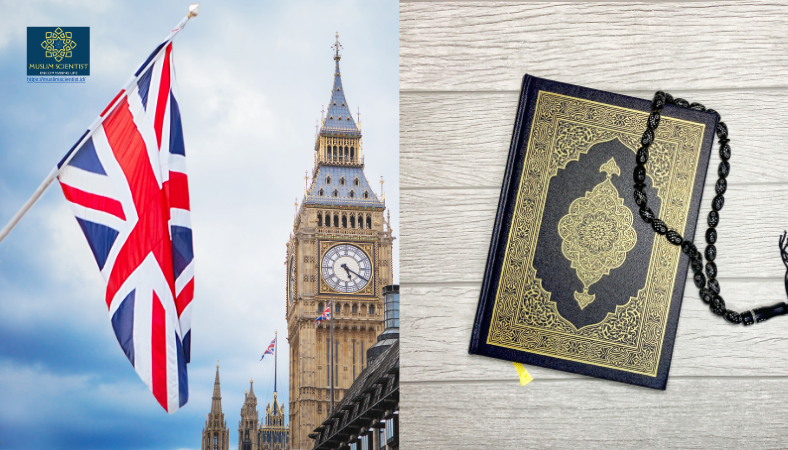
Few books have traveled such a turbulent road into British life. The Quran, Islam’s holy scripture, has weathered bans, burnings, and bitter polemics over 14 centuries. Yet today, it stands as a best-seller, embraced in homes, mosques, and institutions across the United Kingdom.
This transformation did not happen overnight. Instead, it unfolded through centuries of conflict, scholarship, migration, and gradual cultural shift. Understanding this journey helps explain Britain’s complex relationship with Islam—and why 2.7 million British Muslims now call this country home.
The Spoken Word Takes Written Form
Muslims believe the Quran’s words first came through the angel Gabriel to Prophet Muhammad in a cave near Mecca, beginning around 610 CE. Over 22 years, these revelations continued, with followers memorizing and reciting them aloud.
The Quran’s very name means “the recitation,” which highlights its oral tradition. Its rhythmic language and powerful content were designed to be heard, not just read. This oral character remains central to Muslim practice today.
After Muhammad’s death in 632 CE, preserving these words became urgent. Many who had memorized the revelations died in the Ridda wars. Consequently, the Third Caliph, Uthman, established a committee to compile and standardize the written text. This created the Quran’s first official written version, which served as a memory prompt rather than a replacement for recitation.
Copies traveled to Kufa, Basra, Damascus, and Mecca. Within a century, they reached India, China, North Africa, Spain, and France. By the 10th and 11th centuries, Quranic manuscripts had become works of art. Calligraphy flourished, with decorative geometry and floral patterns enhancing the pages.
Key Milestones in the Quran’s British Journey
| Year | Event | Significance |
|---|---|---|
| 610-632 CE | Revelation to Prophet Muhammad | Quranic words first spoken |
| 644-656 CE | Standardization under Caliph Uthman | First official written version |
| 1537 | First printed Quran in Europe | Pope Paul III orders copies burned |
| 1649 | First English translation (Alexander Ross) | Based on French version, critical of Islam |
| 1734 | George Sale’s translation | First direct Arabic-to-English version |
| 1738 | Quran used in court oath | First official acknowledgment in British legal system |
| 1889 | First purpose-built mosque in Woking | Formal Muslim presence in Britain |
| 1930 | Marmaduke Pickthall’s translation | Influential version by a Muslim convert |
| 1978 | Oaths Act | Quran given equal legal status with Bible |
| 1997 | First MP swears on Quran | Muhammad Sarwar in House of Commons |
| 2015 | Birmingham’s ancient fragments found | Carbon-dated to 645 CE, among world’s oldest |
The Crusades and Early English Encounters
European contact with the Quran intensified during the Crusades, which began in 1095. Christians had long rejected the Quran’s divine origins, and the Crusades brought many Europeans face to face with Islamic culture.
Interestingly, some crusaders returned home having learned Arabic. They introduced Middle Eastern customs, including perfumes, and Arabic words entered English vocabulary—terms like “algebra” and “algorithm” originated from this contact.
Nevertheless, hostility remained the dominant attitude. In 1537, Venice printed the first Quran, but both Christians and many Muslims opposed it. Pope Paul III ordered copies burned as heresy. Muslims, valuing calligraphic tradition, resisted printed versions too.
Hostility in Elizabethan England
By the 16th century, trade with Mediterranean Islam had become big business. However, this contact also troubled Queen Elizabeth I. Many English seamen converted to Islam after encountering Muslims abroad, while Ottoman Turks kidnapped others and forced their conversion.
This anxiety fueled anti-Islamic polemics. Christopher Marlowe’s 1588 play Tamburlaine the Great featured a Quran-burning scene, which reflected popular sentiment. The play referred to Mohammed being “not worthy to be worshipped,” demonstrating the era’s prevailing hostility.
Scholarly Curiosity Grows
The next century brought a different approach to understanding Islam. In 1636, Oxford University established a full-time chair of Arabic, appointing Edward Pococke as Britain’s first renowned Arabist. Although he considered the Quran false, Pococke criticized earlier Christian scholarship for relying on poor translations.
He advocated rational, historical study of Islam, and this approach influenced philosopher John Locke’s thinking. In 1649, Alexander Ross produced the first English translation of the Quran. Based on a French version, it framed Islam as “Turkish vanities.”
A more significant translation came in 1734 from George Sale, a Kentish lawyer and linguist. Sale translated directly from Arabic, though he viewed the Quran as Christian heresy. Despite his criticism, Sale acknowledged the translation’s limitations, noting “it must not be supposed the translation comes up to the dignity of the original.”
The Quran Enters British Courts
Britain’s expanding empire forced greater accommodation of different faiths. Historically, non-Christians could not swear on the Bible in English courts. However, a 1738 case against Gibraltar’s governor tested this precedent: a Muslim witness swore on the Quran without objection from the chief justice.
Nevertheless, full legal equality took another 240 years. The Oaths Act of 1978 finally granted the Quran equal status with the Bible in English courts. This legislative change reflected Britain’s growing religious diversity.
Conversion, Translation, and Community Building
The 19th century saw increasing British interest in Islam. Lord Stanley became the first Muslim convert admitted to the House of Lords in 1869. William Henry Quilliam, a Liverpool lawyer, converted in 1887 and established the Liverpool Muslim Institute.
Quilliam converted over 600 people and attempted a more accurate Quran translation through his newspaper The Crescent. Britain’s first purpose-built mosque opened in Woking, Surrey, in 1889, marking an important milestone for Muslim presence.
The First World War: Respect on the Battlefield
During World War I, the British Army enlisted over 500,000 Indian soldiers, and more than a quarter of these were Muslim. They fought against fellow Muslims in the Mesopotamia campaign, creating complex loyalties.
Official policy mandated respect for their religious customs. Army handbooks explicitly ordered officers to respect Indian religious prejudices. Consequently, the Quran effectively became part of military protocol during this period.
Pickthall’s Translation: A Turning Point
The biggest shift in British understanding arguably came through Marmaduke Pickthall, a celebrated novelist and Muslim convert. Unlike earlier translators, Pickthall was seen as an insider, less likely to criticize Islam.
He translated from the 1924 Egyptian edition, which gained wide acceptance. His work influenced Yusuf Ali’s 1938 translation, which became the dominant English version globally, endorsed by Saudi Arabia. Pickthall’s version shifted perceptions dramatically.
Broadcasting the Quran to Britain
On October 6, 1935, BBC radio broadcast Quranic recitation for the first time. Recorded in Cairo, it featured Sheikh Mohammed Rifat, widely regarded as the 20th century’s finest reciter. For most Britons, this marked their first encounter with the Quran’s spoken word.
Wartime Gestures and Postwar Migration
During World War II, Winston Churchill approved a London site for a mosque and Islamic cultural center, honoring Indian Muslim soldiers who died for Britain. The London Central Mosque, often called Regent’s Park Mosque, finally opened in 1978, accommodating over 5,000 worshippers.
The 1976 World of Islam Festival
Queen Elizabeth II opened the World of Islam Festival in London in 1976, the largest celebration of Islamic culture ever seen in Britain. Major museums displayed over 140 Quranic manuscripts, and the BBC broadcast a six-part series introducing basic Islamic ideas.
Milestones in Representation
The 1997 general election brought Muhammad Sarwar, the first British Muslim MP, to the House of Commons. He swore his oath on the Quran, enclosed in an envelope to avoid non-Muslim contact. By 2015, 13 Muslim MPs served in Parliament.
The Digital Age and Ancient Discovery
Today, digital versions unite oral recitation, calligraphic manuscripts, and commentary, making the Quran accessible to all. In July 2015, the University of Birmingham revealed an extraordinary find: Quran fragments dating to at least 645 CE, possibly written during Prophet Muhammad’s lifetime.
These folios had lain unidentified in the university library for almost a century, until a researcher ran carbon dating tests on them. This discovery offers evidence that contemporaries of the Prophet recorded verses near the time of his death—or even while he still lived.
Understanding Quran Translations
| Translator | Year | Background | Impact |
|---|---|---|---|
| Alexander Ross | 1649 | Scottish chaplain | First English version, based on French translation |
| George Sale | 1734 | English lawyer and linguist | First direct Arabic-to-English translation, widely influential |
| Marmaduke Pickthall | 1930 | British novelist, Muslim convert | Seen as insider; translated from 1924 Egyptian edition |
| Yusuf Ali | 1938 | Indian Muslim scholar | Became dominant English version globally |
Frequently Asked Questions
Why did it take so long for the Quran to be accepted in Britain?
Initial hostility stemmed from religious conflict, particularly the Crusades, and perceptions of Islam as a threat. Trade, scholarship, and colonialism gradually increased exposure, while Muslim migration and conversion shifted attitudes.
Who was Margaret White and why is she important?
Margaret White, the wife of a 17th-century London printer, instigated the first English publication of the Quran in 1649. Her role highlights how ordinary Britons contributed to cultural exchange.
What happened to the Birmingham Quran fragments?
Discovered in 2015, these folios spent nearly a century unidentified in the university library. Carbon dating revealed they likely date to 645 CE, possibly written during Prophet Muhammad’s lifetime.
How many Muslims live in Britain today?
Nearly 2.7 million Muslims live in the UK, with over 1,500 mosques. The Quran is a best-seller, widely available in homes, institutions, and libraries.
Refrence: here
Other Articles: