A 1,400-Year-Old Scientific Revelation
Imagine opening a 1,400-year-old text and finding descriptions of genetic inheritance, natural selection, and even the double-helix structure of DNA. This isn’t science fiction—it’s the remarkable finding of a study that bridges ancient Islamic scripture with cutting-edge genetics .
The findings challenge the common perception that science and religion occupy separate spheres. Instead, they suggest an intriguing overlap where ancient spiritual texts appear to describe natural phenomena with remarkable accuracy. Far from being a scientific textbook, the Qur’an offers glimpses of understanding that resonate with contemporary discoveries .
Recessive Inheritance: When Traits Skip Generations
One of the most compelling examples involves a hadith describing a man from the Banu Fazara tribe who approached Prophet Muhammad with a concern. His wife had given birth to a black child, though both parents had lighter complexions—a situation that could have led to false accusations of infidelity .
The Prophet responded by asking whether the man had camels, and whether any were dusky-colored among the red ones. When the man confirmed this, the Prophet explained that the child’s coloration likely resulted from a genetic trait reverting through generations. The Arabic word used was `irq, which closely approximates our modern understanding of genes .
The scientific principle here is straightforward: recessive traits can remain hidden for generations when masked by dominant alleles, only to reappear when two carriers produce offspring. This concept, fundamental to Mendelian genetics, was described in the 7th century, predating Gregor Mendel’s 19th-century pea experiments by over a millennium .
The hadith carries profound social implications. Understanding that darker-skinned children can be born to lighter-skinned parents prevents false paternity accusations that could destroy families and communities. Islam’s emphasis on justice and human rights aligns with this genetic reality, protecting innocent people from wrongful punishment .
Natural Selection’s Ancient Recognition
Modern genetics reveals that natural selection operates at every level of reproduction. Among hundreds of millions of sperm released during intercourse, only one typically fertilizes the ovum. This process of competition and selection mirrors broader evolutionary principles .
The Qur’an describes human creation as beginning from an extract (sulāla) of a liquid, while a hadith states that not all the seminal fluid participates in fertilization . These descriptions, from more than 1,400 years ago, anticipated our understanding of sperm competition and the selection process that occurs during fertilization.
Beyond sperm competition, natural selection continues through embryonic development. Studies suggest that up to 78% of pregnancies may be spontaneously aborted, often without the mother’s knowledge. The vast majority of these early miscarriages result from chromosomal abnormalities, demonstrating nature’s rigorous quality control .
The Qur’anic perspective thus acknowledges both the biological mechanisms and the divine sovereignty over creation. Science describes the mechanisms, while faith recognizes the ultimate Designer behind them.
Mothers: The Genetic Champions
Islam grants mothers a unique and elevated status. A famous hadith instructs Muslims to honor their mothers three times more than their fathers—a teaching that takes on new meaning when viewed through the lens of genetics .
Modern science reveals that mothers contribute more genetic material to their offspring than fathers. While both parents provide nuclear DNA, mothers exclusively pass on mitochondria—tiny energy-producing structures containing their own DNA. These mitochondria contain 37 genes and play crucial roles in cellular function and development.
The X chromosome, inherited from the mother by sons, contains significantly more genetic information than the Y chromosome inherited from the father. This maternal genetic contribution, combined with cytoplasmic determinants present in the unfertilized ovum, guides embryonic development and body orientation .
The Qur’anic verse acknowledging a mother’s hardship—”his mother bears him with faintings upon faintings”—reflects biological reality while Islam’s teachings recognize these contributions spiritually. The Islamic emphasis on maternal care and respect thus finds support in both scripture and science .
Environment Meets Genetics
Modern epigenetics reveals that environmental factors can influence gene expression without altering the underlying DNA sequence. Childhood experiences, nutrition, and even maternal stress during pregnancy can affect how genes function throughout life.
The Prophet Muhammad recognized environmental influences on development, stating: “The misfortunate one is who became misfortunate in the womb and the happy is the one who became happy in the womb” [citation:25]. While traditionally interpreted as referring to spiritual destiny, this hadith also suggests that prenatal environment shapes the child’s character and wellbeing .
Subsequent research has confirmed that maternal nutrition, stress levels, and environmental exposures affect fetal development and lifelong health outcomes. The womb environment truly matters, influencing everything from disease susceptibility to behavioral tendencies .
Key Genetic Concepts in Islamic Texts
| Concept | Islamic Source | Modern Scientific Parallel |
|---|---|---|
| Recessive Inheritance | Hadith on child’s skin color reverting through ancestors | Mendelian recessive traits, carrier parents producing affected offspring |
| Natural Selection | Hadith stating only part of seminal fluid creates child | Sperm competition, only one sperm fertilizes ovum |
| Maternal Genetic Contribution | Qur’an prioritizing mothers, hadith of three-fold honor | Mitochondrial DNA, larger X chromosome from mother |
| Epigenetics | Hadith on womb’s influence on child’s fortune | Environmental factors altering gene expression |
| Pairing in Universe | Qur’an creating pairs of all things | DNA double helix, matter-antimatter duality |
Source: Ghareeb BAA. Human Genetics and Islam: Scientific and Medical Aspects. JIMA. 2011 .
The Science Behind Maternal Inheritance
| Component | Maternal Contribution | Paternal Contribution | Significance |
|---|---|---|---|
| Nuclear DNA | 23 chromosomes | 23 chromosomes | Equal contribution to offspring’s genome |
| Mitochondrial DNA | 100% | 0% | Only mothers pass mitochondria to children |
| X Chromosome (sons) | 100% | 0% | Sons receive X only from mother |
| X Chromosome (daughters) | 50% | 50% | Daughters receive one X from each parent |
| Cytoplasmic Determinants | 100% | 0% | Guide early embryonic development |
| Genes on X Chromosome | 1,846 per X | 454 on Y | X chromosome carries far more genetic information |
| Size of Chromosome | 154.9 million base pairs (X) | 57.7 million base pairs (Y) | X is significantly larger |
Source: Ghareeb BAA. Human Genetics and Islam. JIMA. 2011 ; Campbell NA et al. Biology. 2008 .
The Mystery of Gender Determination
Classical genetics teaches that fathers determine offspring gender through the Y chromosome. However, Islamic texts describe a more nuanced picture, suggesting environmental factors may influence gender outcomes.
The Qur’an emphasizes both male and female contributions to creation: “We created humans from a drop of mingled fluid”. This acknowledges that both parents contribute to the embryo’s formation, including factors influencing gender .
Hadiths describe a “competition” between male and female reproductive substances, with the prevailing substance determining both gender and resemblance. While traditional interpretations focused on spiritual or metaphorical meanings, scientific evidence suggests environmental factors like pH, temperature, and maternal nutrition may influence which sperm successfully fertilizes the ovum.
Studies have shown that maternal nutrition and reproductive tract conditions may affect gender outcomes, suggesting that mothers do indeed influence their child’s gender beyond providing the X chromosome. This doesn’t contradict the father’s role in providing either X or Y sperm but adds complexity to our understanding.
Pairing in the Universe
The Qur’an declares: “Glory be to Him Who created pairs of all things, of what the earth grows, and of their kind and of what they do not know”. This concept of universal pairing has profound implications across multiple scientific disciplines .
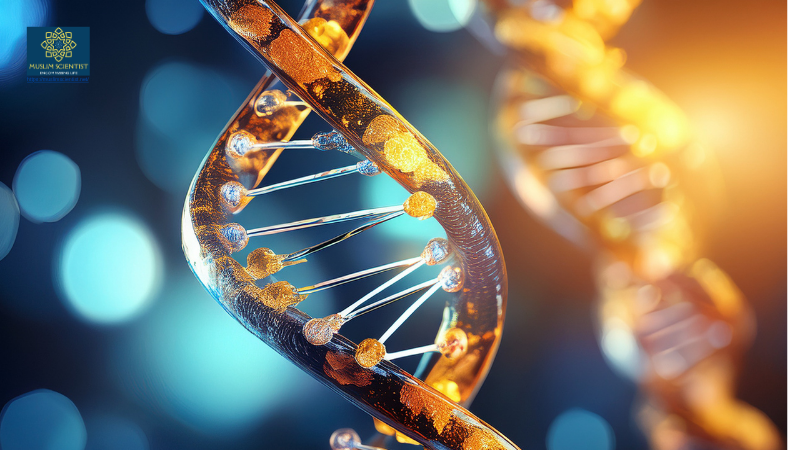
In genetics, pairing manifests as the double-helix structure of DNA discovered by Watson and Crick in 1953. Complementary base pairs—adenine with thymine, cytosine with guanine—form the fundamental structure of genetic information storage and replication. Without this pairing, life as we know it could not exist.
Similarly, RNA molecules form double-stranded structures through complementary base pairing. These pairings are essential for gene expression, protein synthesis, and the regulation of cellular processes.
The concept extends beyond biology into physics, where Paul Dirac’s Nobel Prize-winning work revealed that matter is created in pairs—particles and antiparticles. Each particle has its counterpart with opposite charge, a duality that mirrors the Qur’anic description. The uncertainty principle further suggests that pair creation and annihilation occur constantly in the vacuum of space.
Practical Implications for Modern Muslims
The intersection of genetic science and Islamic teachings has practical applications for contemporary Muslim communities. Understanding inheritance patterns can guide responsible mate selection, genetic counseling, and family planning .
Islamic texts recommend carefully choosing marriage partners, with hadiths advising: “Choose well your mate (for your semen) as (the hidden) traits can reappear” . This guidance reflects an intuitive understanding that heritable characteristics, including both physical traits and disease susceptibilities, can be passed to future generations .
The ethical framework provided by Islamic teachings aligns with modern genetic counseling principles, emphasizing informed decision-making while trusting in divine wisdom . Pre-natal genetic testing, for instance, is considered permissible in Islam when used for legitimate medical purposes, not as fortune-telling or challenging divine will .
This balanced approach encourages Muslims to embrace scientific knowledge while maintaining spiritual perspective. As the Qur’an declares: “Are those who know and those who do not know alike? Only the men of understanding are mindful”.
A Bridge Between Faith and Science
The study’s findings demonstrate that Islamic texts contain profound insights that continue to resonate with modern scientific discoveries . Rather than suggesting the Qur’an is a scientific textbook, this research highlights the compatibility between faith and reason when properly understood .
The Qur’an’s primary purpose is spiritual guidance, yet it contains references to natural phenomena that reflect the Creator’s wisdom. As scientific understanding advances, believers gain deeper appreciation for the subtle knowledge embedded in scripture. This reciprocal relationship enriches both scientific inquiry and religious faith.
Future Research Horizons
Dr. Ghareeb’s work opens numerous avenues for further investigation. Future research might explore additional genetic concepts in Islamic texts, including chromosomal abnormalities, genetic counseling practices, and the ethical implications of genetic testing from Islamic perspectives .
The study of epigenetics—how environmental factors influence gene expression—presents particularly exciting opportunities. Islamic teachings on prenatal care, maternal health, and childhood development may align with emerging scientific understanding of how early experiences shape lifelong health outcomes .
Understanding the genetic basis of diseases prevalent in Muslim populations can inform public health strategies while respecting cultural values. Consanguineous marriage, common in some Muslim communities, increases the risk of recessive genetic disorders, and Islamic jurisprudence has developed nuanced approaches to addressing these concerns .
Conclusion
The dialogue between science and religion continues to evolve, with each discipline illuminating different aspects of truth. This research demonstrates that Islamic texts contain references to genetic principles that predate contemporary discoveries, challenging the perceived conflict between faith and science .
For believers, this discovery strengthens faith by revealing the Creator’s signs in both scripture and creation. For scientists, it offers fresh perspectives on the relationship between ancient wisdom and modern discovery. The intersection of genetics and Islam provides a rich field for exploration that benefits both communities.
The Qur’an promised: “Soon We will show them Our signs in the horizons and their own souls, until it becomes manifest to them that this is the Truth” . Fourteen centuries later, these signs continue to unfold, demonstrating the timeless relevance of divine revelation and its resonance with human knowledge.
Reference: here
Other Articles: