Summary
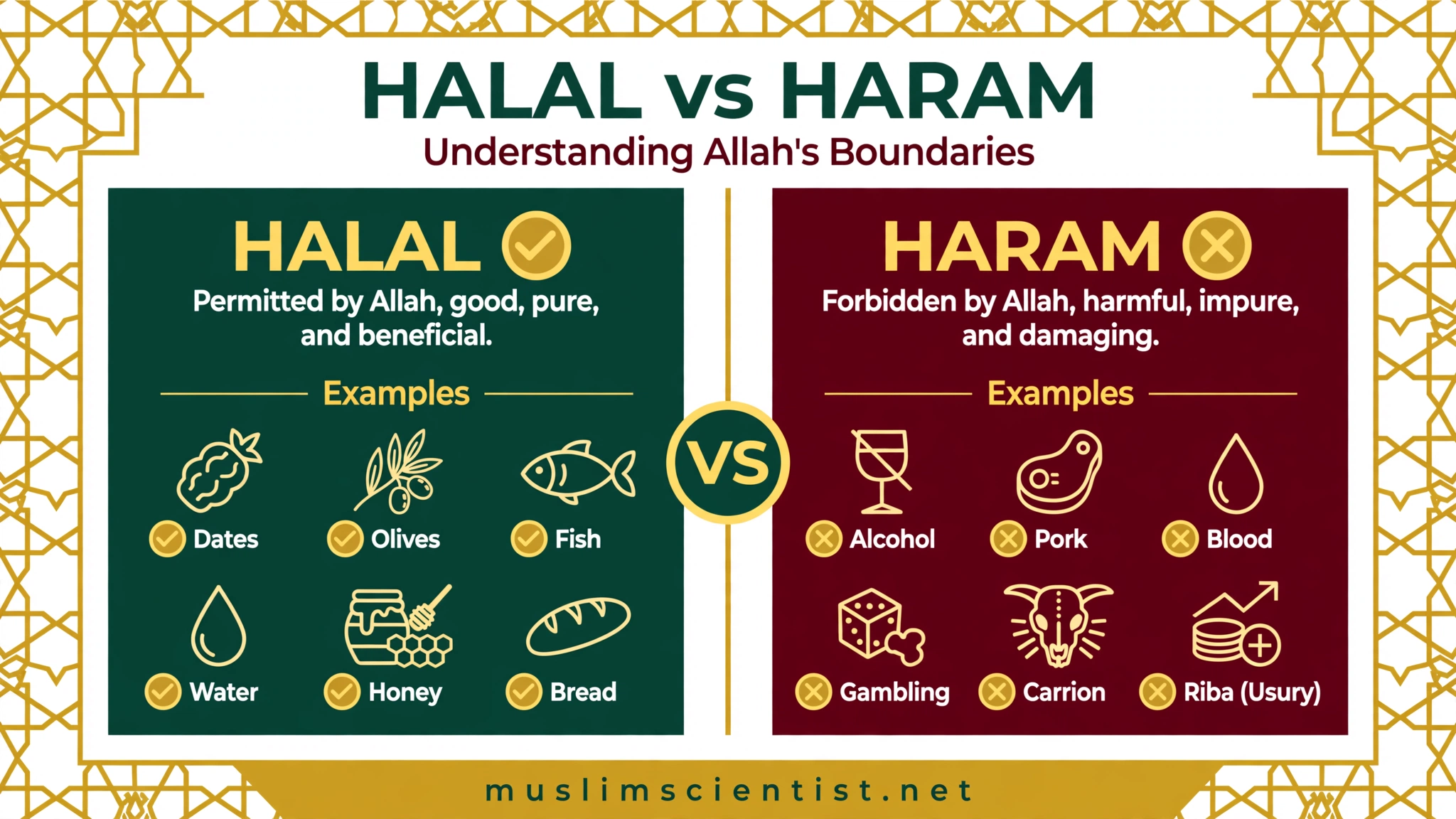
For nearly 2 billion Muslims worldwide, the words “halal” and “haram” shape daily choices about food, drink, and even medicine. Halal means permitted or lawful. Haram means forbidden. Between them sits a grey zone called “syubhat”—things that are unclear or doubtful, which devout Muslims try to avoid as a precaution.
The core principle in Islamic law is simple: everything is permitted unless there is a clear prohibition. This means the list of forbidden items is actually quite short. The Quran explicitly prohibits pork, blood, carrion (animals that died without proper slaughter), and animals slaughtered in the name of anything other than God. Intoxicants—alcohol and drugs—are also forbidden. Predatory animals with sharp claws, carnivores, and amphibians fall into the haram category as well.
For meat to be halal, the animal must be slaughtered correctly. This involves a swift cut to the throat, invoking God’s name, and ensuring the animal is alive at the time of slaughter. An animal that died from strangulation, a blow to the head, a fall, or being gored by another animal is considered carrion and cannot be eaten.
Many Muslims also look for halal certification logos on products. These labels confirm that a product—whether food, cosmetics, or medicine—has been checked to ensure it contains no forbidden ingredients and was produced in a way that complies with Islamic rules. Indonesia, home to the world’s largest Muslim population at roughly 248 million people, has a mandatory halal certification system for many products.
One common misunderstanding involves alcohol in food. While alcoholic drinks are clearly haram, trace amounts of alcohol can appear naturally in fermented foods like tapai (fermented cassava or rice). Scholars distinguish between khamr (intoxicating wine) and natural fermentation byproducts. Tapai contains alcohol but does not intoxicate, so most scholars consider it halal. The key question is whether something is deliberately produced to intoxicate—if yes, it is haram; if alcohol appears incidentally and does not cause intoxication, it is generally acceptable.
The global halal market is enormous. Muslims spent US$2.43 trillion on halal products in 2024, a figure projected to reach US$3.36 trillion by 2028. This covers food, beverages, pharmaceuticals, cosmetics, and tourism. Interestingly, the top five exporters of halal products are non-Muslim countries: China, India, Brazil, Russia, and the United States.
For ordinary consumers—Muslim or not—understanding halal and haram helps make sense of why certain products carry special labels, why some restaurants advertise “halal certified,” and why some Muslims politely decline certain foods. The rules are not meant to be burdensome. Islamic law holds that the earth and its resources were created for human benefit, and the default status of things is permission, not prohibition. The forbidden items are exceptions, limited and clearly defined.
What Do Halal and Haram Actually Mean?
The Arabic word halal means “permitted” or “lawful.” Haram means “forbidden” or “unlawful.” These terms apply far beyond food—they cover business dealings, clothing, entertainment, and daily conduct. But food and drink remain the most visible and discussed application.
A third category matters just as much: syubhat, meaning “doubtful” or “unclear.” The Prophet Muhammad reportedly said that between the clearly permitted and the clearly forbidden are matters many people do not know about. Whoever avoids the doubtful protects their religion and honor. This is why many Muslims prefer products with clear halal labels—not because the product is known to be haram, but because the label removes uncertainty.
The Three Categories at a Glance
| Category | Arabic Term | Meaning | Example |
|---|---|---|---|
| Permitted | Halal | Allowed by Islamic law | Fresh vegetables, properly slaughtered chicken, fish |
| Forbidden | Haram | Explicitly prohibited | Pork, blood, alcohol, carrion |
| Doubtful | Syubhat | Unclear status | Products with unspecified additives or unclear sourcing |
The Short List of Forbidden Foods
Most people are surprised to learn how narrow the list of haram foods actually is. Islamic jurisprudence begins with a broad principle: everything is permissible unless proven otherwise. The Quran states that God created everything on earth for human use. Prohibitions are exceptions that require clear textual evidence.
The Quran names four categories of forbidden food in one verse: carrion (dead animals), blood, pork, and animals slaughtered in a name other than God’s. A later verse expands the carrion category to include animals that died by strangulation, a violent blow, a fall, being gored, or being attacked by a wild animal—unless the person reaches the animal and slaughters it properly before it dies.
Intoxicants form another major category. Alcoholic drinks, drugs, and any substance that clouds the mind are forbidden. The Arabic term khamr specifically refers to intoxicating wine and similar drinks. Islamic law prohibits khamr entirely—whether consumed in large or small amounts.
Common Haram Items and Why
| Item | Why It Is Haram |
|---|---|
| Pork and pork products | Explicitly prohibited in the Quran |
| Blood | Explicitly prohibited in the Quran |
| Carrion (dead meat) | Animal was not slaughtered properly |
| Alcohol and intoxicants | Cloud the mind and impair judgment |
| Carnivores (lions, tigers, cats) | Prophetic tradition prohibits predatory animals |
| Birds of prey (eagles, falcons) | Sharp claws and predatory nature |
| Amphibians (frogs, toads) | Classified as non-halal in mainstream scholarship |
Sources: Singapore MUIS; Quranic verses as cited in Republika.
How Meat Becomes Halal
The method of slaughter matters as much as the animal itself. For meat to be halal, the animal must be alive at the time of slaughter, and the person performing the slaughter must be a Muslim (or in some scholarly views, a Person of the Book—Jew or Christian). The cut must sever the throat, windpipe, and blood vessels swiftly. God’s name must be invoked during the act.
This explains why an animal that dies from disease, accident, or natural causes cannot be eaten—it falls into the carrion category. Likewise, an animal dedicated to a shrine, idol, or any being other than God is forbidden, even if the physical slaughter method is correct.
Many Muslims in Indonesia, Malaysia, and Singapore look for the halal logo when buying meat. These logos indicate that the slaughterhouse and processing facility have been audited. For imported products, the presence of a recognized foreign halal certificate provides similar assurance.
The Grey Zone: When Alcohol Appears in Food
Fermentation creates alcohol. Soy sauce, vinegar, bread, and tapai all contain trace amounts of alcohol as natural byproducts. Does this make them haram?
Islamic scholars distinguish between khamr—intoxicating drinks deliberately produced for consumption—and incidental alcohol in food. Imam Abu Hanifa, a founding figure of Islamic law, held that a food containing alcohol but incapable of causing intoxication is not khamr and remains halal. Most contemporary scholars follow this reasoning. Tapai, a traditional Indonesian fermented food, contains alcohol but nobody becomes drunk from eating it, so it is generally considered halal.
The key question is intent and effect. If a product is manufactured specifically to intoxicate, it is haram. If alcohol appears as a natural result of fermentation and the food does not intoxicate when consumed normally, it falls outside the prohibition.
Why the Global Halal Market Is Booming
Halal is no longer just a religious requirement. It has become a marker of quality, cleanliness, and ethical production. The global halal market reached US$2.43 trillion in 2024 and is expected to grow to US$3.36 trillion by 2028. Muslims make up about 25% of the world’s population, and that share is growing.
Table 3: Key Halal Market Facts
| Fact | Figure |
|---|---|
| Global Muslim population (2025) | ~2.15 billion (26% of world population) |
| Global halal spending (2024) | US$2.43 trillion |
| Projected spending (2028) | US$3.36 trillion |
| Indonesia’s Muslim population | ~248.6 million (world’s largest) |
| Top halal exporters | China, India, Brazil, Russia, USA |
Indonesia leads the world in Muslim population, with roughly 248.6 million Muslims. Yet Indonesia is still primarily a consumer market rather than a production leader. The country ranks third in the State of the Global Islamic Economy indicator, behind Malaysia and Saudi Arabia, and has slipped to fourth place in halal food. This gap between market size and production capacity represents both a challenge and an opportunity.
Non-Muslim consumers also drive demand. Many choose halal products because they associate the label with cleanliness, animal welfare, and ethical sourcing. In the UK, for example, about 20% of chickens slaughtered monthly are halal—some 8 million birds—serving both Muslim and non-Muslim buyers.
What This Means for Everyday Life
For a non-Muslim reader, the practical takeaway is straightforward. When a Muslim colleague declines a ham sandwich or asks whether a restaurant is halal-certified, they are following a code that begins with permission and carves out specific exceptions. The rules are not arbitrary; they aim to protect health, maintain spiritual discipline, and ensure that consumption is ethically sourced.
For Muslims, the growth of the halal industry means more choices than ever. Certification systems, while not perfect, provide a layer of assurance in a complex global food supply chain. When in doubt about a product, the principle of syubhat encourages caution—but not paralysis. Islamic law is built on ease, not hardship. The Quran tells believers to eat what is halal and good from the earth. That permission is broad, and the exceptions are limited.